This is the third article in Capco + Hartigen’s PowerOptix® series ‘Commercializing power for the AI economy’, which explores how organizations are redefining generation, commercialization, and digital operations in the era of AI.
AI data centers are emerging as one of the fastest-growing and most power-intensive forms of digital infrastructure. Their electricity demand is continuous, highly concentrated, and mission-critical, with load profiles that increasingly rival those of traditional heavy industrial facilities. As these environments scale, the limitations of conventional generation and grid capacity are becoming increasingly apparent.
In response, organizations are deploying hybrid, behind-the-meter generation portfolios that combine gas, renewables, and energy storage to deliver immediate, reliable capacity. Small modular reactors (SMRs) are being explored as a longer-term source of clean baseload power, but near-term strategies are centered on flexible, multi-asset portfolios that can be deployed incrementally.
Together, these approaches reflect a shift away from single-plant solutions towards portfolio-based generation strategies designed to balance reliability, speed of deployment, carbon performance, and supply chain resilience.
Why traditional generation models fall short
Conventional grid-tied generation and transmission planning were designed for geographically distributed demand, not for large, concentrated power loads operating continuously at a single location.
AI and high-performance computing facilities now require tens to hundreds of megawatts per site, with minimal tolerance for interruption. Meeting this demand through traditional grid expansion alone has proven increasingly difficult.
The challenges are well understood:
- Interconnection delays that frequently extend beyond three years
- Supply chain constraints associated with grid expansion, including long lead times for transmission equipment and construction resources, which further exacerbate delays in relying on the grid to serve AI-scale demand
- Transmission congestion that raises delivered costs and introduces reliability risk
- Decarbonization mandates that reduce the available dispatchable capacity.
In addition to these structural constraints, supply chain limitations are increasingly shaping generation design. Long lead times and OEM backlogs for gas turbines, reciprocating engines, transformers, and balance-of-plant equipment are forcing operators to source capacity across multiple vendors within the same generation technology. As a result, reliable baseload power is now achieved through diversified, multi-vendor portfolios, rather than reliance on a single plant or supplier.
To meet AI demand without waiting for new transmission or equipment availability to catch up, organizations are moving generation closer to the data center’s electricity demand and adopting portfolio-based approaches that balance reliability, flexibility, and sustainability.
Hybrid generation systems: Flexibility and speed
Today, hybrid generation systems represent the primary deployment model for AI-scale behind-the-meter power. These systems combine natural gas generation, renewable resources and battery energy storage into flexible, dispatchable portfolios.
Hybrid systems enable operators to:
- Deploy generation quickly to support near-term AI workloads
- Use gas for dispatchable baseload while leveraging renewables and storage for peak management and carbon performance
- Phase capacity additions as data center campuses expand
- Reduce dependence on any single technology or vendor.
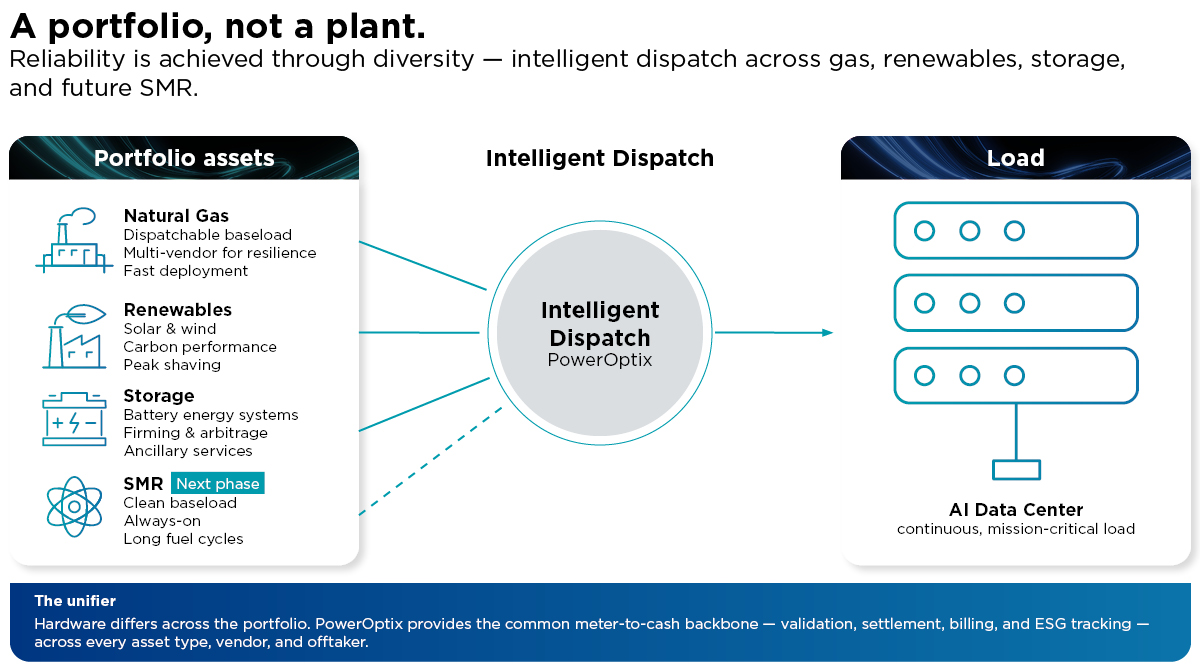
In practice, many hybrid portfolios incorporate multiple gas generation vendors and asset types to mitigate delivery risk and ensure continuous capacity despite supply chain constraints. Reliability is achieved not through a single perfect asset, but through redundancy, diversity, and intelligent dispatch across the portfolio.
Hybrid architectures also provide a practical transition path, allowing operators to integrate new technologies such as SMRs or hydrogen as they mature, without re-architecting the entire energy system.
Small modular reactors: Baseload for the AI era
While hybrid systems dominate near-term deployments, small modular reactors are increasingly being evaluated as a future source of clean, long-duration baseload power for AI data centers.
SMRs represent a fundamental shift in how nuclear power can be deployed. Designed for smaller footprints, modular fabrication, and standardized components, they align well with the scale and siting requirements of AI-driven infrastructure.
Key attributes include:
- Continuous, high-reliability output for dense, always-on compute environments
- Compact siting directly adjacent to or within industrial and data center campuses
- Enhanced safety characteristics through passive cooling and modular containment
- Long fuel cycles that reduce logistics complexity and operational emissions.
From a commercial perspective, behind-the-meter SMRs introduce new long-term opportunities. Operators can prioritize internal load while retaining optionality to monetize surplus capacity through export programs or structured, multi-tenant power purchase agreements within shared campuses.
Importantly, SMRs are best understood as the next phase of portfolio evolution, complementing rather than replacing hybrid systems.
A portfolio, not a single technology
The emerging behind-the-meter ecosystem is defined by portfolios, not point solutions. Nuclear, gas, renewables, hydrogen, and storage increasingly coexist within the same campus, each serving a specific role in reliability, cost control, and sustainability.
What unifies these portfolios is not hardware, but commercial and digital infrastructure.
PowerOptix® sits at the center of this ecosystem, integrating operational telemetry and commercial processes across all generation types while maintaining consistency in settlement, billing, and reporting.
Digitalization makes these models commercially viable
Metering, validation, settlement, and invoicing must handle multiple energy sources, contractual arrangements, and regulatory interfaces for hybrid portfolios and future SMR deployments to operate reliably at scale.
Owning or operating a hybrid portfolio or future SMR deployment is not only an engineering challenge. It is a data and commercialization challenge.
Multi-source, multi-vendor environments require systems that can:
- Capture and validate high-frequency meter data
- Apply distinct contract, pricing, and charge allocation logic across multiple offtakers, including recurring fees and non-energy charges that must be allocated independently of price and quantity
- Allocate volumes across shared infrastructure and tenants
- Automate settlement and invoicing
- Maintain market-ready data structures for optional ISO participation
Hartigen’s PowerOptix® platform provides a unified meter-to-cash backbone across nuclear, thermal, renewable, and storage assets.
Capco complements this platform with deep market design, regulatory and integration expertise, ensuring that commercial frameworks, cost allocation and compliance requirements remain aligned as portfolios evolve.
Future-proofing energy for AI
As AI infrastructure continues to expand, the winning generation strategies will share three characteristics:
- Reliability through baseload stability provided by intelligently dispatched hybrid portfolios and future SMR deployments
- Carbon intelligence through traceable, auditable emissions data tied directly to generation and settlement
- Commercial readiness through automated systems that convert energy flows into financial and contractual outcomes
Behind-the-meter generation, anchored by hybrid portfolios and evolving towards SMRs is rapidly becoming the dominant model for mission-critical computing environments.
The Capco and Hartigen advantage
Together, Capco and Hartigen provide the operational and commercial foundation required to deploy these next-generation power systems with confidence.
Hartigen’s PowerOptix® serves as the digital meter-to-cash backbone, while Capco ensures long-term market, regulatory, and integration readiness across complex, multi-source, and multi-vendor portfolios.
With a single platform and an integrated delivery model, AI data center operators can deploy behind-the-meter power that is reliable, clean, and commercially viable from day one.
Key takeaway
The future of AI power will not rely on a single energy source. It will be a hybrid ecosystem of gas, renewables, storage, and nuclear designed as a portfolio, digitally managed, and commercially optimized through a unified platform.
Capco and Hartigen are helping organizations lead this transition by transforming power from a fixed operating cost into a strategic, measurable, and market-ready asset.