This is the fourth article in Capco + Hartigen’s PowerOptix® series ‘Commercializing power for the AI economy’, which explores how organizations are redefining generation, commercialization, and digital operations in the era of AI.
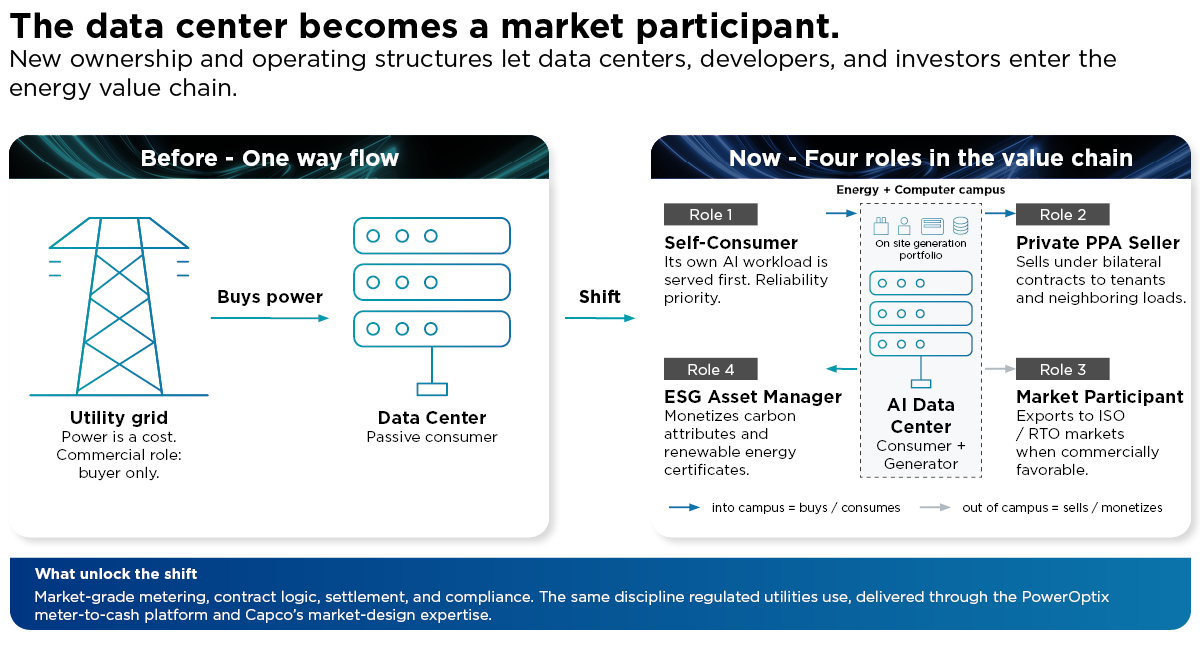
The AI revolution is reshaping not only data and computing but also the business of power itself. Organizations that own and operate data centers are no longer passive consumers of electricity. They are becoming active participants in power generation, ownership, and commercialization.
What began as a requirement for reliable power has evolved into a structural shift. Data center operators, power developers, and investors are now sharing roles that once belonged almost exclusively to utilities. As a result, new models for energy ownership and monetization are emerging that are more flexible, capital-efficient, and commercially sophisticated.
The shift from consumption to commercialization
Historically, data center operators purchased electricity from the grid through retail tariffs or long-term supply contracts. That approach is increasingly insufficient for AI-driven computing, which demands scale, predictability, and sustainability that traditional grid models cannot always provide.
To secure their energy futures, organizations that develop and operate data centers are now:
- Investing directly in generation assets
- Forming joint ventures with power developers
- Entering customized behind-the-meter power purchase agreements (PPAs) that provide control over both cost and carbon outcomes
This is where the concept of the data center operator as a generator begins to take shape and where commercial frameworks start to resemble those seen in other capital-intensive industries that have undergone similar transitions.
Three emerging ownership and operating models
1. Integrated model: Data center-owned generation
In this model, the data center operator directly finances and owns the generation asset, typically built behind-the-meter. This structure combines operational control with full economic ownership, allowing power to be managed as a long-term strategic asset.
Advantages
- Full control over reliability and cost
- Direct management of energy mix and carbon profile
- Ability to monetize surplus power through market export
In this model, the data center operator captures the full value chain, controlling both consumption and generation, and retaining upside if excess power is sold to the market.
Key considerations include – significant upfront capital requirements, balance sheet implications, and the need for operational expertise or trusted operating partners. As a result, this model is best suited for organizations with scale, balance sheet flexibility, and a long-term commitment to energy as a strategic capability.
2. IPP or developer model: Energy as a service
Under this model, an independent power producer (IPP) or infrastructure developer builds, owns, and operates the generation asset, selling energy to the data center operator under a private, behind-the-meter PPA.
Advantages
- Capital light structure for the data center operator
- Predictable long-term energy pricing
- Turnkey operational expertise from the developer
This approach allows organizations to secure reliable power without the capital burden of ownership, reflecting an energy-as-a-service model similar to what is seen in the broader industrial sector.
Key considerations include – careful commercial structuring to ensure pricing mechanisms, performance guarantees, and carbon attributes remain aligned with data center requirements over time.
3. Hybrid or joint venture model: Shared risk, shared reward
In this model, the data center owner or operator, often in coordination with facility owners or infrastructure partners, and a power developer co-invest in the generation asset, sharing operational control and commercial upside.
Advantages
- Balanced capital and risk exposure
- Combined technical, commercial and operational expertise
- Flexibility to serve on-site load, multiple tenants, or the grid
This structure is particularly well suited for large-scale, multi-tenant data center campuses where shared infrastructure and flexible monetization are core requirements.
Key considerations include – additional governance and coordination, but these are often offset by the ability to align incentives, share risk, and unlock new sources of value across partners.
A familiar evolution
This evolution in power commercialization is not without precedent. A similar structural shift occurred in LNG two decades ago when the market transitioned from vertically integrated ownership to tolling and merchant models, thereby opening access to new capital and participants.
Behind-the-meter generation for AI data centers is now following a similar path. As capital costs rise and technology diversifies, new entrants are adopting hybrid approaches that blend ownership, service, and market participation.
These emerging models require digital systems, like PowerOptix®, to measure, validate, and settle transactions transparently, ensuring that every megawatt produced, consumed, or exported is accurately accounted for and monetized.
How PowerOptix® enables all three models
Regardless of who owns the asset, the underlying commercial requirements remain the same:
- Accurate and transparent metering
- Automated validation and settlement
- Contract-based invoicing for each offtaker
- Flexible allocation of costs and revenues
- Data structures ready for ISO or market export
Hartigen’s PowerOptix® platform delivers the digital foundation for these requirements, integrating metering, validation, settlement, and invoicing within a single meter-to-cash system.
Capco complements this platform with commercial design, regulatory expertise, and integration capabilities, ensuring that these models are operationally sound, financially robust and compliant across jurisdictions.
Together, Capco and Hartigen provide a complete solution that allows operators and developers to commercialize energy assets under any ownership structure.
The Capco and Hartigen advantage
Capco and Hartigen PowerOptix® are uniquely positioned to operationalize this new commercial landscape.
- Capco designs the business models, governance, and financial structures that align investors, operators, and developers
- Hartigen PowerOptix® delivers the meter-to-cash platform that makes every kilowatt-hour measurable, auditable, and billable
This combination ensures that, regardless of the ownership model a company adopts, it can manage power with the same rigor and reliability as its core business operations.
Key takeaway
AI-scale computing is redefining the relationship between energy and digital infrastructure. Whether organizations choose to own, contract, or co-invest in power generation, success depends on their ability to manage data, settlement, and commercial outcomes with precision and transparency.
Capco and Hartigen PowerOptix® provide the digital and commercial foundation that makes this new generation of energy-enabled infrastructure viable.