This is the final article in Capco + Hartigen’s PowerOptix® series ‘Commercializing power for the AI economy’, which explores how organizations are redefining generation, commercialization, and digital operations in the era of AI.
The next phase of energy commercialization will not be defined solely by infrastructure, but by intelligence. As AI continues to transform the energy landscape, the systems that manage generation, consumption, and settlement will evolve from rule-based automation to real-time, adaptive decision-making.
This is the world of autonomous energy operations where AI agents continuously balance cost, carbon, and reliability across a dynamic energy ecosystem. In this model, data becomes the primary currency, and platforms like PowerOptix® serve as the digital foundation that connects operational decisions with commercial outcomes.
From automation to autonomy
Today’s energy systems rely on structured automation. Metering, validation, and settlement occur in a defined sequence. While efficient, they remain reactive.
AI will move the industry beyond automation to autonomy, where systems anticipate conditions, learn from outcomes, and optimize decisions in real-time.
Future-ready organizations that own and operate power assets for AI infrastructure will deploy AI-driven agents that:
- Forecast load, price, and carbon intensity across multiple assets
- Adjust dispatch and storage strategies based on predictive analytics
- Reconcile financial outcomes automatically through integrated meter-to-cash frameworks
- Trigger settlement or market participation based on profitability thresholds
The PowerOptix® platform provides the trusted data, settlement logic, and commercial transparency needed to support this evolution.
AI agents in the energy ecosystem
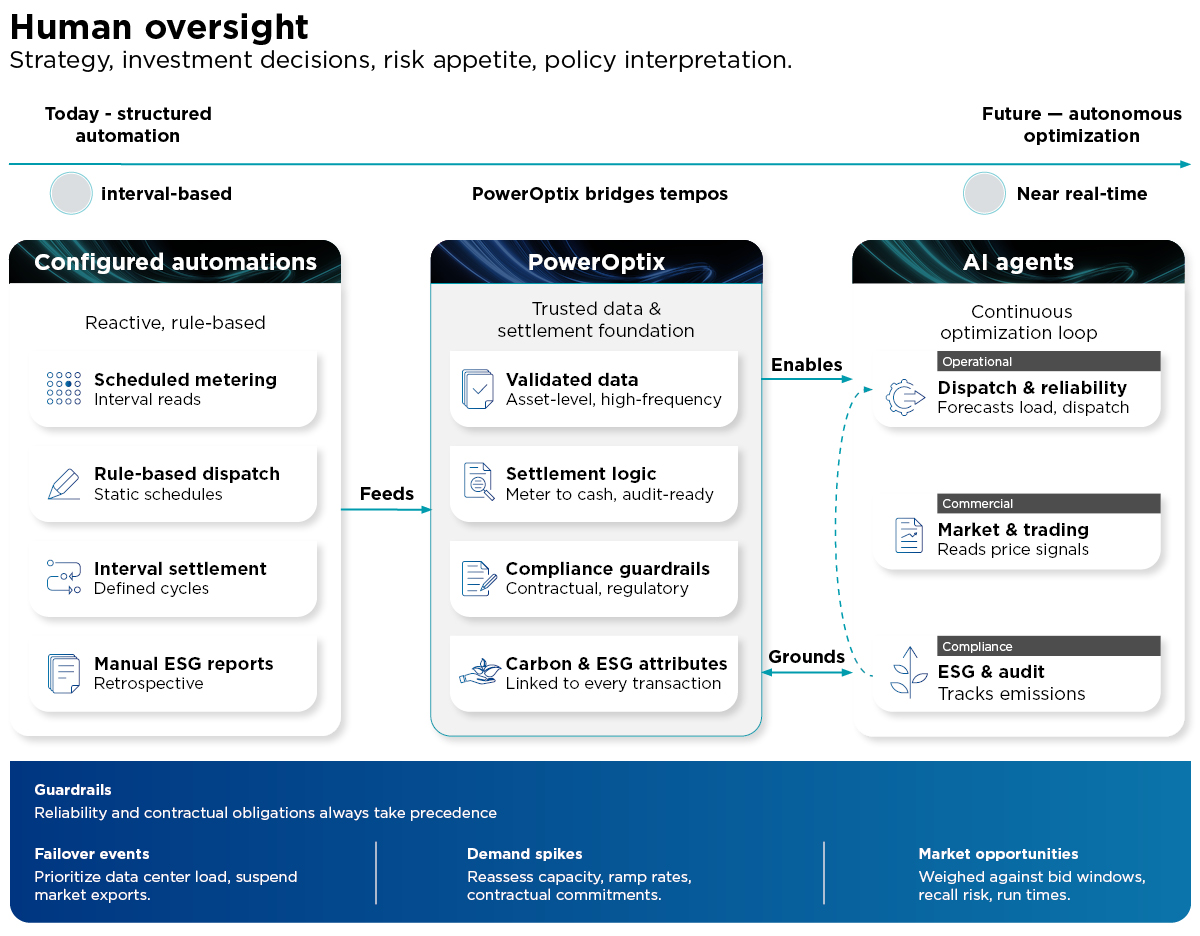
In an autonomous energy environment, AI agents act as intermediaries between physical assets and commercial systems. Each agent performs specialized functions across operational, market, and compliance domains.
- Operational agents manage fuel, generation mix, and asset dispatch to ensure reliability and cost efficiency
- Commercial agents analyze market signals and optimize when and where energy may be sold, stored, or reserved
- Compliance agents track and reconcile emissions and ESG attributes, ensuring that every transaction remains transparent and audit-ready
Together, these AI-driven capabilities will create continuous optimization loops that keep generation assets and AI data center operations aligned with commercial objectives.
While AI workloads operate on near-real-time cycles, power markets and settlement operate in defined intervals, making disciplined coordination between operational decisions and commercial commitments essential.
Real-time optimization under operational and commercial constraints
AI-driven optimization in power systems must operate within explicit operational, commercial, and regulatory guardrails. Real-time decision-making does not mean unconstrained decision-making. In AI-scale environments, reliability and contractual obligations are designed to take precedence over market arbitrage.
- Failover and reliability events. If one generation asset in a redundant configuration becomes unavailable, AI agents immediately prioritize data center electricity demand. Dispatch is rebalanced across remaining assets, reserve margins are reassessed, and any export or market participation is suspended until reliability is restored. Continuity of load always overrides market exposure.
- Unexpected data center demand increases. When data center demand rises unexpectedly, driven by AI training cycles or tenant behavior, AI agents evaluate available capacity, ramp rates, storage state of charge, and contractual commitments before recommending any change in dispatch or market position. Export decisions are dynamically reconsidered to ensure demand obligations are met.
- Market opportunities and bid constraints. While wholesale price spikes may indicate an opportunity to sell power to the grid, real-time optimization must account for bid windows, recall risk, minimum run times, and future load uncertainty. AI agents continuously simulate these scenarios but only execute actions within predefined reliability, commercial, and regulatory guardrails
PowerOptix® enforces these guardrails by ensuring that every operational decision remains aligned with contractual terms, settlement accuracy, ESG reporting requirements, and audit-ready market data.
Market flexibility and dynamic participation
The rise of AI agents will also redefine how organizations participate in power markets. Rather than operating on static schedules, energy producers and asset owners will engage dynamically, responding to real-time market conditions, weather, and carbon pricing signals.
Market flexibility will mean:
- Dispatching power only when prices exceed cost or emissions targets
- Selling stored energy or renewable credits at peak demand
- Adjusting behind-the-meter portfolios to participate in ancillary or balancing markets
By digitizing and standardizing meter-to-cash processes, PowerOptix® enables this flexibility, ensuring that every automated transaction can be validated, settled and recorded transparently and accurately.
Autonomous optimization and ESG integration
ESG will no longer be a retrospective reporting exercise. It will become an active optimization variable.
AI-enabled systems will continuously measure emissions intensity, compare it to contractual or regulatory limits, and adjust operational decisions accordingly.
PowerOptix® already provides the structural data backbone for this evolution by:
- Capturing high-frequency, asset-level data
- Associating energy transactions with carbon and renewable attributes
- Automating the financial and emissions settlement processes
This convergence of operational, commercial, and ESG data enables full-cycle accountability and prepares organizations for the coming era of autonomous optimization.
The human element: Decision support, not replacement
While AI and digital agents will transform energy operations, human expertise remains essential. Strategic decisions such as asset investment, risk appetite, and policy interpretation will continue to require human judgment.
The goal is not to remove people from the process, but to elevate their impact by providing real-time, data-driven insight.
By integrating intelligence across the PowerOptix® framework, Capco and Hartigen help operators, traders, and compliance teams move from manual activity to informed, strategic action.
Preparing for the future
The transition to autonomous power commercialization is already underway. Organizations that begin modernizing their meter-to-cash and data management systems today will be best positioned to integrate AI capabilities tomorrow.
As AI-driven optimization capabilities evolve, these agents will not emerge as a single feature or system, but as a set of capabilities developed incrementally across the energy technology ecosystem. In practice, AI agents may be embedded within platforms like PowerOptix® over time, developed as advisory layers alongside existing systems, or integrated through partner and client environments.
PowerOptix® serves as the trusted commercial and data foundation for this evolution, providing the validated data, settlement logic, and compliance guardrails required for AI-driven decisioning to operate responsibly.
Capco supports this transition by helping organizations design AI strategies, governance models, and deployment approaches that align with business objectives, regulatory expectations, and risk tolerance.
Capco and Hartigen PowerOptix® are enabling that transition by:
- Providing scalable data and commercial architectures
- Integrating operational and financial systems into unified digital workflows
- Designing governance and compliance models that support AI-driven decision-making
This foundation enables operators to evolve naturally from manual oversight to predictive control to fully autonomous optimization.
Key takeaway
The future of power commercialization will be defined by intelligence, transparency, and adaptability. AI-driven systems, anchored by accurate data and automated settlement, will transform how energy is generated, managed, and monetized.
Capco and Hartigen PowerOptix® are building that future today, enabling clients to operate with confidence, agility, and precision in the emerging AI energy economy.