Top Location:
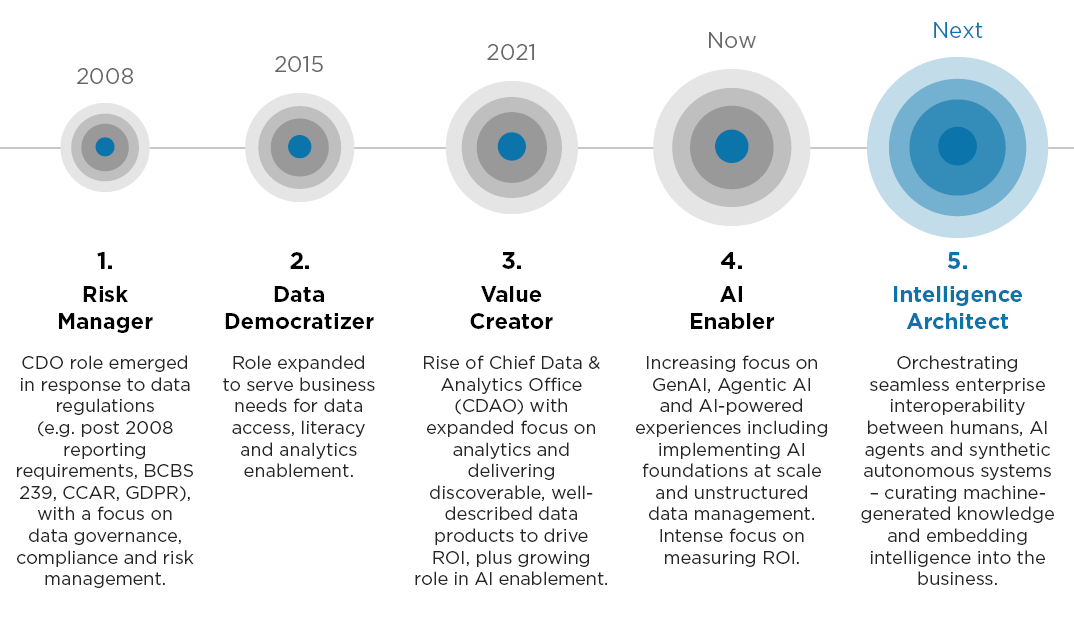
The role of the Chief Data Office is entering a new era. In The New CDO Mandate, the first article in this series, we described how the CDO has shifted from a manager of data risk and compliance into a strategic leader expected to deliver intelligence, embed trust and accelerate business outcomes. Here we turn from mandate to method, setting out how the CDO delivers this new form of value inside a rapidly evolving leadership ecosystem shaped by data, AI and the increasing use of intelligence to compete.
Today’s CDO must operate not only as a custodian of trust and quality, but also as an orchestrator of intelligence across people, systems and decisions. They must create the conditions that allow data to flow, AI to scale, and intelligence to become a repeatable, explainable and enterprise-wide capability.
To achieve this, they must work within an emerging coalition of senior roles that now influence the AI agenda, while holding firm to the parts of the intelligence lifecycle that only they can – and should – own. This article describes that new ecosystem, the responsibilities and boundaries within it, and offers a roadmap that modern CDOs can use to redefine their role as true enterprise-level intelligence leaders.
The new AI leadership landscape
AI is no longer a specialist capability managed within a single function. It has become a leadership challenge that touches every major C-suite role. For example, the CIO and CTO own digital strategy and the technology through which AI is deployed, as well as the platforms, engineering foundations and operational reliability that AI requires to run at scale. The COO, meanwhile, ensures that intelligence transforms processes, customer journeys and frontline execution, and the CISO safeguards the organization, e.g. from AI-driven adversaries.
The result is an unprecedented overlap between executive roles. Each leader touches a different part of the intelligence lifecycle, and without deliberate coordination this produces blurred boundaries, duplicated work and inconsistent priorities.
The CDO sits at the center of this dynamic because the Chief Data Officer remains the only executive accountable for both the truth and the readiness that AI depends upon. Truth refers to the quality and provenance of data. Readiness refers to the semantics, governance, and explainability of the intelligence foundations that make AI outcomes reliable, consistent and safe to scale.
When these foundational layers are unclear or fragmented, AI and the resulting intelligence becomes unreliable, risky or simply unable to scale, with organizations falling into three predictable traps:
- Duplication: Multiple teams attempt to solve the same problems in parallel, wasting effort and introducing inconsistency
- Gaps: No function clearly owns outcomes and capabilities such as trust, explainability or the underlying semantics that enable business outcomes
- Bottlenecks: Groups such as business and technology wait for each other, hindering the progress of priority use cases and creating friction that slows the entire AI agenda.
The AI era demands a new model of leadership where the role of each C-suite leader is clearly defined and where the CDO can lead the intelligence agenda without over-extension or ambiguity. The CDO cannot emerge in a reimagined form unless the broader leadership environment evolves alongside it.
AI has created a space in which accountability is ambiguous and leadership agendas overlap. Unless the relevant members of the C-suite define who owns what, the enterprise will fill it with competing priorities and inefficiency.
Redefining responsibilities across the C-suite
Most organizations have invested significantly in data platforms, analytics tooling, AI capability and transformation programs, yet few can scale intelligence effectively. What is missing is not technology or talent, but the system that connects these elements – an intelligence ecosystem that defines how people, data, AI models and decisions interact to generate value.
The most significant challenge in designing this ecosystem is the lack of clarity across leadership roles. AI touches every corner of the organization, but without clear boundaries, accountability becomes diluted, decisions slow down and value becomes harder to realize. To operate effectively in this environment, organizations must articulate a simple, coherent and deliberate delineation of responsibilities across the C-suite.
The CDO is at the heart of this ecosystem because they curate the foundations – data structures, semantics and ontologies – that make intelligence possible. They oversee the quality, lineage and discoverability that determine how much trust can be placed in AI outputs. They design and govern the frameworks for transparency, explainability and ethical alignment that ensure AI can withstand regulatory scrutiny and societal expectations.
Critically, they also develop the reusable knowledge assets and data products that accelerate business adoption, forging the organization’s strategy on unstructured data management, data marketplaces and data value measurement.
Ultimately, they architect the operating model for intelligence: the processes, roles and principles that dictate how data, humans and autonomous systems combine to produce decisions. They orchestrate rather than control, empower rather than own and influence rather than dictate. Their strength comes from clarity of purpose, precision of scope and the trust that the organization places in their leadership
However, for the CDO to develop this role effectively, they must understand the role other C-suite executives typically play – as set out in the box below.
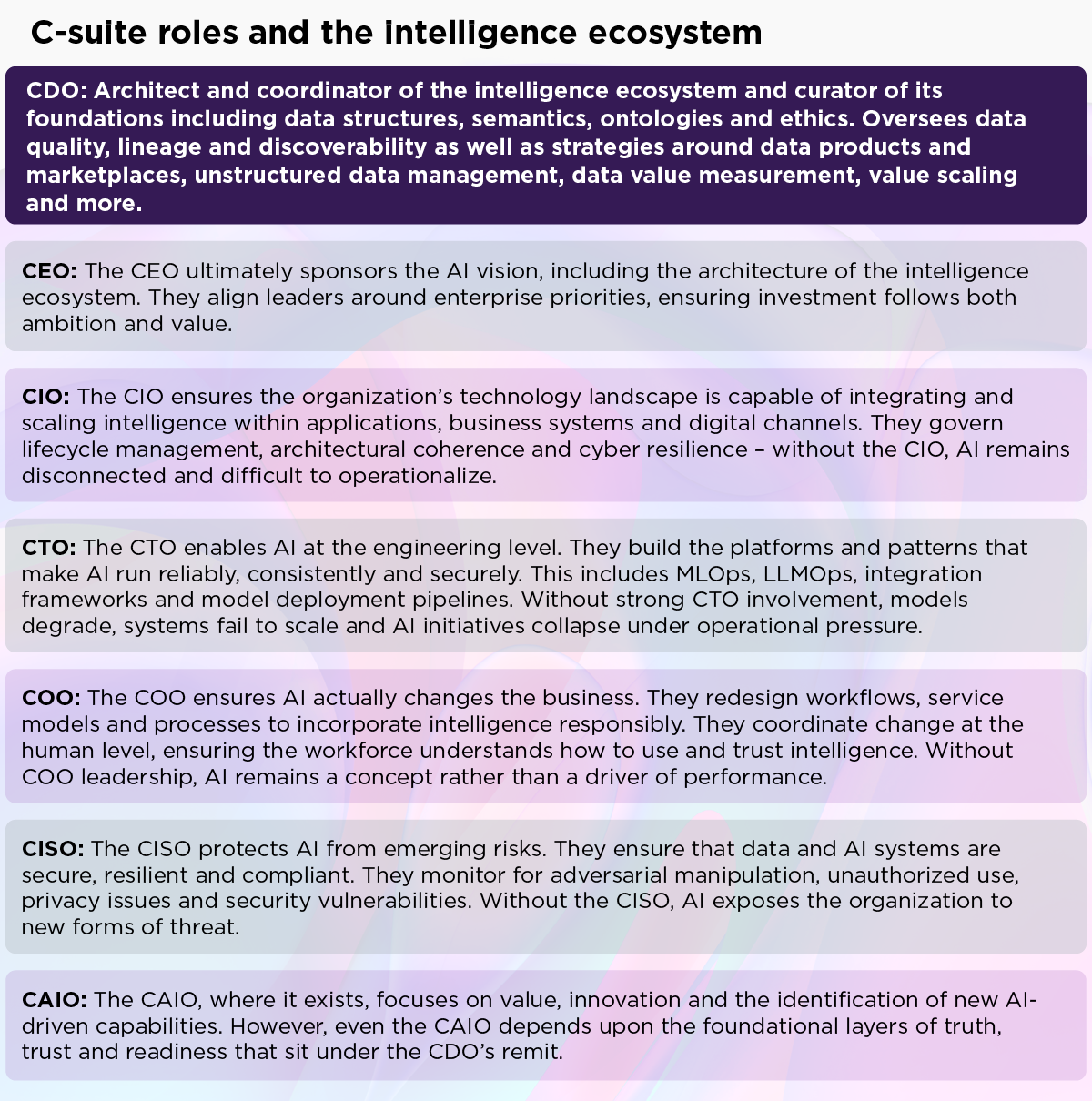
These roles together form an intelligence leadership ecosystem. When responsibilities are clearly divided and mutually reinforcing, the CDO becomes a strategic orchestrator of intelligence rather than a bottleneck or catch-all owner of data problems. The CDO’s power comes not from owning every part of the system, but from leading the parts only they should and can.

The CDO must stop trying to own everything and start leading the things that matter.
Coordinating and governing the intelligence ecosystem
A mature intelligence ecosystem clearly defines the role of C-suite leaders and aligns them around outcomes such as trusted and explainable intelligence, faster time to value, safe autonomy and measurable return on investment.
Day-to-day collaboration can be established through mechanisms such as joint steering committees, shared sandboxes, cross-functional adoption teams and early governance integration. The new ecosystem also ensures funding follows value by encouraging shared budgets, portfolio-level planning and investment models based on reusability rather than one-off delivery.
Traditional governance committees are slow, procedural and focused on risk mitigation rather than decision acceleration. As organizations adopt more advanced forms of AI, including agentic systems and autonomous workflows, the need for a smarter, lighter and more responsive governance model becomes essential.
As part of the wider push to rationalize and modernize data-related governance forums, we may see a new body emerge to offer a real-time mechanism for validating AI-driven decisions – and oversight of how AI generates intelligence. These ‘Intelligence Councils’ would bring together leaders from the business, the CDO, technology, risk, security and operations to evaluate intelligence in context – embedding C-suite partnerships, trust, transparency and alignment into the delivery of high-grade intelligence to the business.
Whatever the exact mechanisms put in place, for today’s CDO, the call to action is to design, champion and maintain the emerging ecosystem so that intelligence becomes a coherent enterprise capability rather than a cluster of disconnected initiatives.
While the reimagined CDO is not the owner of all data and AI, they will be the primary architect of the enterprise intelligence ecosystem.
The CDO roadmap for intelligence at scale
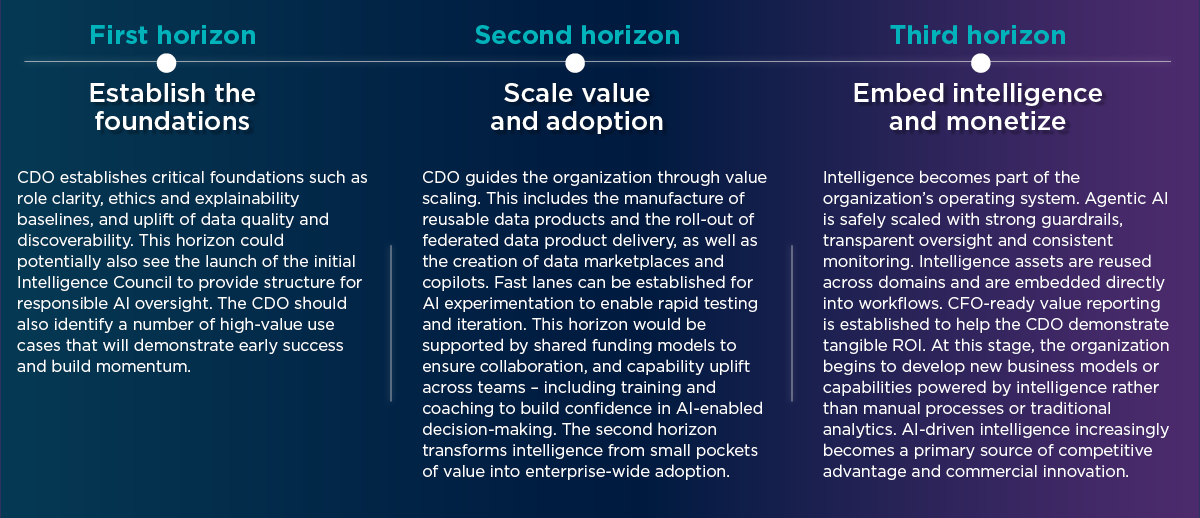
Delivering intelligence at scale requires a structured, pragmatic, enterprise-aligned plan that turns the vision of the CDO into business reality across three horizons:
The CDO must guide the organization through these horizons with a disciplined commitment to clarity, collaboration and outcomes. Their success is measured not by the number of systems deployed or data quality scores but by the degree to which intelligence becomes a reliable and strategic driver of performance.
The modern CDO succeeds through clarity: clear priorities, clear metrics, clear boundaries.
The CDO reimagined
The role of the CDO is being reshaped by the demands of AI, the expectations of the C-suite and the need for trust in a world of accelerating towards fully autonomous operations. The reimagined CDO is a strategic leader who sits at the center of the intelligence ecosystem, designing the structures, standards and capabilities that enable AI to operate safely, consistently and at scale.
They orchestrate, empower and influence rather than dictate, with their strength coming from clarity of purpose, precision of scope and the trust placed in their leadership.
Organizations that elevate the CDO into this new position will unlock growth, competitive differentiation and resilience. Ones that do not risk investing in AI without seeing meaningful outcomes, watching their competitors scale and embed intelligence while they remain stuck in governance challenges and pilot projects.
The next chapter of the CDO is not written in governance frameworks, but in the intelligence ecosystems they enable.
Contact us
To find out more about working with Capco and how we can help you overcome potential challenges, contact our experts via the form below.