
Digital banking, open banking/API


The onboarding of corporate and small & medium-sized enterprise (SME) business banking customers remains one of the most complex, compliance-heavy and critical journeys in financial services. Yet too often, it is manual, opaque and fragmented. With competition from fintechs growing and client expectations on the rise, it has never been more urgent for banks to transform onboarding from a regulatory bottleneck into a seamless and strategic entry point. This paper outlines a future-ready vision for onboarding that is fast, compliant and customer-centric.
Lea sets up an appointment with a corporate Relationship Manager (RM) at her trusted bank. She anticipates an efficient process, given her loyal relationship as an individual customer. However, the moment the meeting begins, Lea quickly realizes that establishing her company’s banking relationship will be an entirely different experience.
A seemingly endless checklist of documents, signatures from board members in multiple countries, site visits to verify her business address and back-and-forth emails with vague regulatory requirements turn the process into a logistical nightmare. Weeks turn into months, and by the time the partnership deal closes, Lea swears off ever going through such a painful experience again. Next time, she tells herself, the company will explore fintech alternatives that can onboard her business in days, not months.
Business banking relationships do not begin with a handshake. They begin with onboarding. For many institutions, the first step in the relationship is still burdened with inefficiencies. Legal entity structures are complex. Documentation requirements are high. Multiple stakeholders, such as directors, legal representatives and compliance officers, must be engaged. Regulatory expectations, including Know Your Customer (KYC), Anti-Money Laundering (AML), beneficial ownership (BO) and ESG disclosures, continue to expand in both scope and depth.
From the client’s perspective, onboarding can take weeks or months. The process is often paper-heavy, repetitive and frustrating. Banks, too, face operational inefficiencies, mounting compliance costs and siloed systems that obstruct speed and visibility. Critically, the onboarding journey remains disconnected from downstream product engagement and revenue generation. That is no longer sustainable.
In an era of real-time expectations, onboarding must evolve into a digitally enabled, client-focused, and revenue-generating process. Despite the significant progress digital onboarding enables, banks still face some of the most persistent challenges in transforming the business banking client journey. Among the largest obstacles are legacy system limitations, fragmented data sources, inconsistent regulatory interpretations and internal misalignment between front office and compliance teams.
Perhaps most critically, banks often encounter deeply embedded cultural resistance to change, especially from traditional Relationship Managers who are accustomed to manual processes and personal networks over digital tools. In many cases, siloed departments operate with ingrained ways of working that do not align with the flexibility and agility required by modern onboarding systems. These entrenched mindsets, if left unaddressed, can stall even the most well-intentioned digital initiatives and erode client confidence when delays and inconsistencies emerge.
To overcome them, banks must take an integrated and iterative approach. This means investing in flexible orchestration engines that work across siloed systems, standardizing data models and embedding compliance logic early in the process design. It also requires structured collaboration between Relationship Managers, legal and operations teams, underpinned by change management and training programs.
Reimagining business banking onboarding means building it around the client journey and making it seamless for both the customer and the Relationship Manager. It requires blending automation, compliance, product fulfillment and human interaction.
A future-ready onboarding model for business banking clients should include:
Most importantly, this model must also support scalability, ensuring that both high-touch enterprise clients and fast-moving SMEs receive a tailored but consistent experience. The right balance between configuration and standardization is essential.
KYC (Know Your Customer) is just one part of the broader business banking client onboarding journey, but it remains the most compliance-sensitive, high-risk and resource-intensive step. Because of this, optimizing KYC is among the highest-impact levers for banking institutions aiming to modernize onboarding without compromising regulatory standards.
An approach referred to as iKYC - a digital, data-driven and continuously monitoring model – transforms KYC from a manual burden into a streamlined, scalable capability.
What iKYC can do differently
What this means in practice
By orchestrating data retrieval, document extraction, compliance checks and policy-based decisioning in parallel - all within a unified iKYC framework - banks can compress KYC verification timelines from several weeks to just minutes. In many standard onboarding scenarios, approval and risk-clearance can happen in seconds.
This is a radical shift from traditional, largely manual models where onboarding a business client could take weeks, involving repeated back-and-forth between RMs and compliance, manual document collection and heavy internal coordination. With modern iKYC platforms, these determinations are supported by automated data aggregation, decision engines and exception handling, making the process faster, inherently auditable, and regulator-ready by design.
The benefits are manifold: improved operational control, reduced human error, lower compliance overheads, faster time-to-market for clients and fewer delays or drop-offs that can damage a bank’s reputation.
Typical iKYC process for business clients
When onboarding a business client, iKYC generally covers:
All these checks are done in real-time, leveraging automated data feeds, machine-readable registries and compliance-engine logic.
How iKYC fits into the overall onboarding flow
When integrated into the broader business banking onboarding blueprint (from client acquisition to activation), iKYC becomes the compliance backbone that enables real-time verification without sacrificing speed or regulatory rigor. Whether starting from lead qualification or final account activation, the bank can embed iKYC early in the process, reducing turnaround time, increasing transparency and improving client experience. Implementing iKYC also supports a cost-efficient, scalable onboarding model, turning what used to be a costly, manual compliance exercise into a value-driving, automation-enabled capability.
In a truly client-centric model, Relationship Managers are digitally empowered, not digitally displaced. With tablet-based tools, RMs can initiate onboarding in front of the client, guiding them through steps, capturing e-signatures, scanning IDs and clarifying any issues on the spot. This journey is not just digital, it is collaborative. The client is never left alone in a ‘black-box’ process. RMs provide confidence and continuity, while the system handles complexity behind the scenes.
Digital channels remain open before and after the RM’s involvement, allowing clients to upload documents, track progress or revisit agreements at their convenience. This hybrid approach ensures efficiency without compromising the relationship.
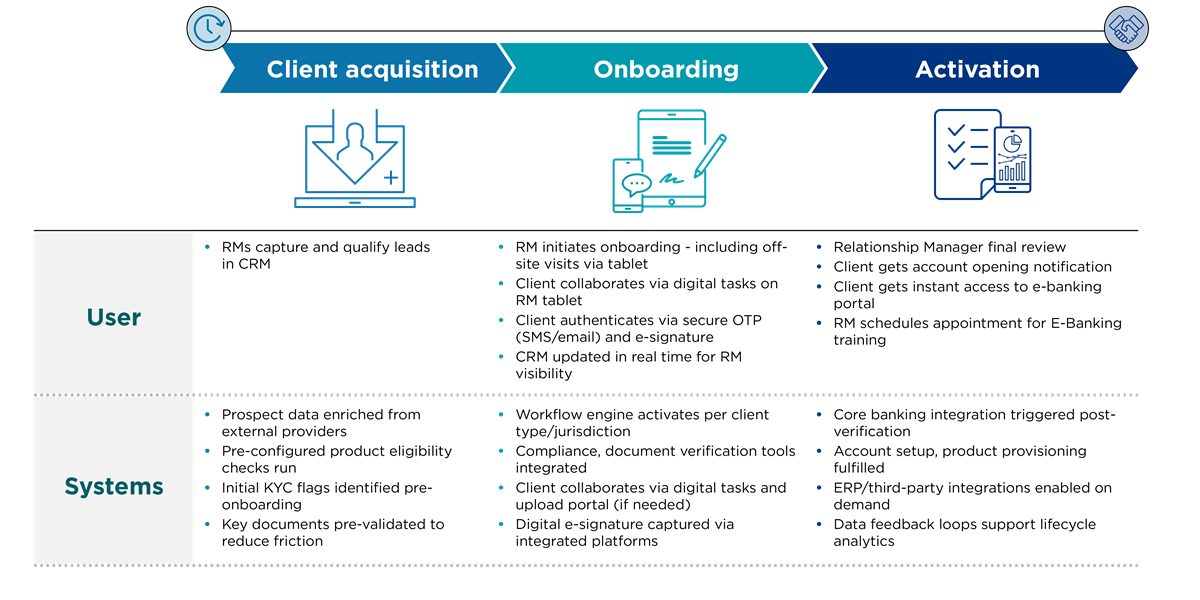
A successful onboarding transformation must span the full client lifecycle. The high-level blueprint includes three critical phases:
Client acquisition
Onboarding
Activation
This blueprint ensures that all components - CRM, onboarding orchestration, compliance and core banking - work in concert to deliver a seamless experience. It also provides a scalable foundation for advanced services such as customer lifecycle monitoring, real-time alerts and contextual upselling.
The battle for SME to corporate business clients is intensifying. Fintech challengers, ERP-native financial solutions and neo-banks are setting new benchmarks in onboarding simplicity. Banks that continue to operate with outdated, paper-heavy processes risk more than delays. They risk losing relationships entirely.
Successful onboarding transformation requires more than technology; it demands collaborative design, iterative validation and cross-functional execution from blueprint to launch. In addition, a modern onboarding ecosystem integrates workflow engines, CRM platforms, document intelligence and real-time compliance tools, enabling seamless, secure and scalable client activation. Security, scalability and compliance must be embedded from the start. Platform decisions should also factor in data residency, privacy laws and local regulatory expectations.
Winning institutions will recognize that onboarding is no longer a back-office compliance task. It is a front-line strategic asset. The ability to onboard quickly, compliantly and intelligently will define tomorrow’s market leaders.
Capco combines deep domain expertise in banking, regulatory compliance and client experience design to deliver business banking onboarding transformations that work in the real world.
Capco’s strength lies not only in concepts, but in end-to-end delivery capability. Culture is often the biggest barrier and overcoming traditional mindsets requires structured collaboration and active change management. Our delivery methodology addresses these issues by aligning cross-functional stakeholders from the outset, co-creating scalable solutions and embedding feedback loops to ensure ongoing refinement.
We work with leading financial institutions worldwide to design and implement onboarding experiences that are scalable, intelligent, and client-centric. From experience strategy to architectural blueprints, we collaborate with business, compliance, and technology teams to deliver lasting transformation. The future of business banking onboarding is fast, human, and seamlessly orchestrated.
Let’s reimagine it together.
