

Over the past decade, machine learning (ML) techniques have progressively transformed credit risk management practices across financial institutions. This transformation is particularly visible in credit scoring and credit risk monitoring. Advances in data availability, computing power, and analytical techniques have enabled banks to adopt more complex, data-driven approaches. These approaches can handle large and diverse datasets at scale.
The credit risk landscape is evolving rapidly. Financial institutions now manage increasingly diverse customer segments, alternative data sources, and dynamic credit behaviors. Credit risk monitoring frameworks must detect emerging risks earlier and adapt more quickly to changing economic conditions. Machine learning represents a powerful lever to enhance these processes and improve decision-making.
At the same time, supervisory authorities have increased their scrutiny of model risk management, governance, and transparency. This raises important questions around the use of ML in credit decision-making. Machine learning models, and Large Language Models (LLM) in particular, introduce challenges related to explainability, data quality, bias, stability, and regulatory compliance. Ensuring that these models remain robust, interpretable, and aligned with prudential expectations is a rising concern for risk and compliance functions.
In this paper, we provide an overview of machine learning applications across the credit lifecycle, from granting to monitoring. We discuss emerging opportunities from LLM and generative AI. Finally, we examine the associated challenges that banks may face when deploying these technologies.
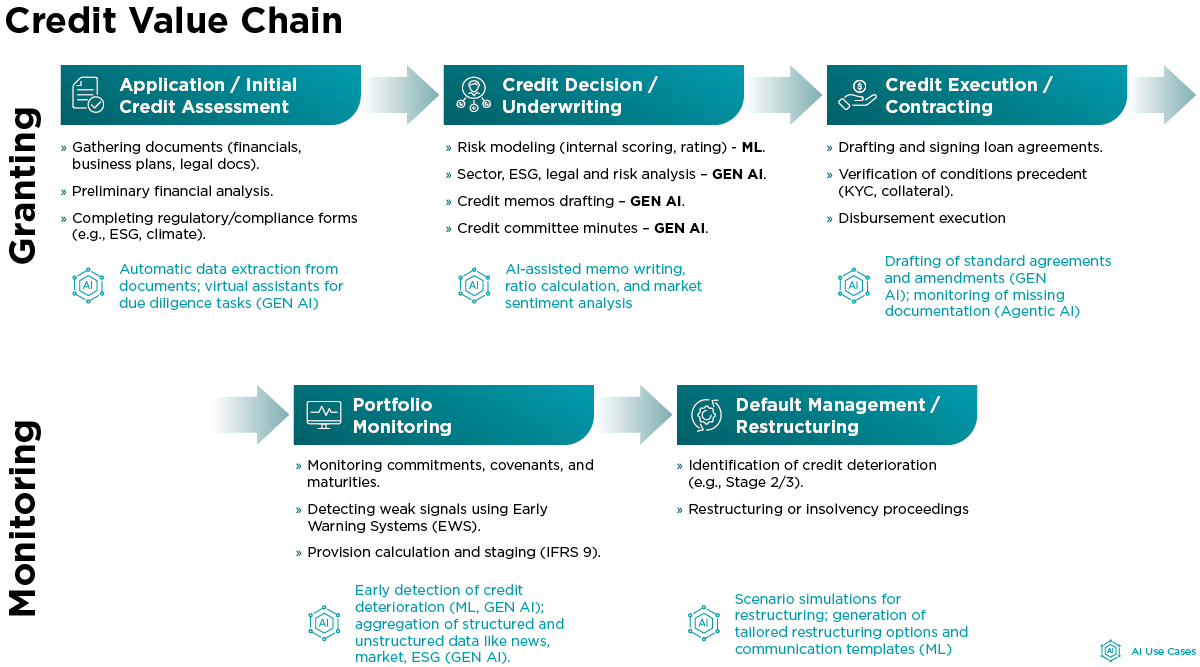
Part I. Machine Learning and Credit Granting
While artificial intelligence and machine learning have dominated industry discussions in recent years, the credit industry has relied on these mathematical concepts since the 1970s. Long before today’s AI boom, banks - constrained by the computational power of their time - were already developing what were then simply referred to as statistical models to assess the likelihood of default. This early use of modeling is clearly observed at the credit granting stage, the first step in the credit lifecycle, where initial lending decisions are made.
From Logistic Regression to Early Scoring Systems
Credit scoring was one of the earliest real-world applications of predictive analytics. Institutions such as FICO pioneered statistical credit scoring models using logistic regression and decision trees. These models learned from historical data, repayment histories, income levels, demographics, to estimate a borrower's probability of default.
The goal was to replace intuition and manual underwriting with data-driven, consistent decision-making. In essence, credit scoring was machine learning before the term existed. The model was trained, validated, and deployed, just as in today's ML lifecycle.
For decades, logistic regression dominated. Its appeal lay in its interpretability, regulatory acceptance, and operational simplicity. Supervisors valued its transparency. Risk teams valued its stability. For a long time, it represented the perfect balance between analytical rigor and compliance.
The Shift Toward Modern Machine Learning
By the 2000s, the data landscape had changed. Digitization, online banking, and richer behavioral datasets enabled new approaches. As computational power increased, banks began experimenting with nonlinear machine learning algorithms: random forests, gradient boosting machines, and later XGBoost and LightGBM.
These methods captured complex, non-linear interactions between variables that traditional models missed. For example, they could identify nuanced patterns. A young borrower with modest income but long job tenure may present lower risk than a high-income borrower with multiple short-term loans.
The result was often a significant boost in predictive power. This included fewer false negatives, better portfolio segmentation, and more dynamic pricing strategies.
Balancing Performance and Interpretability
However, this increase in performance came with a trade-off: opacity. Machine learning models are powerful, but their decision boundaries are harder to explain. In credit origination, where fairness, regulatory compliance, and customer trust are paramount, this is not a trivial concern.
Banks have responded with a hybrid approach. Many use complex models to detect nonlinearities and interactions. They then translate these into simpler, interpretable frameworks for production scoring. In parallel, explainability tools such as SHAP and LIME are increasingly used to illustrate which variables most influenced a given credit decision.
This focus on interpretability ensures that machine learning remains compatible with the explainable AI principles promoted by regulators. It also maintains the performance gains offered by modern algorithms.
A Foundation for the Future of Credit
In many ways, credit origination was the birthplace of applied machine learning, and it continues to evolve. What began with logistic regressions on mainframes has expanded into complex, adaptive systems. These systems can ingest vast and varied data sources in real time. Far from being a recent disruption, machine learning in credit is a story of continuity and refinement. It represents a half-century journey from simple scorecards to sophisticated predictive ecosystems, all pursuing the same goal: making better, fairer, and more consistent credit decisions.
Part II. Machine Learning and Credit Risk Monitoring
Credit risk monitoring is a primary component of financial institutions' risk management framework. Proactive and sturdy portfolio monitoring enables more efficient and accurate evaluation of client risk profiles.
Traditional risk monitoring methods are based on historical performance with limited predictive capacity. ML enriches these systems by incorporating real-time financial data and news combined with predictive capabilities.
ML and Early Warning Systems
ML can strengthen Early Warning Systems (EWS). Better identification of early warning signals enables institutions to take corrective measures, such as restructuring or additional collateral, before the risk materializes. A strong EWS also plays a role in reinforcing customer relationships.
ML processes vast ranges of data sources, both internal and external. It can analyze large volumes of data using advanced models and continuously learn from new information. By incorporating structured data (transaction records, repayment histories, account balances) and unstructured data (news feeds, earnings announcements, sector reports), ML-based EWS can detect weak signals. These signals would be difficult for traditional models or human analysts to capture. This reduces credit losses and maintains stronger, more transparent relationships with clients.
Drawing on our experience supporting European banks, Capco can support the design and implementation of a next-generation, ML-enabled Early Warning System by combining deep banking expertise with advanced data engineering and model development. We will assess EWS maturity and data architecture readiness, define the target operating model, and build scalable ML solutions that integrate structured and unstructured data—while simultaneously upskilling risk teams to strengthen internal data science capabilities and model ownership.
ML Driven Transaction Analysis
A key advantage of machine learning lies in its ability to analyze granular transaction-level data. By monitoring changes in spending habits, liquidity patterns, or cash-flow irregularities, ML models can detect financial difficulties and potential default risk. For example: unusual declines in account balances, increased reliance on short-term credit, or sudden shifts in payment priorities. These insights enable credit managers to intervene more promptly.
ML for Probability of Default and Portfolio Risk Metrics
ML also improves the estimation of core risk parameters, such as Probability of Default (PD). By learning from diverse indicators, late-payment patterns, behavioral scores, macroeconomic conditions, sector-specific risks, ML models often outperform traditional logistic regression approaches. Their non-linear modeling capabilities capture interactions that classic statistical methods may overlook. This provides more accurate and responsive PD estimates.
Part III. Large Language Models and Credit Risk Monitoring
LLM in a Nutshell
The face of AI evolution is widely recognized as the emergence of LLMs. These foundation models use deep learning for natural language processing and text generation. They are pre-trained on vast amounts of data to learn language complexity and linkages.
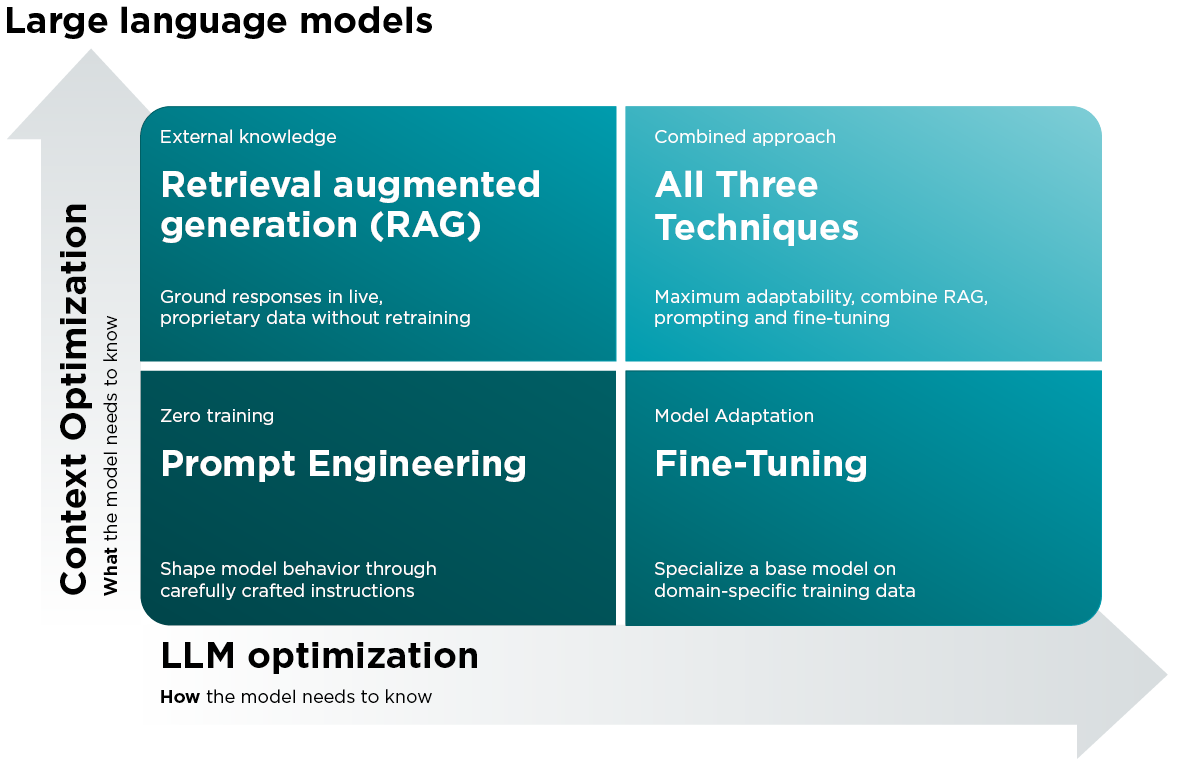
Risk experts and AI engineers collaborate to define objectives, optimize the model, and ensure regulatory alignment. Data engineers prepare secure pipelines. The final phase focuses on deployment, monitoring, and continuous refinement.
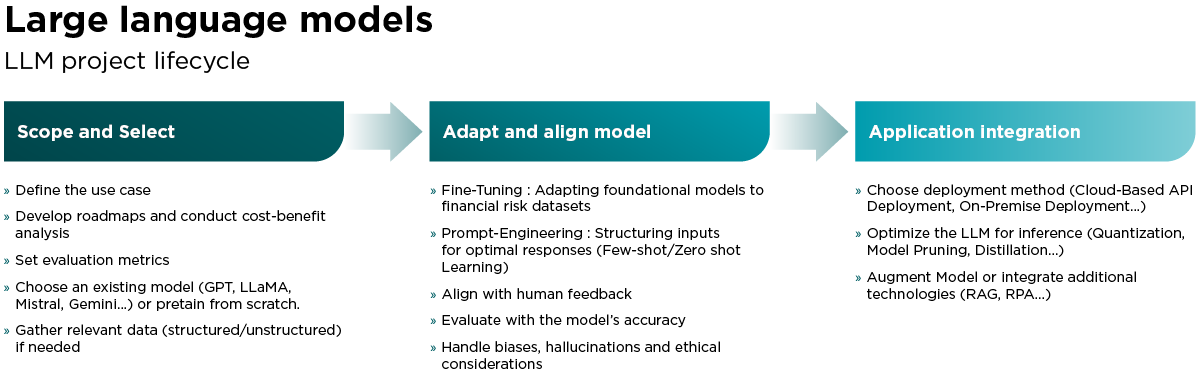
LLM optimization consists of two goals: context optimization and cost/efficiency optimization. This optimization can happen at multiple levels:
- Model-level optimization focuses on improving LLM through techniques like Fine-Tuning, enabling better performance on domain-specific tasks.
- Prompt engineering operates at the interaction layer, refining how instructions are given to the model to maximise relevance and accuracy.
- System architecture optimization improves the overall workflow using methods like retrieval augmented generation (RAG) to deliver more context-aware outputs.
Use Case 1: Early Warning System Enhanced with LLM
Early warning systems can be enhanced by integrating traditional features with qualitative sentiment analysis. This hybrid approach leverages structured data from financial statements and unstructured data processed through LLMs.
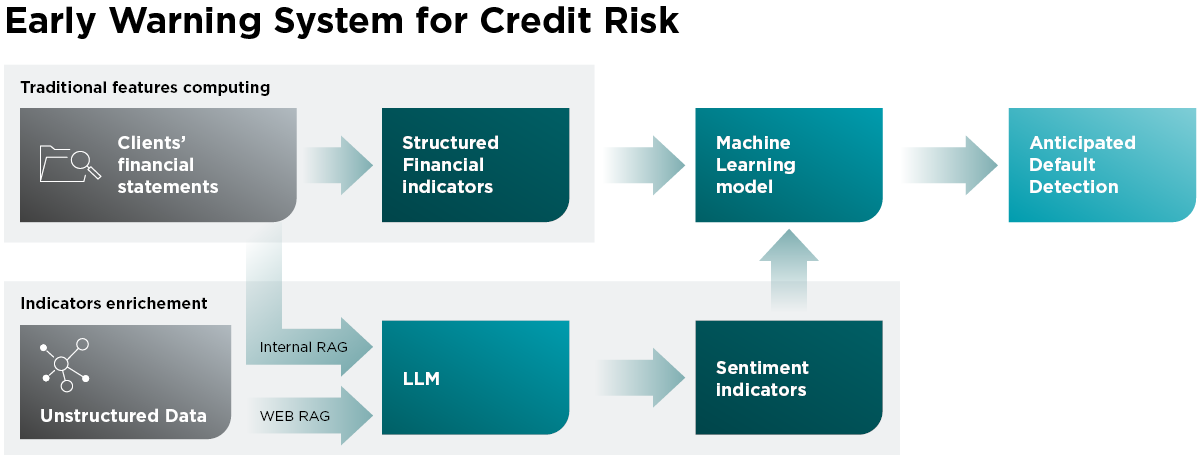
In the indicators enrichment phase, a web RAG system uses an LLM to retrieve real-time information from news, filings, and social media. The LLM analyzes this data to gauge sentiment and detect early signs of financial distress or reputational risk.
This hybrid approach delivers multiple benefits. It combines AI-generated indicators with quantitative financial data for a holistic risk profile. Sentiment analysis provides early signals before financial distress appears. The segregation of indicator generation and risk prediction enhances explainability and supports regulatory compliance.
Use Case 2: Risk Advisory Chatbots for Neobanks
Neobanks, as fully digital financial institutions, represent the future of banking by offering faster, more accessible, and personalized services without the limitations of traditional branch networks. Their technology-driven model allows them to leverage alternative data sources and advanced AI tools to improve both customer experience and risk management.
A key innovation is “Risk Advisory Chatbots” powered by LLMs. These chatbots provide personalized guidance on credit risk and financial health by analysing transaction histories, repayment patterns, and behavioural signals. They can detect early signs of financial stress and deliver actionable recommendations to retail customers, such as adjusting spending, scheduling repayments, or restructuring loans, all through natural, conversational interactions.
Keep in mind that their deployment raises important conduct risk and consumer protection caveats. LLMs are probabilistic and may generate inaccurate or overly confident responses, potentially leading to unsuitable guidance. Even if framed as “informational”, interactions may be treated as regulated advice where customers rely on them, triggering suitability and best-interest obligations under regimes enforced by the Financial Conduct Authority and guided at EU level by the European Banking Authority. These challenges will be discussed in more detail in part IV of the article.
The traditional banking equivalent would be relationship managers or credit advisors, who perform similar functions manually. While LLM chatbots offer scalability and efficiency, their use must be supported by strong governance, clear boundaries between guidance and regulated advice, and robust oversight to ensure automation enhances — rather than compromises — fair customer outcomes.
Part IV. Challenges and Drawbacks
The deployment of machine learning models in banking remains subject to several key challenges.
1. Data Quality
Despite the strong predictive power of ML models, their performance relies on training data quality. Models cannot compensate for flawed datasets. If key variables are missing or poorly measured, models rely on proxies—potentially amplifying hidden biases. Financial institutions must ensure data quality covering provenance, completeness, bias, and noise.
From a regulatory perspective, data quality extends beyond accuracy to include representativeness, temporal stability, and bias detection. Historical credit data may embed legacy practices or structural biases that ML models can learn and propagate. To meet supervisory expectations (SR 11-7, ECB and EBA guidelines), institutions must implement robust data quality frameworks with clear lineage, documented assumptions, and ongoing controls.
From a business perspective, poor data quality increases development costs, delays time-to-market, and limits scalability. Models trained on non-representative data may perform well in testing but deteriorate rapidly in production, particularly during economic shifts. Investing in high-quality, well-governed data is both a regulatory necessity and a critical enabler of sustainable performance.
Through our deployment experience, we have developed a structured data quality assessment framework that identifies critical data gaps and architectural constraints before model development begins. This front-loaded approach de-risks delivery, accelerates validation cycles, and significantly reduces costly rework during model approval.
2. Model Complexity and Stability
There is a trade-off between accuracy and interpretability. In many situations, less complex models are preferred. There are Machine learning models that are complex by structure: the first example to come to mind would be Deep neural networks (DNNs). They consist of many layers where credit inputs pass through several non-linear transformations. The final decision becomes untraceable due to the complexity of weights and biases.
Even traditional models can become complex through design and governance. Excessive variables and transformations reduce interpretability. Non-strategic use of sub-models and segmentation creates heterogeneity that makes global understanding difficult.
ML models also face stability challenges over time. Model drift occurs when learned relationships evolve due to shifts in borrower behavior or economic conditions. Data drift happens when statistical properties of input variables change. Addressing these issues requires robust MLOps frameworks: continuous performance tracking, periodic retraining, and validation processes.
3. LLMs Challenges
For large language models (LLMs), interpretability in the form required by banks and regulators is currently difficult to attain, given their scale, complexity, and probabilistic outputs. Limited use of LLMs is preferred in some use cases to maintain traceability. The hybrid approach in Use Case 1 is an example where LLMs have limited influence on model output while preserving interpretability.
One main challenge is hallucinations. LLMs generate text based on statistical patterns rather than factual verification. When prompts are ambiguous or outside the model's grounded knowledge, it may prioritize linguistic coherence over factual accuracy, leading to hallucinated outputs.
An additional challenge is Data leakage risk, credit risk ML models and LLMs handle highly sensitive information: client personal data, financial transactions, internal models, and policies. Robust data governance is essential.
4. Regulatory Challenges
The use of AI in credit risk management faces strict regulatory requirements. Under the EU AI Act, credit scoring and creditworthiness systems are classified as high-risk. This obliges banks to ensure strong governance, high-quality data, explainability, and human oversight. Meanwhile, ACPR supervision and GDPR enforcement by CNIL limit fully automated credit decisions and require transparency toward customers. In fact, article 22 of GDPR gives individuals the right not to be subject to a decision based solely on automated processing and request human intervention. These regulations increase compliance costs and constrain deployment of advanced AI.
Our experience supporting institutions under supervisory scrutiny shows that scalable AI in credit risk depends less on model sophistication than on governance, documentation, and human oversight designed from day one. We help clients embed compliance-by-design, operationalize explainability, and structure early regulator dialogue so advanced analytics can be deployed with confidence rather than constrained by uncertainty.
Conclusion
Artificial intelligence has become a true partner across the credit lifecycle. From origination to monitoring, AI enables banks to make faster, more informed, and fairer decisions. Mathematical models and objective data reveal insights that human observation alone cannot. This makes credit more accessible and equitable.
Continuous monitoring transforms the credit cycle from a linear process into a dynamic continuum. Analysis and adjustment happen in real time. Generative AI complements traditional machine learning by accelerating workflows, analyzing complex documents, and enriching training datasets. These technologies demonstrate how different AI approaches can work in synergy.
These advancements come with challenges. Increasing model complexity and data volumes require rigorous oversight and human supervision. Balancing performance, explainability, and human oversight is essential to fully realize benefits.
Ultimately, AI is not a replacement for human judgment. It is a partner that strengthens each stage of the credit process, enabling banks to innovate responsibly, enhance risk management, and broaden the quality and consistency of credit decisions.
CAPCO’s Integrated Credit Risk & AI Delivery Team
Capco's teams have developed extensive expertise combining credit risk management and machine learning techniques. Our delivery model relies on key profiles who collectively cover all functional, technical, and strategic requirements for ML and LLM applications across the credit risk chain.
- Project managers: Planning, coordinating stakeholders, ensuring alignment
- Risk practitioners: Translating risk policies into requirements, ensuring regulatory alignment
- Data scientists: Developing and optimizing ML/LLM models for credit risk
- Data/AI engineers: Deploying AI solutions, ensuring production-grade data pipelines
Get in touch
To find out more about working with Capco and how we can help you overcome any potential challenges, contact our experts or subscribe for the latest insights below.