

In July 2025, Hong Kong Exchange (HKEX) introduced the new rules mandating hybrid general meetings, electronic voting and the disclosure of record dates for proxy voting events to enhance shareholder engagement, reduce administrative burdens and align local practices with global standards. We explore the implications of this expansion of Hong Kong’s paperless listing regime.
Having originally initiated its wide-ranging electronification and modernization initiative in July 2020, in February of last year HKEX published the conclusions to its industry consultation on the Proposals to Further Expand the Paperless Listing Regime and Other Rule Amendments.1 All the proposals outlined in the consultation paper were accepted with only minor modifications, opening the way for “issuers… to flexibly adopt digital communication and payment technologies, enhancing operational and regulatory efficiency, whilst further reducing the impact of listing-related processes on the environment”.2
Alongside requirements for securities holders to have the option to send instructions to issuers, receive corporate action proceeds and pay subscription monies for offers electronically – to be implemented when Hong Kong’s Securities and Futures Commission’s Uncertificated Securities Market (USM) rules come into force this year – this meant that since July 2025 issuers have been required to ensure their constitutional documents enable them to hold hybrid general meetings and provide electronic voting.2.3
Bringing Hong Kong in line with global standards, this stipulation serves to boost engagement for retail and overseas investors, while the introduction of a mandatory record date further strengthens shareholder rights and minimizes disputes, again aligning with international best practices.4
Figure 1 illustrates the new proxy voting process flow under the paperless regime.
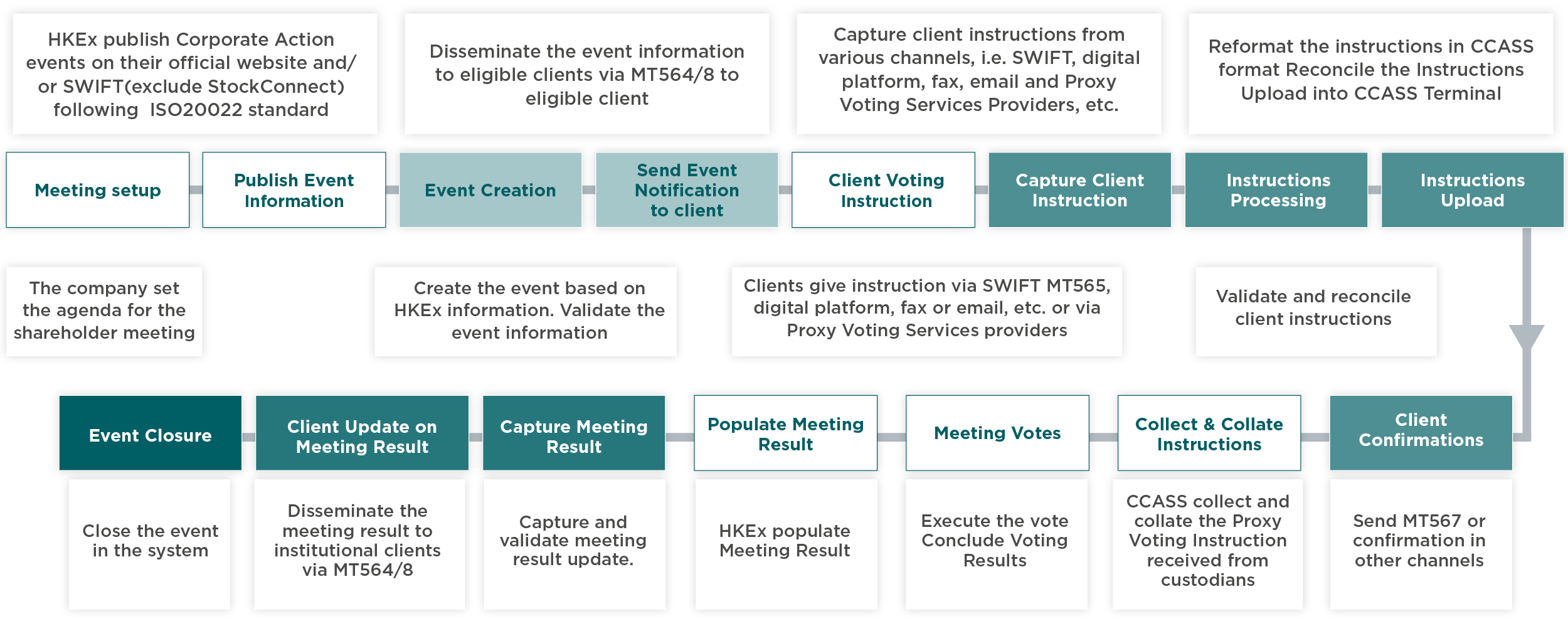
Typically Hong Kong’s proxy voting value chain comprises five major stakeholder groups –issuers, proxy agents, custodians, depository and investors – and below we outline in greater detail the impacts of these recent changes.
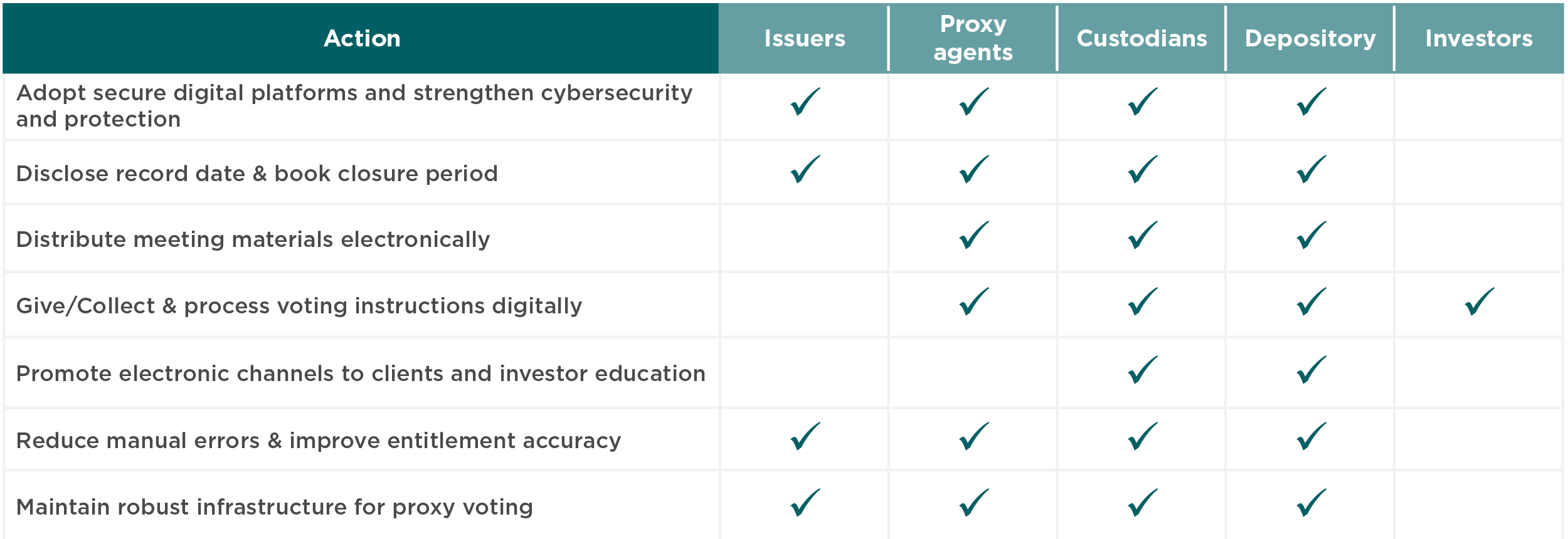
Issuers. Issuers must update their governance frameworks by amending constitutional documents to allow hybrid general meetings and electronic voting. They also need to ensure that shareholders joining through different channels have equal rights to speak and vote. From a technology standpoint, issuers must modernize their systems by adopting secure digital platforms that support virtual attendance, electronic proxy submissions, identity verification and cyber‑risk mitigation. Additionally, they are required to disclose the record date and book‑closure period in advance, allowing custodians and clearing systems to clarify shareholder eligibility.
Proxy agents. Proxy agents will see an increase in digital distribution of meeting materials and the collection of voting instructions. While this reduces reliance on paper and lowers printing and mailing costs, it also exposes them to greater cybersecurity risks. Strengthening data protection and ensuring system resilience will therefore be essential. The mandatory disclosure of record dates simplifies shareholder eligibility reconciliation and reduces errors historically caused by trading activities near meeting dates.
Custodians. Limited operational disruption is expected as many of custodians’ interactions with proxy agents are already digital. However, the transition presents an opportunity for them to encourage clients to adopt electronic channels for receiving materials and submitting votes, improving accuracy and reducing manual errors. Clearer record‑date disclosure further improves operational efficiency and reduces disputes over voting entitlements.
Depository. The paperless regime reinforces Hong Kong Securities Clearing Company’s role as the central infrastructure for distributing corporate action information in standardized formats and transmitting proxy voting instructions electronically. Its clearing and settlement platform – CCASS – must remain flexible and robust to handle various voting scenarios. The mandatory record‑date disclosure enhances accuracy in determining shareholder entitlements, particularly for Stock Connect and dual‑listed securities.
Investors. Investors benefit from greater accessibility through hybrid meetings and electronic voting, although some retail investors may face challenges in adopting digital platforms. Investor education by intermediaries will be important in promoting wider adoption. Mainland investors participating via Stock Connect, however, will not receive expanded participation rights; they must continue submitting instructions through HKSCC, which votes on their behalf. Even so, clearer disclosure of record dates provides investors with better certainty regarding eligibility for dividends, meeting attendance and other shareholder rights.
In Figure 2, we summarize key actions required across different stakeholders groups.
Future developments & strategies
As Hong Kong transitions toward a more transparent, technology enabled and sustainability focused market environment, stakeholders must adapt strategically to three thematic trends.
Evolving roles across the proxy voting value chain
Transformation is redefining the roles of issuers, custodians, depositories and proxy agents. Issuers are increasingly expected to take a proactive role in understanding shareholder behaviour, aligning agendas with investor expectations and enhancing transparency. Smaller issuers may need to partner with intermediaries – particularly proxy agents – to access cost effective digital platforms and advanced voting technologies.
Depositories remain critical in safeguarding market integrity, maintaining accurate shareholder records and ensuring timely entitlement recognition. As settlement cycles shorten and digital participation expands, HKSCC may take on new responsibilities, including certifying e-voting platforms to ensure market wide security and standardization.
Custodian’s partnerships with proxy agents have evolved in sophistication to become technology-driven collaborations that improve connectivity between issuers and investors via end-to-end digital proxy voting. Notable benefits include enhanced investor communications, reduced risk and greater transparency.
Proxy agents are evolving most rapidly, shifting from administrative processors to strategic governance advisors. With rich datasets from e-voting platforms, they can deliver insights on voting patterns, investor preferences and ESG trends. Their role in shaping corporate governance continues to expand as they adopt AI, machine learning and blockchain to support reliable, scalable and secure voting infrastructures.
In summary, the future value chain will be characterized by interoperability, digital standardization and shared governance principles to drive transparency and market resilience.
Investor expectations
Investors are becoming increasingly sophisticated in their assessments of corporate governance, sustainability performance and long-term strategic resilience. ESG, once viewed as a compliance ‘tick box’, has evolved into a central benchmark for ongoing value creation – a strategic differentiator that shapes investor confidence, capital allocation and competitive positioning.
Investors expect issuers to embed sustainability into their core business models in the belief that companies with strong ESG foundations are better positioned to anticipate regulatory changes, manage risks and compete globally.
Those expectations extend to operational transparency and stewardship, including digital distribution of meeting materials, the provision of hybrid meeting participation options and clearer disclosures on how votes are executed.
Investors are also placing greater demands on proxy agents, requiring them to pivot from more administrative support to become value added governance partners providing timely insights, analysis and voting recommendations. Mainland investors participating through Stock Connect increasingly expect the ability to vote directly in their own names and attend meetings electronically. These rising expectations reflect a broader shift toward greater investor empowerment, digital efficiency and governance accountability across post-trade ecosystems.
Technology-driven transformation
In the near term, the paperless regime is accelerating the digitalization of meeting materials, registration processes and hybrid meeting formats. Issuers must now implement secure and scalable systems capable of consolidating votes across multiple channels – including CCASS, e voting platforms and in person attendance – while ensuring data integrity, auditability and compliance.
Over the longer term, emerging technologies such as AI, big data and distributed ledger technology (DLT) will fundamentally transform operating models. AI and analytics allow issuers to evaluate shareholder sentiment, identify topics likely to attract voting resistance and tailor engagement strategies accordingly. Natural language processing provides insights into market sentiment, analyst commentary and investor feedback, enabling issuers to take a more proactive governance approach.
DLT’s decentralized databases promise secure, tamper proof and transparent voting records, reducing reconciliation errors and strengthening trust in cross border participation. Immutable ledgers, combined with multi factor authentication and smart contract based validation, can streamline registration and create real time visibility into vote submissions. These innovations enhance both operational efficiency and governance integrity.
We can expect proxy agents to focus on enhancing their e-voting platforms to be more secure, easy to use on mobile devices, scalability, and vigilant to detect unusual activities. For custodians, improved reconciliation technologies and digital workflows will be key to keeping pace with investor expectations for accurate entitlements and timely settlement.
Conclusion
The proxy voting landscape in Hong Kong is being reshaped as rising investor expectations, accelerating technology-driven transformation and regulatory imperatives converge to redefine how voting processes are managed and monitored. With roles across the proxy voting value chain evolving, stakeholders – from issuers to intermediaries to investors – must reassess their responsibilities and align with new rules of engagement.
These changes signal a long term shift toward a highly digital, data led proxy voting environment, and passivity is not an option. To remain competitive and resilient, stakeholder groups will benefit from leveraging external expertise that can help them navigate complex regulatory requirements, adopt secure digital platforms and latest technology, and ensure that their operations keep pace with rapidly advancing market practices.
In our future spotlight series, we will explore how the shift from T+1 settlement and beyond will further impact operating models, readiness, and stakeholder collaboration.
References
1 https://www.hkex.com.hk/-/media/HKEX-Market/News/Market-Consultations/2016-Present/August-2024-Further-Expand-the-Paperless/Conclusions-Jan-2025/cp202408cc.pdf
2 https://www.hkex.com.hk/News/Regulatory-Announcements/2025/250124news?sc_lang=en
3 https://www.sfc.hk/en/Rules-and-standards/Uncertificated-Securities-Market
4 https://www.hkex.com.hk/-/media/HKEX-Market/Listing/Rules-and-Guidance/Other-Resources/Listed-Issuers/Practices-and-Procedures-for-Handling-Listing-related-Matters/e_bk_close.pdf
Contact Us
To find out more about working with Capco and how we can help you overcome any potential challenges, contact our experts or subscribe for the latest insights below.
