

As customers demand more convenience, personalization and accessibility, embedded insurance is already redefining the landscape, integrating coverage seamlessly into everyday transactions, right when it is needed. In this article, we explore its impact, the key opportunities and also the complexities insurers must navigate – and how its full potential can be unlocked.
Embedding insurance into platforms such as payroll systems, e-commerce sites and car leasing services represents a strategic shift that expands reach, lowers costs and enhances the customer experience – but it also brings challenges, from regulatory compliance to technology integration and customer awareness.
Through partnerships with digital platforms, underserved markets can be tapped to expand insurers’ customer base and increase premium volumes. By looking beyond traditional distribution channels, acquisition costs can be reduced while accelerating policy issuance, improving scalability and profitability. Seamless integration into the buying process also makes coverage more accessible which in turn serves to elevate customer satisfaction and stickiness.
Embedded insurance’s evolution from an optional add-on to fully integrated protection within everyday purchases marks a decisive shift in how coverage is distributed and experienced. Adoption continues to accelerate steady expansion is predicted with a projected 30.30% cumulative growth rate by 2034 where the global market is expected to reach USD 1464.42 Billion by 2034.1
In the UK, embedded insurance still represents a small share of overall insurance distribution in most traditional lines, but the model is gaining momentum as insurers, platforms and brands embrace its potential to streamline journeys, enhance engagement and open new market segments.
- Seamless Integration – coverage becomes an effortless extension of the customer experience, activated automatically as part of a purchase or service
- Relevance – protection aligns precisely with context and need, from gig-worker income protection to theft cover for digital devices
- Accessibility – by embedding protection within existing customer journeys, embedded models bridge the protection gap for individuals and SMEs historically underserved by traditional channels.
Successful examples of embedded insurance include payroll, where platforms auto-enrol employees in group life, income protection or critical illness cover, eliminating the need for separate policies and enhancing financial security. In the automotive sector, telematics-based insurance is embedded in car sales, adjusting premiums based on driving behavior. Meanwhile, wellness apps are linking health coverage to fitness metrics, offering personalized incentives and proactive care.
E-commerce is also embracing embedded insurance. Booking sites like Expedia have integrated travel insurance directly into their booking systems, you’ll also see it if you’ve ever booked and flown with Ryanair, where the option to add insurance appears at checkout via a simple click. Amazon India, for instance, partners with Acko Insurance to bundle device protection into electronic purchases. Car leasing firms now include comprehensive insurance in monthly rental fees, enhancing convenience while creating new value for insurers. 2
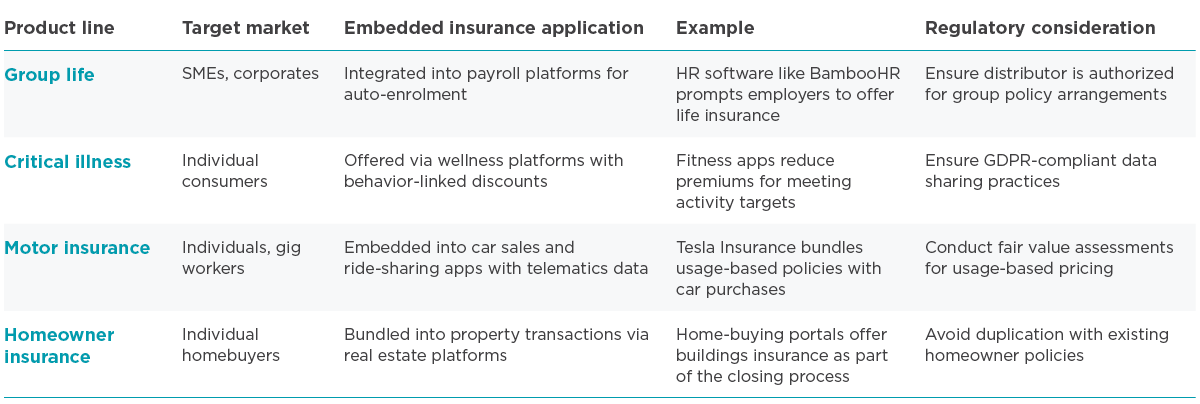
Figure 1
Embedded insurance in 2026 and beyond
Research shows most consumers prefer insurance integrated into purchases rather than as a separate product.3 Technology has a crucial role to play, with Application Program Interfaces (APIs), Internet of Things (IoT) and data analytics enabling real-time pricing and hyper-personalized coverage.
As embedded insurance gains traction, the conversation must move beyond integration mechanics to measurable outcomes for customers, distributors and carriers alike. The most successful models are not just frictionless: they’re data-driven, adaptive and capable of shaping new behaviors. By combining contextual data from partner ecosystems with advanced analytics, insurers can move from passive protection to proactive enablement — anticipating risk, tailoring offers and building trust through relevance.
This is where competitive differentiation can be established. Insurers that treat embedded models as a core strategic capability will be positioned to capture untapped value in digital ecosystems, from mobility and health to SME services and finance platforms. The call to action is clear: shift from transactional, point-of-sale thinking to designing integrated ecosystems that support continuous, contextually relevant customer engagement – for example, design partnerships, technology and products that align with the customer’s lifecycle, rather than isolated point-in-time sales.
Seizing the opportunity
By focusing on compliance, fair value and technology, insurers can unlock embedded insurance’s full potential while delivering lasting consumer value.
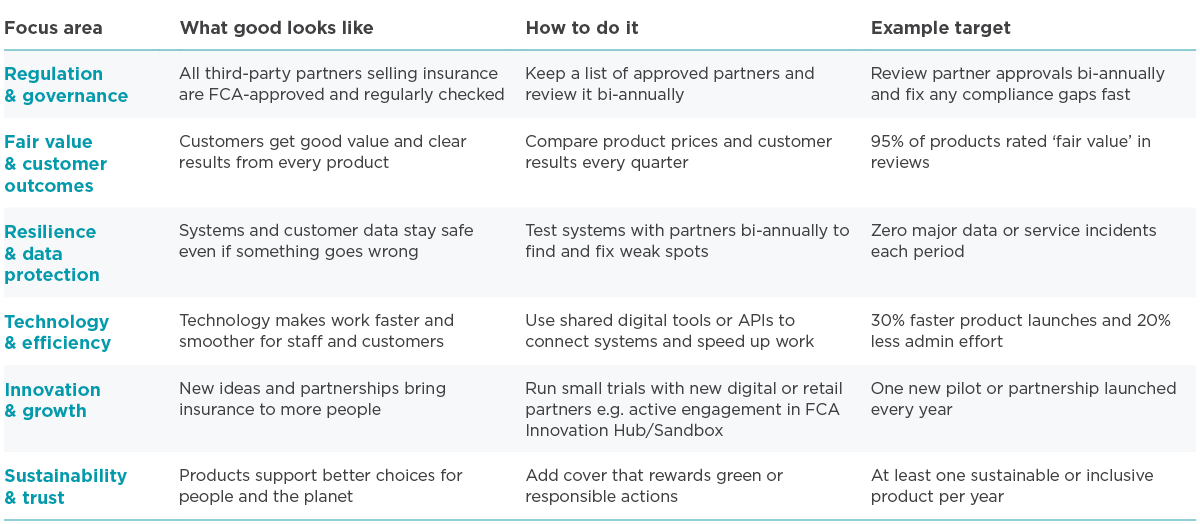
Ensuring distribution partners are FCA-authorized is crucial to mitigating regulatory risks. Due diligence confirms they have the required permissions, safeguarding compliance. Regular product pricing and outcome reviews help align with FCA’s PROD rules, ensuring fair value and consumer trust. Strong data protection frameworks further enhance security and credibility.
Strong data protection and operational resilience frameworks further reinforce consumer confidence – vital as embedded propositions increasingly rely on data sharing across digital ecosystem. Technology is key to efficiency, cost reduction, and risk management. The FCA supports innovation, encouraging firms to integrate advanced solutions to streamline operations and enhance customer experiences.
To translate ambition into action, insurers should benchmark progress against clear indicators of success, as we set out in Figure 2 below.
Navigating evolving UK compliance requirements
For embedded insurance offerings, the Financial Conduct Authority (FCA) mandates strict requirements regarding distributor authorization, fair value assessments, and customer outcome monitoring to ensure air value, transparency, and positive consumer outcomes in line with the Consumer Duty. 4
Distributor authorization. Any distributor involved in selling, arranging, or advising on embedded insurance products is properly authorized. This applies even in embedded models where distributors operate under group or master policies. For example, a car dealership offering embedded motor insurance must either be directly authorized or operate under an insurer’s oversight. Due diligence in verifying distributor compliance is essential to prevent regulatory breaches.
PROD & fair value assessments. While embedded insurance simplifies purchasing, it also introduces the risk of obscuring standalone costs or market comparisons. The FCA’s PROD 4.2 Manufacture of insurance products mandates that insurers assess whether the total price of an embedded product reflects fair value relative to its benefits. A travel insurance product sold as part of a holiday package, for instance, must not only be competitively priced but must also clearly outline its benefits and limitations to ensure customers receive genuine value. Insurers are responsible for conducting these evaluations rather than relying solely on distributors to determine fairness.
Consumer Duty. The FCA’s Consumer Duty reinforces the requirement to avoid consumer detriment, ensuring embedded insurance enhances customer outcomes rather than creating unnecessary confusion or duplicate coverage. A common risk is consumers unknowingly paying for coverage they already have, such as embedded gadget insurance overlapping with home insurance policies. Limited customer awareness – where policy terms are unclear, leading to misunderstandings about coverage – is also a concern. To ensure customers can make informed decisions, insurers must provide clear, accessible and well-timed information. 5
Data privacy and security. Embedded insurance models frequently rely on real-time data sharing between insurers and platforms, making compliance with GDPR and FCA Handbook SYSC 3.2 (Systems and Controls) non-negotiable. Insurers must ensure they obtain explicit customer consent before using personal data and implement robust cybersecurity measures to protect sensitive information. Any lapse in data governance could result in both regulatory penalties and reputational damage.
Technology integration & customer awareness. Beyond regulation, insurers must address two practical hurdles:
- Technology integration. Embedded insurance depends and relies upon robust API enabled systems that have the capability to connect effectively with partner platforms and support the end-to-end customer journey. This requires meaningful investment by insurers in infrastructure, strong digital capability and ongoing management to ensure reliability, security and scalability as partnerships grow. 6
- Customer understanding. The value of embedded insurance must be real and tangible, both at the point of purchase and throughout the customer relationship. If coverage is not well explained to the end user, it can be perceived as an unnecessary add-on rather than meaningful protection. Clear communication of benefits, scope and limitations is essential to build trust and encourage sustained adoption. 7
To successfully navigate these complexities, insurers must take a proactive and structured approach. Fair value must be rigorously assessed, consumer understanding must be prioritized, and embedded products must genuinely serve customer needs. Aligning with FCA requirements goes beyond mere compliance to ensure insurers can build trust, ensure sustainable growth and reinforce the perceived integrity of embedded insurance.
Claim complexity. Embedded insurance is incredibly easy to buy, but making a claim is not always as straightforward. That imbalance has rightly caught the attention of the FCA. If insurance protection cover is simple enough to add at checkout and buy, it also needs to simple enough to use when it matters.
The Consumer Duty reinforces this point. Supporting customers does not stop once the policy is sold. It runs across the entire lifecycle, and that includes making sure claims can be submitted without unnecessary friction. The FCA’s ICOBS (Insurance Conduct of Business Sourcebook) is equally clear that claims must be handled promptly and fairly, with proper guidance provided along the way. In practice, that means the experience of claiming should feel aligned to the experience of buying.
The broader imperative from the regulator is consistent. The convenience and simplicity that make embedded insurance attractive must be mirrored in any associated claims journey. If a gap emerges, trust erodes quickly – and once trust is lost, the value that embedded models are designed to generate begins to dissipate.
Unlock the full potential of embedded insurance
Embedded insurance is transforming how coverage is distributed, consumed and valued. It enables insurers to reach new markets, streamline operations and provide seamless protection as needed. However, successful adoption requires more than vision – a strategic, compliant and technology-driven approach.
At Capco, we help insurers navigate the complexities around embedded insurance, ensuring FCA compliance across distributor authorization, fair value assessments and GDPR standards. In addition, we develop targeted ecosystem strategies, identifying the best platforms – such as SME payroll systems, digital marketplaces or mobility platforms – in which to embed your products. Our API-powered solutions ensure seamless integration with third-party platforms, enhancing connectivity and efficiency.
Innovation drives embedded insurance, and we collaborate with insurers to design tailored products that align with market trends and customer needs. From user experience to claims processing, we optimize every touchpoint to drive adoption, engagement and loyalty.
At Capco, we help insurers unlock the full potential of embedded insurance across the following business-critical areas:
- Regulatory compliance – we design robust governance frameworks, implement RegTech automation and enable FCA-aligned monitoring to ensure compliant, scalable growth
- Data quality – we build strong data models and governance structures, enhanced with real-time analytics to drive better decision-making and performance.
- Integration – we define API strategies, implement middleware solutions and streamline partner onboarding to enable seamless ecosystem connectivity.
- Claims – we optimize the end-to-end claims journey through journey mapping, automated triage, claims APIs and practical support playbooks.
- Product strategy – we apply agile development, conduct Consumer Duty assessments and validate product/channel fit to ensure sustainable, customer-centric propositions.
- Innovation & scalability – we enable cloud modernization, deploy embedded accelerators and support InsurTech co-creation to future-proof and scale embedded offerings.
References
1 https://www.fortunebusinessinsights.com/embedded-insurance-market-113634
2 https://www.stubbenedge.com/insight/why-is-embedded-insurance-so-popular-right-now
3 https://www.hoganlovells.com/en/publications/embedded-insurance-in-the-uk-growth-and-uk-regulation
7 https://www.bain.com/insights/customer-behavior-and-loyalty-in-insurance-global-edition-2023