

Customer experience (CX) is often viewed within financial services as a mere support function – important for ensuring consumer satisfaction, certainly, but historically difficult to tie directly to revenue generation. That is rapidly changing. In today’s fragmented financial ecosystems, where customers increasingly engage with multiple providers and digital-first platforms and ‘stickiness’ is harder to maintain, CX becomes critical to securing customers’ long-term trust and loyalty.
How customers perceive, interact with and ultimately feel about a financial institution across every touchpoint – from onboarding and daily transactions to service interactions and life-event moments – collectively serve to engender trust and determine whether they deepen their relationship with a provider or look elsewhere.
A 2023 study by 10x Banking – the SaaS banking platform founded by former Barclays Group CEO Antony Jenkins – notes that global banks are losing one in five of their customers due to poor CX.1 If poor experiences can push customers toward competitors, Forrester data indicates that just a 1 point improvement in the CX Index can generate up to $33.3 million in additional revenue for multichannel banks.2
A clear divide is emerging between financial institutions that lead with experience and those that lag behind.
CX leaders focus on delivering seamless, intuitive journeys across the entire customer lifecycle – from onboarding to issue resolution. They leverage personalization to deliver relevant offers, empower frontline representatives with the tools to resolve issues quickly and enable intuitive self-service options that reduce friction for customers. Most importantly, they maintain consistency across touchpoints, building trust and strengthening long-term relationships.
CX laggards, by contrast, often struggle with fragmented processes and outdated digital journeys. Customers encounter clunky interfaces, generic interactions that fail to recognize their context, long wait times for support and siloed product experiences that prevent institutions from offering a holistic financial view.
Industry research shows that customer experience has a direct impact on loyalty and growth. Consumers are more than three times as likely to recommend and trust a brand after a positive experience, and over twice as likely to make additional purchases. In banking specifically, customers are more than three times as likely to increase their spending following a strong experience, underscoring the clear link between CX and revenue growth.3
Driving growth by shaping customer behaviors
Traditionally, financial institutions focused their growth strategies on expanding product portfolios and increasing product distribution. However, in today’s experience-driven environment, simply pushing more products is no longer enough to drive sustainable growth.
Instead, growth increasingly comes from shaping customer behavior. The most valuable behaviors – customers staying longer, buying additional services and recommending the institution to others – are direct outcomes of intentional and well-designed customer experiences.
When financial institutions remove friction from key journeys, provide relevant guidance and create meaningful engagement moments, they influence how customers interact with their services. These improvements encourage customers to deepen their relationship with the institution, increase product adoption and become advocates for the brand.
Three key experience drivers consistently influence these outcomes.
- Ease and effectiveness. Ensure that customers can complete tasks quickly and intuitively, reducing friction in everyday interactions. Metrics such as customer effort score, task completion rate and customer satisfaction help measure this dimension.
- Personalization. Enables institutions to deliver relevant offers and services tailored to individual customer needs and financial contexts. This driver directly impacts cross-sell rates, wallet share and customer lifetime value.
- Emotional connection. Build trust and loyalty by making customers feel valued and supported. This dimension is often reflected in metrics such as Net Promoter Score (NPS), referral rates and customer acquisition costs.
The business impact of these experience drivers is significant.
Applying CX drivers across the customer journey
Institutions that design journeys holistically are better able to identify friction points, personalize experiences at key moments and align internal teams around delivering consistent outcomes. Over time, these improvements shape customer behavior and generate measurable business impact.
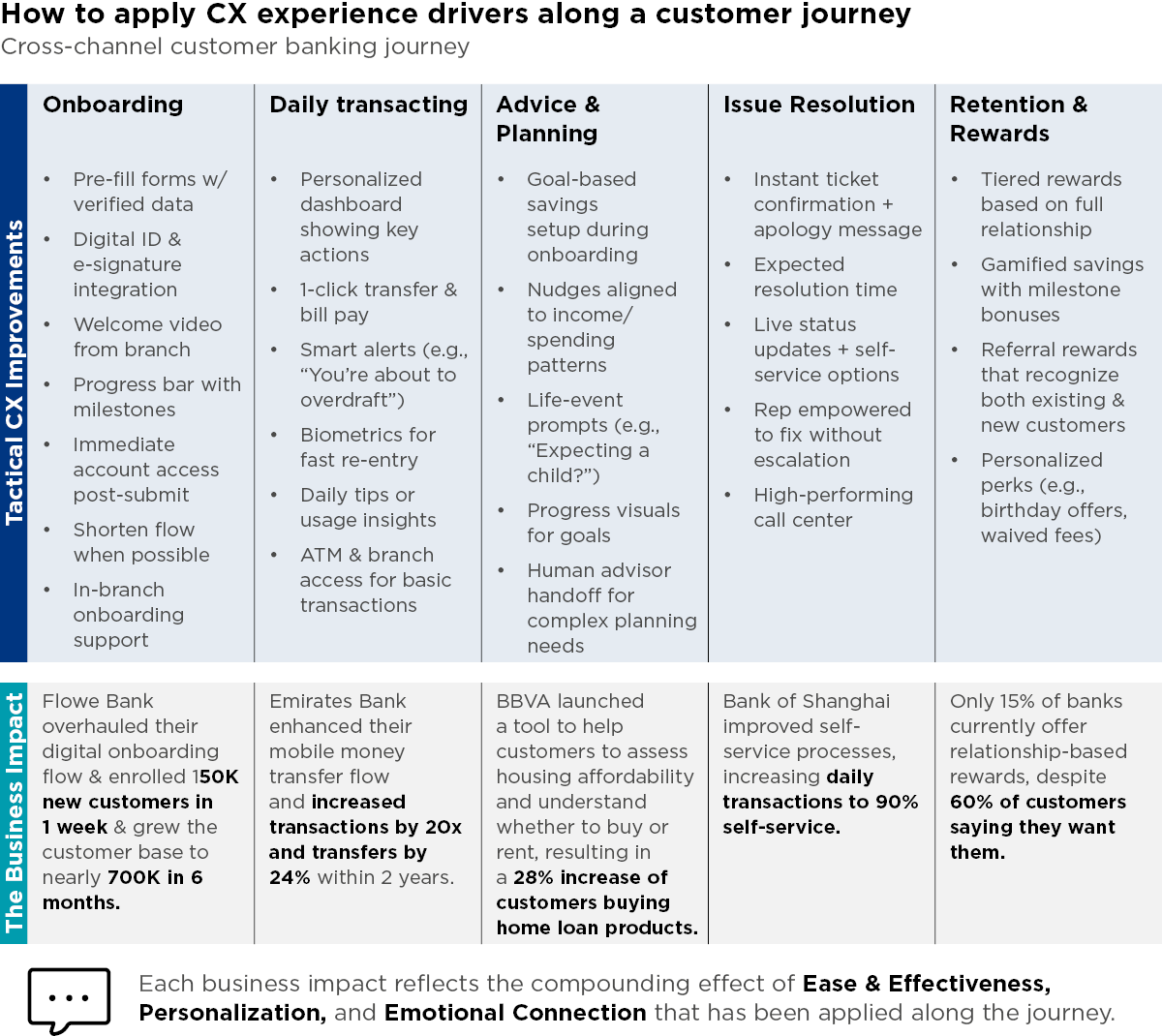
While many financial institutions recognize the importance of customer experience, translating CX ambitions into measurable outcomes requires the right capabilities, tools and organizational alignment. Delivering meaningful improvements involves more than redesigning digital interfaces – it requires embedding customer-centric thinking across strategy, operations and technology. Below we outline six key steps to facilitate this journey to enhanced CX.
1. Embed the voice of the customer to de-risk decision making
A strong CX strategy begins with a deep understanding of customer needs, behaviors and pain points. Embedding the voice of the customer into decision-making helps ensure that product features, journey designs and service models are grounded in real customer expectations. Through UX research, customer testing and continuous feedback mechanisms, organizations can validate ideas before launch and ensure that solutions address genuine customer needs. This approach helps reduce costly misalignment between internal priorities and customer expectations while improving stakeholder confidence through evidence-based decisions.
2. Rapid prototyping to accelerate delivery and reduce rework
In a fast-moving financial ecosystem, institutions must be able to experiment and innovate quickly. Rapid prototyping enables organizations to test ideas early in the development process and refine solutions based on real user feedback. By validating designs before large-scale implementation, institutions can identify what works, reduce costly rework and accelerate time-to-market for digital experiences that are intuitive and aligned with customer needs.
3. Journey mapping to uncover friction and opportunity
Journey mapping provides a structured approach to designing and visualizing customer experiences across channels and life stages. By mapping how customers interact with financial institutions at each stage of their journey, organizations can better understand where friction exists and where opportunities for improvement lie. This approach enables institutions to identify key moments that matter in the customer journey and design more personalized experiences across products, features, messaging and support interactions.
Journey mapping also helps create alignment across teams by visualizing how people, processes and technology platforms work together to support customer experience. With a clear view of the full journey, organizations can break down internal silos and design more seamless and connected interactions.
4. Customer-centric operations to reduce cost and friction
Delivering seamless customer experiences requires aligning metrics around customer outcomes in order to reduce friction and deliver faster more trusted support. This often begins with shifting KPIs toward outcomes such as first-contact resolution, ensuring that customer issues are addressed efficiently and effectively. Institutions can also implement mechanisms to gather customer feedback throughout the lifecycle of the customer journey.
These insights, combined with business intelligence, enable organizations to identify recurring operational challenges and continuously optimize processes. Equally important is aligning backend processes to support seamless customer journeys. When operational systems and workflows are designed around customer needs, institutions can remove inefficiencies that often create frustration for both customers and employees.
5. Embedding customer-centricity into culture, workflows and mindsets
Sustainable CX transformation requires embedding customer-centric thinking into the organization’s culture and ways of working. Creating a customer-first environment involves designing incentive structures and operational frameworks that place customer experience at the core of decision-making. This includes empowering frontline teams, such as call center staff with the tools, authority and information needed to resolve issues quickly and effectively.
Establishing organization-wide standards for CX excellence also ensures consistency in how customer experiences are designed and delivered. To reinforce these behaviors, organizations can align employee incentives with customer outcomes, using performance frameworks that reward teams for delivering high-quality customer experiences. Continuous improvement processes then help translate insights from customer feedback into tangible operational changes.
6. Enabling CX measurement through data and analytics
To demonstrate the ROI of CX initiatives, financial institutions must establish the infrastructure needed to capture and analyze experience data at scale. Experience management platforms such as Qualtrics or Medallia enable organizations to capture real-time insights at key moments across the customer journey. Digital analytics and behavioral analytics tools such as Amplitude and Mixpanel provide visibility into how customers interact with digital products, helping teams identify usage patterns, feature adoption, and friction points.
At the foundational level, modern data platforms such as Snowflake or Google BigQuery integrate experience data with operational, financial and product datasets. This enables organizations to connect CX improvements directly to measurable business outcomes. Tracking metrics including Net Promoter Score, Customer Effort Score, Customer Lifetime Value, cross-sell rates, referral rates and revenue per customer allows institutions to quantify the impact of experience improvements and continuously optimize their CX strategy.
Turning CX enhancements into measurable impact
For many financial institutions, the challenge is not recognizing the importance of CX but knowing where to focus and how to turn experience improvements into measurable results. At Capco, we work with financial institutions to define the right strategy, design better customer journeys and build the tools and measurement frameworks needed to make CX work in practice.
If you are exploring how to strengthen customer experiences within your organization or looking to better demonstrate its business impact, please contact us using the form below.
References
1 https://www.10xbanking.com/news/banking-customer-experience-trends
2 https://www.forrester.com/report/the-roi-of-cx-transformation/RES136233?ref_search=3186049_1686218902833
3 https://www.qualtrics.com/research/global-roi-cx-2023/
Get in touch
To find out more about working with Capco and how we can help you overcome any potential challenges, contact our experts or subscribe for the latest insights below.
