

Growth in renewables generation and increases in battery storage are driving relentless change in the US power markets. In the first of a new series of articles on the opportunities ahead, we assess the drivers of this transformation and their impact on the power trading landscape.
The US in 2024 was the world’s second largest electricity consumer after China, consuming slightly more than half the amount of electricity that China consumed in total.1 Interestingly, US consumption per capita was about 2.2 times that of China.2
An analysis of EIA data from the past decade shows that US electricity consumption has averaged an annual growth rate of about 0.5%. There were six years when there was a decline in consumption and four years with an increase. The most recent data suggests a nearly 3% increase in 2024 after a 1% decline in 2023.
The EIA is predicting a 2% annual growth rate in US electricity consumption in the coming years,3 with many other sources predicting even higher growth rates, up to 5% per year. Whether that growth in demand will be 2% or up to 5% annually, it represents significantly higher annual growth in electricity demand as compared to the past decade.
The US growth in demand will come from an increase in semiconductor and battery manufacturing facilities, growth in data centers, and the ongoing electrification of the transportation and building sectors.
Data centers, backed by the rapidly increasing demand for AI, are being singled out as the largest and fastest growing drivers of power demand in the US. Furthermore, data centers may be concentrated in specific regions, creating an even more profound impact on certain power markets.
Projected increases in US renewable generation
While total US electricity generation grew by about 5% over the past decade, the source of that generation changed substantially. An analysis of EIA data for the 10-year period from 2015 through 2024 highlights four very notable changes.
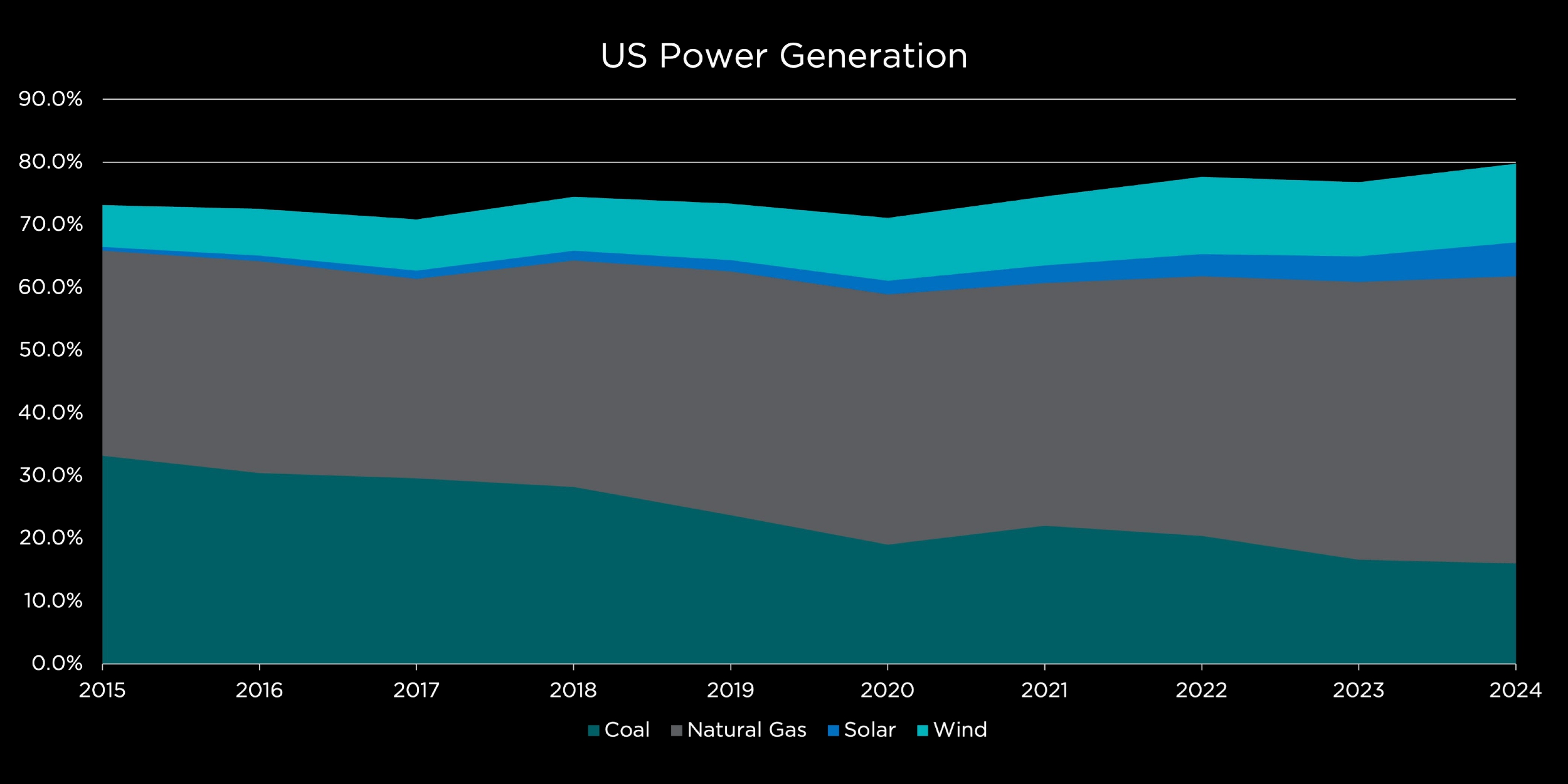
Over this 10-year period, coal, natural gas, solar and wind comprised between 72% and 76% of total power generation, while nuclear remained relatively constant at around 19% and hydro-electric generation remained relatively constant at around 6%. Figure 1 below, and the associated statistics, focus on the relative changes in electricity generation from coal, natural gas, solar and wind.
Figure 1: US power generation: coal, natural gas, solar and wind.
Source: Based on EIA data
- Power generated by coal dropped by 52%, from 33% in 2015 to 16% in 2024
- Power generated by natural gas increased by 40%, from 33% in 2015 to 46% in 2024
- Power generated by wind increased 90%, from 6.6% in 2015 to 12.6% in 2024
- Power generated by solar increased 783%, from 0.6% in 2015 to 5.4% in 2024.
While the year-on-year growth numbers in wind and solar generation do not always appear significant at first glance, it is clear from this longer-term analysis that there has been a substantial increase in renewable generation in the US market over the past decade.
In 2015, renewable generation accounted for 13.6% of total generation and that increased to 22.8% in 2024. Hydroelectric generation is the third primary renewable power source in the US and, as we noted above, it has remained relatively constant over the past decade. By contrast, in 2024, wind was responsible for producing about twice as much renewable power as hydro. Solar, after incredible gains, is now just slightly behind hydro, based on 2024 generation.
Looking ahead, the EIA’s Annual Energy Outlook is projecting US power generation from renewables to nearly double from 22.8% in 2024 to 44% by 2050. That incredible growth is expected to come from wind and solar, with hydro remaining unchanged. The EIA also predicts solar will surpass wind in the early 2030s, after a substantial near-term increase of 12% in 2025 and 10% in 2026.
Nuclear power is undergoing a modest resurgence in the US, particularly in the form of small-scale reactors designed to help cope with the surge in power hungry data centers. However, the EIA is predicting that nuclear’s share of overall power generation will remain relatively flat at around 18% over the next five years. In fact, the EIA is even predicting nuclear’s share of generation may decline slightly as older plants are retired, and new plants barely replace the capacity of the retiring plants.
Nuclear generation provides baseload power generation, which is particularly beneficial where the market also leans on highly variable renewable generation. That baseload generation is also suitable for data centers requiring constant power consumption. However, despite the recent revival of nuclear power generation, at this time it does not appear that nuclear will become a significantly larger overall contributor to US power generation in the short term.
Impact of renewable generation on power trading and CTRM systems
The US power trading market has been significantly influenced by the growth in renewables and by substantial increases in battery storage capacity. In addition, there have been regional changes in demand growth, policy and regulation changes and advancements in technology – including the incorporation of AI.
The integration of renewable energy sources, especially wind and solar, has affected traditional peak and off-peak power trading profiles. These impacts vary regionally depending upon the extent of installed wind and solar generation capacity. The variability and unpredictability of renewable power generation sources has introduced some changes to the previously standard, if not rigid, trading profiles – such as the common 5x16, or on-peak, trading profile.
Although there have always been some slight variations in these standard profiles regionally, they were based on historical and therefore predictable demand usage. Generation was traditionally planned to balance this highly predictable demand.
Both solar and wind generation have made some markets much more dynamic due to their intermittency. Solar, while weather dependent, usually provides the most benefit midday and early afternoon, which can drive wholesale energy prices down during peak hours. Solar contribution tends to diminish in the evening hours when demand is significantly increasing.
By contrast wind, especially onshore wind, tends to contribute more overnight and early morning, leading to lower wholesale prices while demand is lower. This variability in wind and solar generation can lead to increased variability in wholesale power markets that are not aligned with the traditional peak and off-peak demand periods. This in turn diminishes the effectiveness and reliance upon these standard trading profiles.
US power markets with significant renewable power generation sources are incorporating alternative contract structures that better accommodate the variability of generation. Some markets are introducing more flexible trading strategies and market rules to reflect changes in supply and demand balancing.
The intermittency of renewable generation is driving some of these markets to a much more dynamic real-time, hourly or sub-hourly market. This is resulting in a more complex trading environment necessitating more real-time monitoring and significantly increasing the number of trading-oriented transactions. Trading strategies must adapt to the supply intermittency and the increased volatility in power prices during both peak and off-peak portions of the day. This in turn increases trading risk and leads to increased demand for, and reliance on, CTRM systems.
The variability of renewable generation has also led to more frequent instances of negative power prices at certain times of the day, further complicating trading strategies and underscoring the importance of sound risk management practices.
California’s CAISO market, which is heavily influenced by renewable generation, has reported a doubling in price volatility when compared to 2016 to 2018 levels. This increase in volatility has attracted new entrants to the power market, with traders aiming to benefit from an evolving and increasingly volatile market. These new entrants will further increase trading activity, and potentially introduce additional counterparty risk to the existing, established market participants.
Impact of battery storage on power markets and trading strategies
Utility scale battery power storage capacity has been increasing significantly over the past five years in the US. The EIA data as of January 2025 shows that California (CAISO) and Texas (ERCOT) lead the way with 44% and 29% of total installed capacity respectively. Arizona (8%), Nevada (4%) and Florida (2%) round out the top five.
In total, 41 states are reporting battery storage capacity as of January 2025, but apart from those just mentioned, most are at or significantly below 1% of total installed storage capacity. Estimates for the next five years suggest the US installed battery storage capacity will increase five- to six-fold by 2030. California and Texas are projected to lead that growth with those two states maintaining over half of total installed battery capacity projected through 2030.
Battery storage acts as a hedge against price volatility and congestion costs, allowing traders more flexibility when managing their risk exposure in volatile markets. Traders in CAISO and ERCOT utilize battery storage to reduce their risk during market price spikes as well as during periods of high congestion pricing.
Batteries can help to alleviate congestion by charging during periods of low market prices and discharging during periods of high market prices. They allow for temporary storage of electricity, which offers some ability to shift that energy over time.
During the midday period of high solar generation and low market prices, batteries can be charged to absorb the excess supply. In the evening, when demand peaks, the batteries can be discharged to reduce the strain on the grid and lower peak congestion costs. This helps to reduce the magnitude of congestion-related price spikes while reducing dependency on risk management contracts such as Financial Transmission Rights (FTRs).
However, while batteries may alleviate what were historically high congestion paths, they can also create new and more volatile congestion paths and localized congestion spikes. Batteries can respond to real-time price signals, therefore making the congestion patterns less predictable as they are more dependent upon real-time market conditions.
Battery storage therefore has the potential to alter the timing and location of the profitability of FTRs and similar contracts. Markets with significant battery storage growth will encounter evolving market dynamics that require more sophisticated trading analytics.
The fundamental change in congestion behavior – from traditional renewable congestion paths to battery congestion paths – will further necessitate a real-time trading strategy. All of these changes are leading towards a more data-driven, real-time trading market.
Preview of upcoming market changes
The significant and continuing growth in renewables generation is driving change in the US power markets. In particular, ERCOT, CAISO and the Southwest Power Pool (SPP) are introducing major changes to the real-time balancing mechanisms in their markets to improve the efficient utilization of renewable energy sources, along with battery optimization.
Each market is approaching this slightly differently. However, in each case the various changes will affect not only the real-time market structure but also influence day-ahead trading – and create new opportunities for market participants.
In future articles we will explore some of these market changes in more detail.
Capco has been a Trusted Advisor helping companies navigate market changes for over 27 years, including the emergence of MISO, ERCOT going nodal, the rise in FTR/CRR trading, and the expansion of SPP as an integrated trading market.
References
1 https://www.statista.com/statistics/263455/primary-energy-consumption-of-selected-countries/
2 https://ourworldindata.org/grapher/per-capita-energy-use?mapSelect=USA~CHN
3 https://www.eia.gov/todayinenergy/detail.php?id=64264&utm
Get in touch
To find out more about working with Capco and how we can help you overcome any potential challenges, contact our experts or subscribe for the latest insights below.
