


Data


Internal data marketplaces are emerging as an important tool to help APAC’s financial institutions realize value from data in ways that comply with the region’s fast-evolving data regulations, including localization. In this article, we explore how data marketplaces improve data discoverability, enable self-service adoption at scale, and embed controls that give users the confidence to apply data to drive decisions and innovation.
Financial institutions in APAC recognize that data is the key to unlocking enterprise value by accelerating analytics, innovation and AI adoption. Over the last few years, many institutions have been investing in their data, for example through building better data management capabilities and platforms, and developing data products that bring together data, metadata and code to make data easier to apply.
However, these investments have not necessarily made data easily accessible and rapidly actionable for a wide set of business users. Instead, high-value data often remains fragmented and trapped in silos, with potential users lacking ready answers to key questions. For example, is the data suitable and of sufficient quality for our purpose? How do we access the data and efficiently communicate with the data owner? Can the data be used in a compliant way?
Answering the last question is increasingly important in APAC, where many large financial institutions operate across different markets in the region. Fast-evolving data privacy regulations at the national level require rigorous management of data and the associated consents, and new localization rules place strict controls on sharing personal data across borders – sometimes creating the need for federated data usage, including analytics.
The value of data marketplaces
Data marketplaces are the key to efficiently unlocking the value of data at scale across the enterprise. Rather than regarding marketplaces as a specific tool, they are best thought of as a set of capabilities provided through a scalable, governed platform that transforms how organizations publish, discover, access, share and monetize data.
The goal is to shift data from being a siloed asset to a strategic business product by empowering self-service, speeding up analytics and improving governance and user confidence regarding compliance.
Data marketplaces offer a convenient and unified data experience through:
A well-designed marketplace offers a single place to search for and request access to data, regardless of where the data is located. Like an efficient ecommerce marketplace, it helps users find the data asset or product they require, while offering key information about the product alongside quality indicators and user support.
As such, it offers much broader access to data across the organization, while reducing user friction and data owner costs through streamlined, consistent standards and processes. Established marketplace processes can be optimized to promote ‘social visibility’ in the data value-creation process, so that users and sharers can collaborate to solve issues quickly, learn what works best, and focus on the data and data practices that create the most value.
Building data marketplaces – five principles
Planning ambitious, flexible data marketplaces that unify data discovery, data governance and quality insights, and data access in one place – removing the need to navigate multiple systems – is a significant undertaking.
Data marketplaces should be highly automated and founded on principles of data management by design, including privacy by design and role- and purpose-driven access control. They should also build on what organizations already have, e.g. in terms of metadata available to describe data, curated data and data products, quality controls and other features. Five principles can help firms design and build a marketplace fit for the future.
1. Set the right goals & measure success
Firms should adopt a value-driven focus and use this to drive their vision for the marketplace and how its capabilities will evolve in line with organizational goals and business priorities. High impact key performance indicators (KPIs) need to be defined around these goals and priorities and put securely in place so that tangible business value can be demonstrated early in the rollout.
Data marketplaces should not be thought of as repositories for all enterprise data. At the outset of the project, it is critical to identify the business use cases that will create the most value. These can then be related to existing data assets, ‘golden sources’ of data, and planned data products – as well as the metadata and data quality benchmarks needed to support each use case.
The success of the data marketplace must be tracked in terms of key metrics such as user adoption numbers; time-to-insight; number, quality and take-up of data products; the number of cross-functional initiatives using shared data products; the data/AI innovation pilots launched using the data marketplace; the measured benefits of these pilots and the percentage successfully scaled.
2. Design data experiences in partnership with users
The data marketplace must be designed in partnership with the teams that will use it. This includes the underlying workflows and the marketplace interface, as both will determine the user experience for those creating, managing and consuming data. Getting this right means working with various teams to understand their data pain points and objectives.
The secret of ensuring healthy adoption is to solve data user and owner problems, not to simply add new tools. Collaboration needs to begin at the very start of the marketplace project and continue through the whole journey to ensure that what is built aligns with business team goals and how they make decisions about data.
The user data experience must center on intuitive self-service access, with automated tools helping teams to effortlessly publish, find and use data. For example, persona-based user recommendations and guided user journeys can be designed to support data discovery, while trust scores – reflecting underlying data quality – can be used to instill confidence. Features such as instant access to regularly used data, easy-to-use feedback channels to data owners, and GenAI-enabled smart searches can all be deployed to ease potential pain points.
3. Adopt modular API-driven architecture
The marketplace should be designed as a set of modular capabilities that integrate with the firm’s existing capabilities – such as data catalogs and data platforms – where these exist. The key is to define and build out capabilities in a modern, agile and efficient way that ensures compatibility with existing platforms and supports flexibility and scaling over time.
Identifying the right marketplace solution therefore depends on understanding each firm’s starting point. What capabilities does the firm already have, what is their level of maturity, and where are the gaps? The answers will help determine whether the organization needs to build new solutions, develop existing solutions to greater maturity, or simply integrate.
Depending on the firm’s starting point and ambitions, the project might be relatively limited, e.g. extending data catalogs with workflows that enable users to request access to enterprise data. Alternatively, it might mean building out a full set of AI-enabled capabilities with integration to data platforms and other sources to access curated data products.
4. Create trust through governance & controls
The relevant security, governance and controls must be embedded into data marketplace processes to create ‘trust by design’. It is important to proactively address privacy and security concerns to build confidence with consumers and stakeholders.
For example, the organization will need to define global baseline quality and governance standards for any dataset to be published. Alongside publishing rules, the organization will need to build key features into the data marketplace and underlying workflows such as policy-based access controls, data quality checks with automated validation and approval, trust scores, and provenance, lineage tracking and end-to-end traceability. The data quality bar should be clearly defined but not unnecessarily high – there needs to be a balance between controls and the ease with which data assets can be published.
Data ownership and stewardship roles must be well-defined with clear escalation lines and accountability metrics. With the right foundations in place, data stewards and governance specialists can use the marketplace as a central point to monitor and enforce data ownership, quality and compliance policies. This is likely to prove especially important in APAC, given the privacy and data protection regulations introduced recently in some countries in the region, including data localization requirements, cross-border transfer controls, and stronger mandated data governance and oversight structures – including emerging frameworks regarding AI and data use.
5. Embed a data-sharing culture
Introducing or improving data marketplaces is not just about deploying new technologies and capabilities. It is also about making culture changes that support the drive for adoption. This means embedding data literacy and fostering a data-sharing culture between business and technology teams.
It can take planning and effort to overcome entrenched data-sharing practices. Staff need to be trained on how to exploit the data marketplace, with take-up monitored and tracked to uncover residual pain points – which can then be solved by embracing an iterative development model. Data leaders will need to build trust with data owners and users, e.g. by investing from the outset in data quality. The firm should also make the most of the social visibility afforded by a marketplace to foster collaboration between business domains, data scientists and engineers, and other interested professionals.
There are increasing opportunities to leverage AI and Agentic AI to automate improvements in the quality of the data and metadata in data marketplaces and enhance the user experience, e.g. by automating data discoverability and suggesting new data products. With the right governance, guardrails and explainability in place, agentic strategies will allow the number and quality of data products hosted on data marketplaces to rise as curation costs fall.
Next steps
For organizations looking to establish or extend data marketplaces, the next steps are to set out the marketplace strategy, vision and goals alongside priority use cases. These should be compared to the organization’s current data sharing maturity to identify the critical gaps in today’s approach.
The organization can then set out a roadmap for building the additional capabilities required to support self-service data discovery, consumption and sharing. This roadmap should align with the priority use cases and take account of the need to prepare the organization for adoption, including training.
Data marketplaces do not have to be Big Bang investments. They can be built and introduced to the organization using phased approaches, e.g. moving from MVPs with baseline capabilities to more sophisticated and automated enterprise-wide implementations.
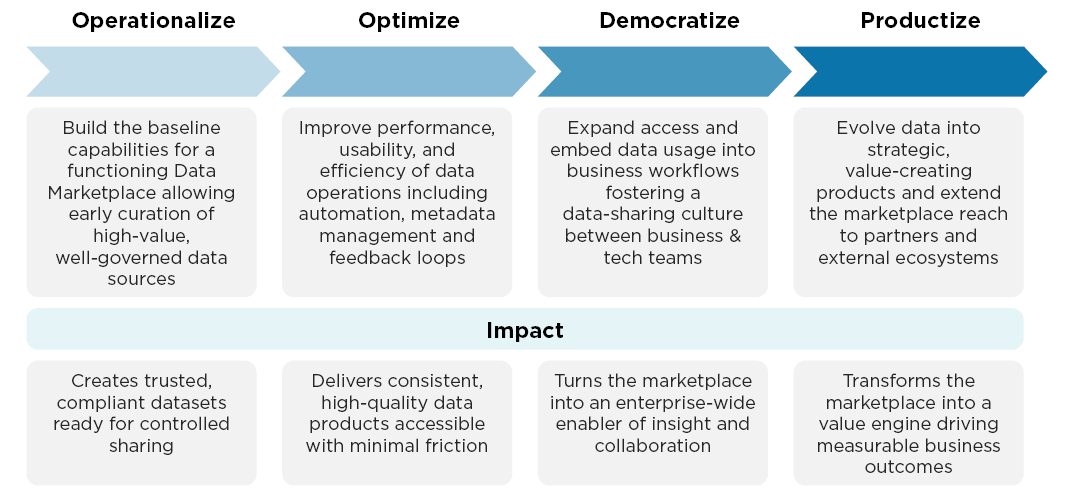
The data marketplace journey – key phases
As the figure shows, we can think of these phases in terms of operationalizing baseline capabilities; optimizing data using features such as automation; democratizing by expanding access; and productizing to extend the marketplace reach to partners and external ecosystems.
Each phase must support well-defined use cases and deliver measurable business outcomes. To continue realizing the value of data at scale, Chief Data Officers and other senior executives need to be able to prove that data marketplaces are supporting efficient data publishing, discovery and access, with all the right governance and controls in place.
To find out more about working with Capco and how we can help you overcome any potential challenges, contact our experts or subscribe for the latest insights below.
