AI investment has moved well beyond experimentation. Most organizations now have live use cases, active programs and executive attention. In some areas, AI has already fundamentally reimagined business processes.
Yet many leadership teams face the same reality: momentum is stalling, scaling is taking longer than expected, and each new use case is reopening debates around risk, ownership, and control. Organizations are finding that AI business cases which looked compelling on paper begin to erode in practice, as identified savings are absorbed by integration effort, governance overhead, control requirements and the cost of operationalizing models safely.
The maturity trap
When AI’s value is questioned, organizations often turn to maturity or readiness assessments. While the logic is sound – identify gaps, fix them, then scale – the problem lies in how that progression is framed.
Most maturity models reduce readiness to a linear score based on whether core capabilities are embedded across operating models, governance, controls, architecture, and skills. This made sense when AI was experimental and contained.
But once AI begins to influence decisions, customer outcomes and operations at scale, the equation changes. Enabling these AI outcomes depend on multiple organizational capabilities working together under real operating conditions. Capability strength in isolation is no longer enough.
As a result, high maturity scores do not automatically translate into scalable value. They show capability depth, but not whether the organization can reliably support more complex, higher impact AI outcomes.
The problem is not measuring maturity. It is treating maturity as the destination, rather than asking what level of value the organization can safely sustain at its current level of maturity.
The missing link: the value ceiling
Every organization has an AI value ceiling – the limit beyond which AI outcomes cannot be reliably and commercially supported at a given point in time. Most maturity models don’t account for this.
Maturity must always be viewed through the lens of the value you are trying to unlock. Saying “we want to be a five” is meaningless unless leaders can clearly articulate:
- what kinds of decisions AI will make or materially influence at that level
- what risks are being introduced
- what failure would look like in practice
- what must be true across data, governance, accountability and operations for those outcomes to hold.
Without that link, maturity targets become abstract, making it difficult to prioritize capability uplift that supports real business outcomes.
Not all AI value is created equal
A key weakness in how organizations approach AI maturity is not a lack of technology but a lack of clarity about the value they are trying to unlock. Without this anchor, even the most robust assessment will lack focus and fail to support decision making.
In operational settings, AI is typically used to:
- improve individual productivity and output quality
- increase productivity at scale by improving coordination and throughput within teams or functions
- automate or optimize processes to increase efficiency
- redesign how work is executed across the organization.
In customer-facing contexts, AI is increasingly used to:
- help customers find and understand information
- support better decisions and interactions
- act on the customer’s behalf and ensure the right outcome.
These outcomes carry different risk profiles: AI used for employee productivity requires lighter governance than AI that influences regulated decisions or acts autonomously. Without clarity on the value the organization aims to unlock, it is difficult to determine whether existing capabilities are fit for the outcomes being pursued.
Why governance never feels done
Governance is a clear example of this dynamic in practice. Many organizations say, with some justification, “we have already built our AI governance”. The right policies exist, committees are in place, risk teams have been consulted, and controls are operational for existing use cases.
However, each new AI use case reopens the conversation, often with higher stakes as the likelihood and impact of risk increase with complexity. In many organizations, governance remains heavily manual, reliant on review forums, documentation and specialist oversight. As complexity grows, so does the process burden. The cost and time required to integrate risk and control into delivery begin to rise disproportionately, eroding the value the use case was designed to generate.
Governance must therefore evolve alongside the value being unlocked, or it risks becoming either an unnecessary brake on low-risk use cases or dangerously insufficient for high-impact scenarios.
The same dynamic applies across other AI-related capabilities. As ambitions change and the AI landscape evolves, the required level of maturity shifts, making it harder to anchor progress to specific outcomes.
A different way to think about maturity
Instead of asking “How mature are we?”, a more useful question is “Given our current level of maturity, what kinds of AI value can we confidently unlock at scale today?”. This is the principle underpinning Capco’s value-led approach to AI maturity.
In Capco’s model, maturity is not the end goal – it is an input into broader decisions. Maturity assessments still matter. They provide an essential view of how strong or uneven an organization’s foundations are. What changes is how that information is used.
Rather than generating a single readiness score, Capco’s value-led approach:
- assesses maturity across the organization
- maps different maturity levels to different types of AI value
- makes the value ceiling explicit
- and shows what must change to raise it.
The output is not a generic roadmap to advanced maturity, but a clear view of:
- which AI use cases are genuinely scalable now in a controlled manner
- which ambitions sit beyond the organization’s current value ceiling
- and which specific capability investments will help break through the value ceiling.
Crucially, Capco’s approach creates a tangible link between capability investment and business value. It is designed for a fast-moving AI landscape, helping organizations assess whether today’s capabilities are still fit for purpose as technology, regulation, and expectations change.
How Capco supports this in practice
At Capco, we help leaders make outcomes-led decisions about capability uplift and sequencing, aligned to the business value they want to unlock.
We start by understanding the AI outcomes you aim to achieve, then assess whether current foundations are strong enough to support them. This establishes a clear view of the organization’s value ceiling.
Rather than collapsing maturity into a single score, we map different maturity levels to different types of AI value. This shows which use cases can be confidently scaled now, which ambitions sit beyond current foundations, and why.
Ready to see what AI value your organization can unlock?
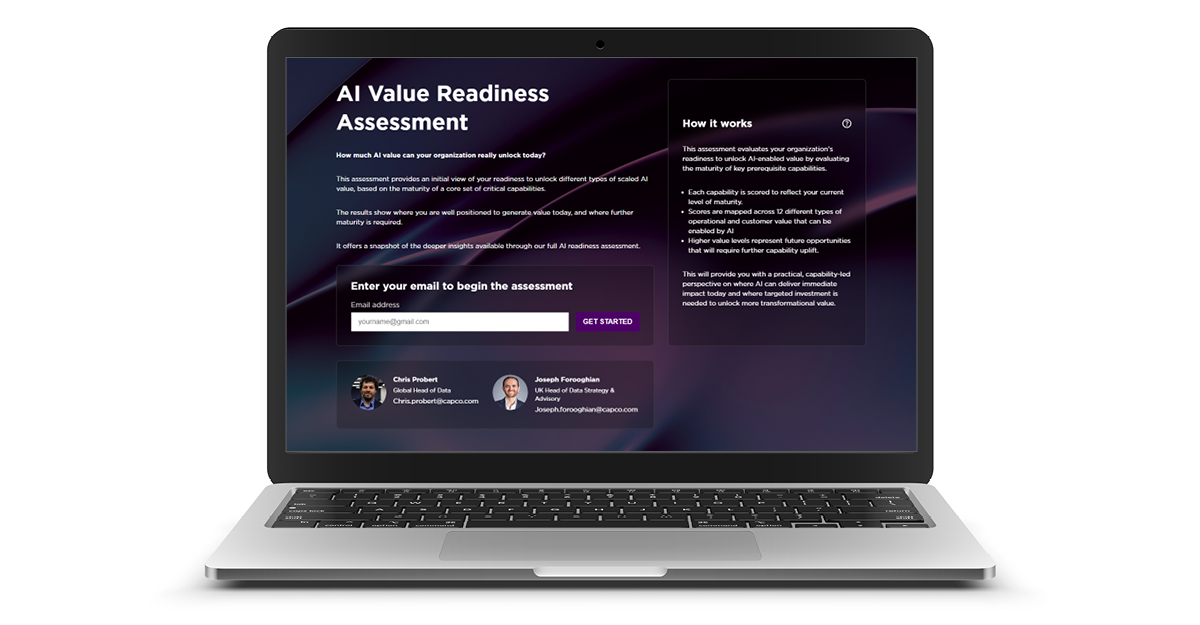
Capco’s free AI Value Readiness Assessment provides immediate insight across 16 critical capabilities – not just where maturity is strong or weak, but the types of AI value your organization can likely support.
You can explore the diagnostic here: AI Value Readiness Assessment
For organizations that want to go deeper, Capco’s full AI Maturity Assessment reviews maturity across more than 150 capabilities and links those levels directly to AI outcomes. The result is not a higher score to chase, but a sequenced view of what needs to change to unlock value over time.
The objective is not to prove maturity, but to help leaders scale AI in a controlled way - with a clear view of what current foundations can support, what will break under pressure, and where targeted investment will raise the value ceiling.