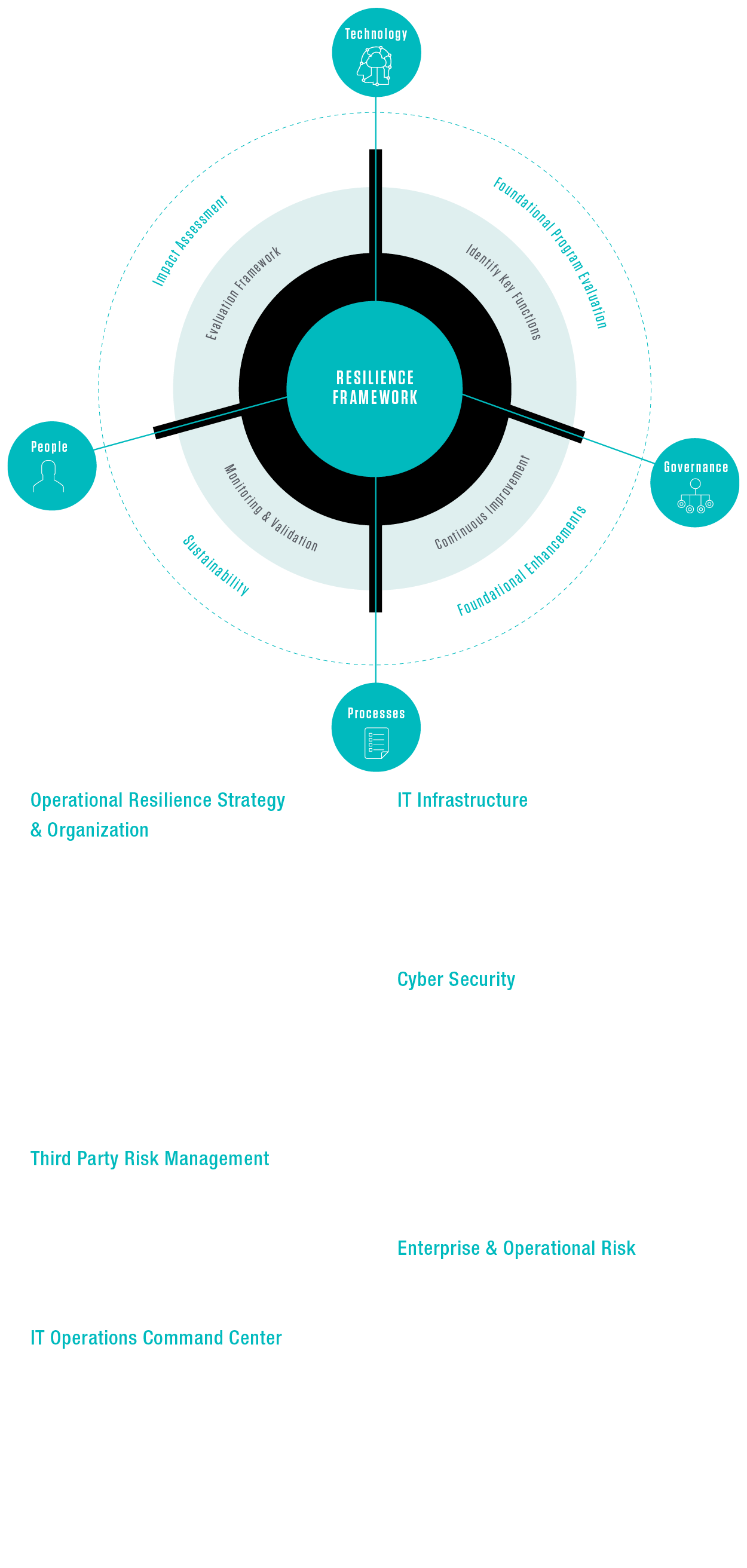

Financial services firms are under increasing pressure to optimize resilience in their operations given the dynamic pace of change and growth within the market.
Foundational industry impacts are also challenging financial services organizations to be able to adapt swiftly and adeptly to new rules and demands. For example, there has been a 72% increase in payments volumes since 2014 while trading activity has also increased, with the notional level of derivatives contracts held by US banks hitting $192.5 trillion in 2023, up 175% since 2003.1,2 Needless to say, with these increases and an associated rise in complexity, the risks of failure have grown exponentially.
Resilience is a priority on several fronts:
Operational resilience is broad and complex. However, there are a few key themes that are easier to introduce into an ongoing change delivery book-of-work. By extending the business requirements definition to include these themes, each change item can secure a bite-sized element of available change funding to deliver business resiliency benefits in addition to what was originally scoped. Adding these considerations into the initial stages of the project life cycle is beneficial to:
Each firm is unique and needs to consider their own priorities, however Capco has identified four themes which are foundational and can be applied into the regular change book of work.
Operating Model
Ensuring focus is on integrating automation, minimizing manual touchpoints, and streamlining operations, ensuring consistency and reliability in their processes. Leveraging STP with exception-based models to maintain a high level of performance during peak demand periods, enhancing an organization’s ability to adapt to changing market conditions.
Business requirements to consider:
Data Strategy
End-to-end data integration with data quality controls to ensure data integrity and accuracy. Designing solutions with timely, automated and monitored data integration between the systems. To provide accurate and timely information for reporting and business decision making especially in times of market volatility or adverse situations.
Business requirements to consider:
Production Support
Organizations must ensure capabilities to quickly recover from unexpected disruptions, such as technical failures, cyber incidents, or natural disasters. Regularly updated and tested disaster recovery plans ensure that the organization can continue operations under adverse conditions, protecting critical business functions.
Business requirements to consider:
Scalability
A scalable platform is fundamental for sustaining business growth and future capacity for change delivery. This flexibility helps the organization respond effectively to maintain reputation, competitive advantage, and operational stability.
Business requirements to consider:
Firms will benefit from acknowledging and incorporating these foundational themes during the initial project budgeting and planning phases, allowing thoughtful consideration during subsequent phases, from requirements to post-production. If each change initiative takes some steps toward embedding operational resiliency, this can also help protect that investment from future funding reallocations and restrictions.
At Capco, we leverage our deep financial services knowledge to define our operational resilience capability. We are ready to work with you to assess opportunities for strengthening operational resiliency, and ensure that it is accorded appropriate prioritization and funding to better prepare for any future adverse or unexpected situations.
1 https://www.nacha.org/content/ach-network-volume-and-value-statistics
2 https://www.occ.gov/publications-and-resources/publications/quarterly-report-on-bank-trading-and-derivatives-activities/files/q4-2023-derivatives-quarterly.html