

Digital assets have moved beyond a niche experiment on the edges of finance. Over the past several years, the market has evolved to become a meaningful component of the global financial infrastructure, with the broader digital asset ecosystem attaining approximately $2.6 trillion in market capitalization.1
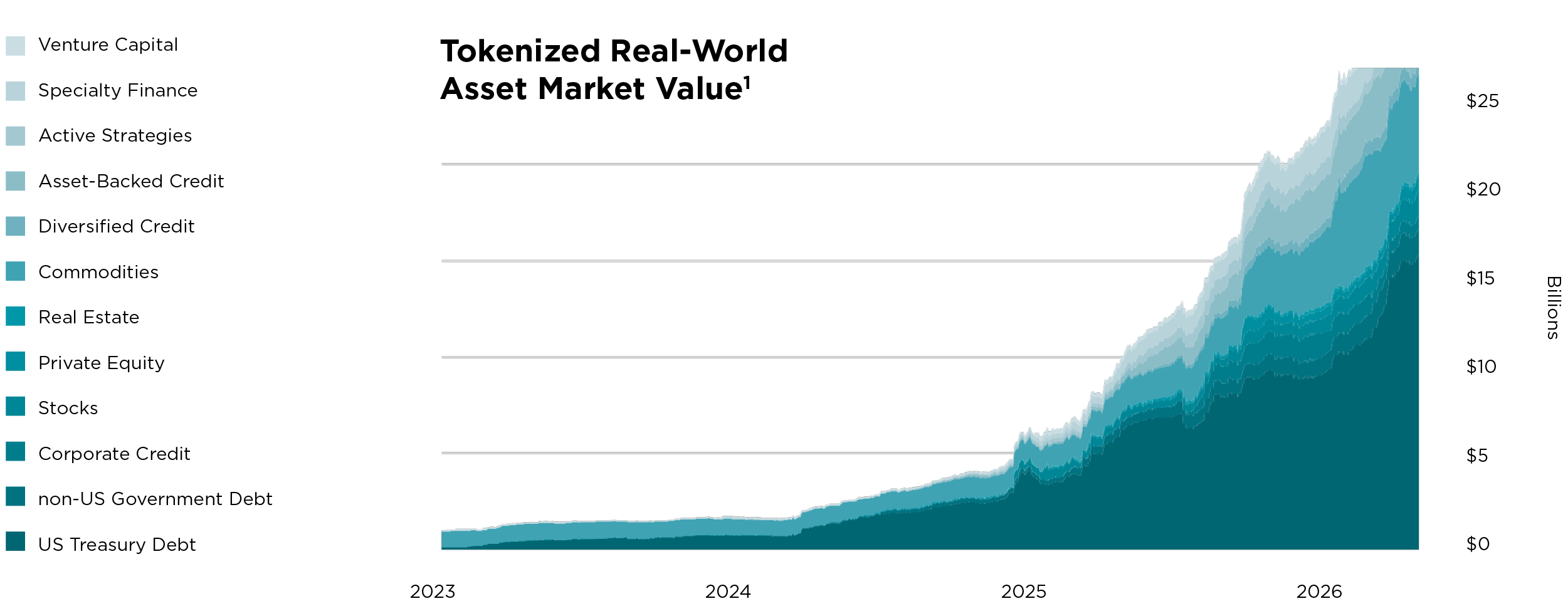
At the same time, the tokenization of traditional financial assets – including equities, fixed income instruments, private assets and real estate – has accelerated at pace. More than $25 billion of real-world assets have already been brought on-chain (see Figure 1), representing an almost eightfold increase in just three years, despite the market remaining in the pilot stages of institutional adoption and infrastructure development.2
Through the first half of 2026, the financial services industry has witnessed a significant acceleration in tokenization-related initiatives, strategic partnerships and market infrastructure modernization efforts. Major institutions such as JPMorgan and BlackRock continue to expand tokenized money market and digital liquidity product offerings, reinforcing growing institutional confidence in blockchain-enabled financial infrastructure.3,4 Morgan Stanley has similarly announced plans to support tokenized equity and ETF trading through its internal alternative trading system, signaling broader integration of tokenized assets into traditional capital markets infrastructure.5
As tokenization adoption expands, corresponding enhancements to supporting market infrastructure are also emerging. Ondo Finance, for example, partnered with Broadridge to introduce shareholder voting functionality for tokenized securities, enabling holders of tokenized equities and ETFs issued by third parties to participate directly in proxy voting processes.6
In parallel, Nasdaq confirmed that – following SEC approval – select equities and exchange-traded products will be eligible for trading and settlement in tokenized form, with settlement occurring through the Depository Trust Company (DTC).7 These and other developments represent a meaningful convergence between distributed ledger technologies and existing regulated market utilities.
Regulatory and institutional infrastructure are evolving alongside these initiatives. Between December 2025 and March 2026, multiple major financial institutions, Morgan Stanley among them, either applied for or received OCC National Trust Bank charters.8 These charters enable broker-dealers to bring fiduciary services, digital asset custody and institutional servicing capabilities further in-house, reducing long-term reliance on third-party providers while strengthening operational control across tokenized asset ecosystems.
For broker-dealers, this shift is not merely technological. It represents a structural transformation in how financial assets are issued, traded, financed, settled, serviced, and collateralized across global capital markets.
Blockchain-enabled infrastructure introduces the potential for more continuous settlement models, programmable collateral management, improved liquidity optimization and greater automation across post-trade workflows. As these capabilities mature, tokenization is increasingly evolving beyond isolated digital asset experimentation and into a broader market infrastructure modernization initiative.
As a result, broker-dealers face a strategic decision that extends beyond product innovation alone. Firms must determine where they seek to retain economic control, where they will rely on external infrastructure providers, and how they will position themselves within increasingly tokenized financial ecosystems.
The question for broker-dealers is no longer whether tokenized financial infrastructure will emerge, but rather how firms should participate as institutional adoption, client demand and regulated market infrastructure continue to converge.
Two strategic paths are emerging
In response to the tokenization wave, leading broker-dealers are generally pursuing strategies that fall into two broad categories.
Infrastructure-led initiatives. Some firms are investing directly in tokenization infrastructure and blockchain-based market rails. A central strategic decision is whether to operate on public blockchains, which offer broader liquidity and ecosystem access, or permissioned networks, which provide greater regulatory control, privacy, and operational integration.
In practice, many financial institutions continue to favor permissioned blockchain environments due to regulatory, privacy, governance, and operational control considerations. However, public blockchain networks may continue to attract institutional interest because of broader liquidity pools, open ecosystem participation, and accelerating infrastructure maturity.
As tokenized financial markets evolve, interoperability between public and permissioned environments may become an increasingly important strategic consideration. This decision typically involves trade-offs across:
- liquidity and ecosystem participation
- governance and regulatory oversight
- interoperability with existing financial infrastructure
- operational resiliency and control frameworks.
Client-access initiatives. Other firms are prioritizing distribution and client-facing services, focusing on providing access to:
- tokenized funds
- on-chain yield products
- tokenized private markets
- digital asset custody and trading services.
These initiatives are often targeted toward institutional investors, corporate treasury clients and ultra-high-net-worth individuals.
For these firms, the primary objective is less about building blockchain infrastructure directly and more about expanding product capabilities, strengthening client relationships and improving access to emerging digital asset ecosystems. In many cases, they are increasingly adopting hybrid approaches that combine selective infrastructure participation with client distribution and servicing capabilities.
Key strategic decision criteria
As broker-dealers evaluate high level tokenization initiatives, a range of factors consistently shape decision making.
1. Clear use cases
Successful initiatives begin with well-defined business problems, including:
- Cross-border and wholesale payments, where tokenization can reduce settlement friction and improve speed.
- Post-trade processes, where real-time settlement can reduce reconciliation costs and operational risk.
- Securities financing and repo markets, where tokenized collateral and near real-time settlement can improve collateral mobility, intraday liquidity management, and capital efficiency.
- Private markets, where tokenization can increase accessibility and simplify asset transferability.
One of the clearest institutional applications of tokenized financial infrastructure is emerging within the global repo market. JPMorgan’s Kinexys platform has already processed approximately $3 trillion in blockchain-enabled repo transactions and is designed to support near real-time settlement, programmable collateral exchange, and intraday liquidity management.10 Industry participants increasingly view tokenized repo infrastructure as a mechanism to improve collateral velocity, reduce settlement friction, optimize capital usage, and modernize operational workflows within the nearly $13 trillion global repo market.11
DTCC’s tokenized collateral initiative further illustrates how blockchain infrastructure is beginning to reshape core market utilities.12 Through its Collateral AppChain platform, DTCC is developing infrastructure designed to support near real-time collateral mobility, automated margining, and interoperable post-trade workflows across traditional and digital asset markets.13 The initiative aims to improve collateral velocity, increase capital efficiency, reduce operational friction, and support the evolution toward more continuous market infrastructure.
2. Balance Sheet and P&L Impact
Tokenized infrastructure can create meaningful operational and financial benefits across multiple areas of the broker-dealer value chain, including:
- reduced operational and reconciliation costs through increased workflow automation
- improved collateral velocity and more efficient margin management
- enhanced intraday liquidity management capabilities
- lower counterparty exposure through faster settlement cycles
- improved capital efficiency through more continuous collateral mobility
- expanded revenue opportunities associated with tokenized products, custody, financing and servicing activities.
For many institutions, the most compelling long-term business case may ultimately reside less in incremental product revenue and more in infrastructure efficiency, balance sheet optimization, and modernization of operating models.
3. Client Demand and Competitive Positioning
Demand is emerging from multiple client segments:
- corporate clients exploring programmable payments
- wealth management clients seeking tokenized investment products
- institutional investors looking for on-chain yield opportunities.
At the same time, fintech platforms and crypto-native firms are rapidly building competing capabilities, raising the strategic risk of disintermediation.
4. Regulatory Fit
Regulatory clarity remains uneven across jurisdictions. Firms must evaluate whether new blockchain infrastructure can be mapped cleanly to existing requirements for:
- custody
- KYC/AML compliance
- market supervision
- capital and liquidity rules.
This uncertainty is one reason many institutions currently favor permissioned blockchain networks over fully public systems.
5. Technology and Integration Feasibility
Integrating blockchain infrastructure into legacy financial systems is complex. Institutions must assess:
- interoperability across blockchain protocols
- integration with existing data and reconciliation systems
- vendor maturity and ecosystem standards.
Tokenization platforms that cannot integrate cleanly with existing golden source data systems often struggle to move beyond pilot stages.
Successful tokenization optimization & risks
A critical component of any tokenization strategy is determining the appropriate asset class, legal structure, technical architecture, issuance model, and distribution framework, while also addressing long-term governance, liquidity and investor value considerations.
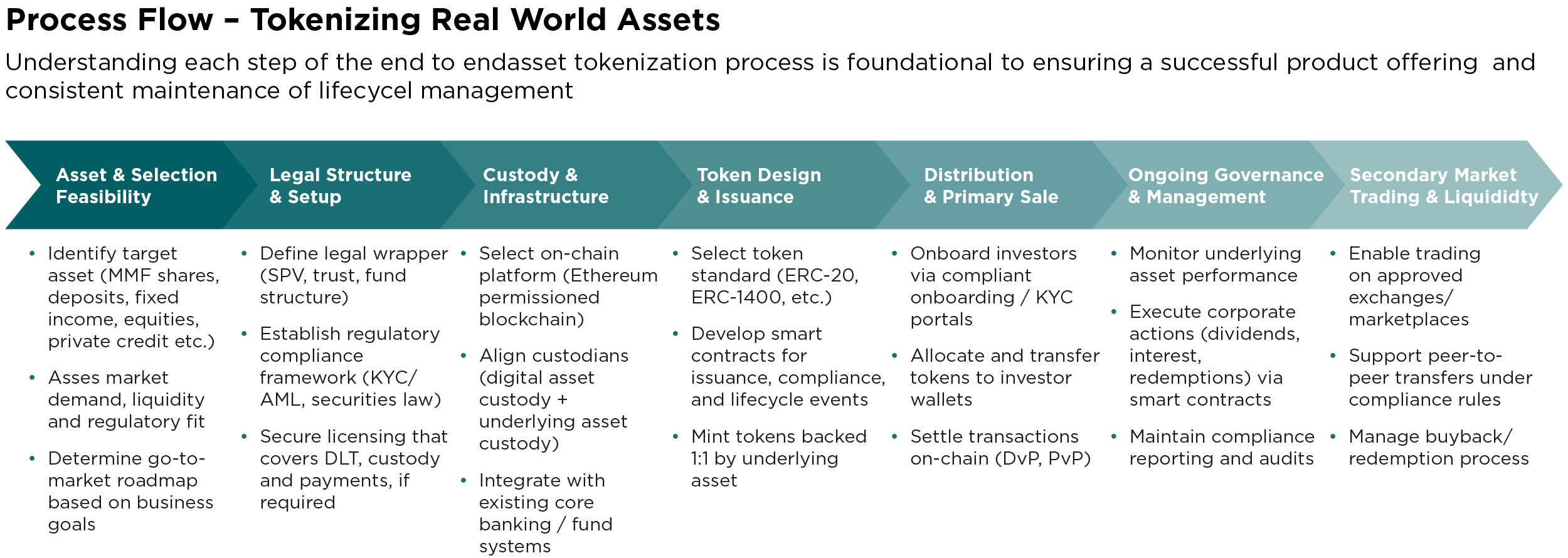
Below we outline three core areas of focus for successful tokenization.
Asset selection and feasibility. Prioritize assets that can be legally and operationally tokenized with clear ownership rights, transparent valuation methodologies and transferability.
Legal and structural framework. Clearly define the legal rights associated with the token, including equity ownership, debt claims, or revenue-sharing entitlements through enforceable legal structures. Conduct securities law assessments to determine the appropriate regulatory classification, registration requirements and applicable exemptions. Ensure compliance with investor eligibility standards, transfer restrictions and KYC/AML obligations.
Token design and issuance. Establish the token structure, including whether the asset will be fungible or non-fungible. Leverage established blockchain standards such as ERC-20 and ERC-1400 to support interoperability and scalability. Implement robust smart contract controls, including multi-signature approvals, independent audits, continuous monitoring, and transparent fee and reserve management. Develop reliable on-chain and off-chain integration mechanisms, including oracle-based synchronization between token states and external records.
So having outlined the areas of opportunity, what about the associated challenges? The primary one is not whether assets can be digitized, but whether tokenized financial products can operate within a securities-grade regulatory, operational and market structure framework.
As tokenized financial infrastructure evolves, broker-dealers must evaluate how distributed ledger technologies align with existing obligations related to custody, market supervision, settlement finality, investor protection, books and records, and operational resiliency.
Several core control areas are emerging as particularly important for scalable institutional adoption.
- Legal entitlement and ownership mapping, including clarity around investor rights, transferability, bankruptcy treatment and regulatory classification.
- Custody and possession-control frameworks governing private key management, wallet access, transfer authority, recovery procedures and safekeeping obligations.
- Market infrastructure interoperability, including integration with transfer agents, custodians, clearing organizations and existing post-trade systems.
- Settlement finality and liquidity management, particularly where tokenized assets interact with cash settlement, collateral management or financing workflows.
- Market surveillance and supervisory controls designed to address market manipulation, transaction monitoring and compliance oversight across tokenized trading environments.
- Corporate actions and investor servicing processes, including proxy voting, disclosures, dividend processing and shareholder communications.
- Privacy and data governance controls balancing transparency, confidentiality and regulatory access requirements.
- Smart contract governance and operational resiliency frameworks addressing protocol upgrades, network disruptions, cyber events and third-party infrastructure dependencies.
While tokenization may improve efficiency and transparency across financial markets, the absence of common standards, interoperable infrastructure, and mature governance frameworks may introduce fragmentation, operational complexity, and increased systemic risk if adoption accelerates faster than supporting controls evolve.
From strategy to execution: operating model & financial implications
While strategic positioning defines direction, the success of tokenization initiatives ultimately depends on how effectively firms translate strategy into scalable operating model design, governance structures and production-ready infrastructure. Tokenization is not simply a new product layer. It reshapes core functions across the broker-dealer value chain, including issuance, financing, trading, settlement, custody, servicing, collateral management and post-trade operations. As firms move beyond pilot programs, the focus is increasingly shifting toward initiatives capable of delivering measurable operational and economic value within regulated market structures.
Operating model archetypes. Each strategic path corresponds to a distinct operating model with different capabilities, investment requirements, and risk considerations.
Infrastructure providers. Infrastructure-led firms develop capabilities across distributed ledger operations, smart contract governance, tokenized settlement workflows, and on-chain compliance frameworks. While this model requires greater upfront investment and operational complexity, it provides firms with increased control over infrastructure economics, transaction flows, and data management.
Distribution-led models. Distribution-led firms focus primarily on client access, custody, product distribution, and servicing capabilities while leveraging third-party infrastructure providers. This approach may accelerate time to market while concentrating strategic value within client relationships and product distribution channels.
Hybrid models. Many institutions are increasingly pursuing hybrid models that selectively combine infrastructure participation with client servicing and distribution capabilities. These approaches require strong interoperability, clear governance structures, and effective coordination across internal and external platforms.
Tokenization’s impact extends beyond operational efficiency alone, and potential fiscal areas of impact include:
- reduced reconciliation and operational processing costs through increased automation
- improved collateral mobility and more efficient margin management
- enhanced intraday liquidity optimization capabilities.
- lower counterparty exposure through faster settlement cycles
- improved capital efficiency and balance sheet utilization
- expanded revenue opportunities associated with tokenized products, custody, financing and servicing activities.
While long-term infrastructure efficiency may create meaningful value, many firms continue to face near-term cost pressures associated with technology investment, regulatory compliance, and parallel system operations during transition periods.
Client demand, competitive positioning & disintermediation risks
Successful tokenization strategies are increasingly anchored in identifiable client demand rather than technology experimentation alone.
Institutional investors continue to explore efficiency and liquidity opportunities across private markets and collateral management workflows, while corporate treasury clients evaluate programmable payment and liquidity management capabilities. Wealth management clients are similarly seeking broader access to tokenized investment products and alternative asset exposure.
Firms that align tokenization initiatives to specific client and operational needs are more likely to achieve scalable adoption and sustainable commercial outcomes.
Tokenization may lower barriers to entry across several areas of financial intermediation, enabling fintech platforms, market infrastructure providers, and crypto-native firms to compete across custody, settlement, financing, and distribution functions.
As market infrastructure evolves, broker-dealers must determine which capabilities they seek to defend, where they intend to differentiate, and where strategic partnerships may be more effective than direct infrastructure ownership.
A decision framework for prioritization
As firms move from experimentation toward scaled deployment, several factors consistently shape investment prioritization decisions:
- use case materiality
- operating model alignment
- financial viability
- regulatory readiness
- strategic control and infrastructure dependency.
This structured approach helps firms prioritize scalable initiatives while reducing the risk of fragmented or non-strategic deployments.
Potential benefits. When implemented effectively, tokenization can deliver:
- improved operational efficiency
- faster settlement and reduced counterparty exposure
- enhanced collateral mobility and liquidity optimization
- expanded product innovation opportunities
- improved client engagement and market accessibility.
For broker-dealers, these capabilities may create meaningful competitive differentiation as tokenized financial infrastructure continues to mature.
Key risks and constraints. Adoption is not without challenges, including:
- significant upfront technology investment
- regulatory uncertainty across jurisdictions
- operational complexity from running parallel systems
- cybersecurity and reputational risks.
In addition, the industry has not yet converged on common standards, increasing the risk of building platforms that may not scale.
Conclusion: moving from experimentation to deployment
Many financial institutions have already completed initial tokenization pilots and proof-of-concept initiatives. The next phase of market evolution will be defined not by experimentation alone, but by the ability to integrate tokenized infrastructure into scalable, regulated financial operating models. This transition will determine whether broker-dealers emerge as:
- infrastructure providers
- distribution and servicing platforms
- hybrid participants operating across both layers of the ecosystem.
As tokenization adoption expands, the competitive landscape may increasingly shift toward firms capable of combining regulated market infrastructure, digital custody capabilities, collateral optimization, client distribution and operational resiliency within a unified strategic framework.
Tokenization is not simply about digitizing financial assets. It represents a broader transformation in how financial markets operate, how liquidity moves across institutions, and how economic value is created across the capital markets ecosystem.
Broker-dealers that successfully align operating model transformation, regulated infrastructure integration, client strategy, and governance modernization will be best positioned to capture the next generation of liquidity, efficiency and market infrastructure opportunity as tokenized finance continues to mature.
The firms that succeed may not necessarily be those that tokenize first – but rather those that most effectively integrate tokenized infrastructure into the operational and economic core of the enterprise.
How Capco can support you
As tokenization moves from experimentation to enterprise-scale adoption, broker-dealers face a critical opportunity to redefine how they operate, compete, and create value across the capital markets ecosystem. Success will depend not only on adopting new technologies, but on aligning infrastructure modernization, regulatory readiness, operating model transformation and client strategy into a cohesive roadmap.
We support financial institutions in navigating this transition through a combination of deep capital markets expertise, practical experience across digital assets, tokenization strategy, operating model design, regulatory alignment, and technology implementation. Whether firms are evaluating initial use cases, scaling tokenized infrastructure, or optimizing client and post-trade capabilities, we can help accelerate execution while managing operational and regulatory complexity.
Our propositions are designed to help institutions move from early interest to practical execution across the areas that matter most.
- End-to-end digital assets adoption – Define where to participate, how to operate in a hybrid environment, and what governance, custody, settlement, and control foundations are needed to scale.
- Tokenization of RWAs – Design tokenized products that are commercially relevant, operationally workable, and institutionally credible across the full lifecycle.
- Stablecoins & tokenized deposits – Assess where digital money can improve treasury, liquidity, settlement, and payments while fitting within existing control and regulatory frameworks.
To discuss how your organization can position itself for the next phase of tokenized finance, contact us to explore how we can help turn strategy into scalable, market-ready outcomes.
References
1 www.coinmarketcap.com
2 https://podcastaddict.com/odd-lots/episode/216678791
3 https://am.jpmorgan.com/us/en/asset-management/adv/about-us/media/press-releases/jp-morgan-asset-management-launches-second-tokenized-fund-on-ethereum/
4 https://finance.yahoo.com/news/blackrock-inc-blk-expands-tokenized-172223564.html
5 https://phemex.com/news/article/morgan-stanley-to-enable-tokenized-stock-trading-by-late-2026-68718
6 https://www.prnewswire.com/news-releases/ondo-finance-brings-shareholder-voting-capabilities-to-tokenized-securities-with-broadridge-302755024.html
7 https://ir.nasdaq.com/news-releases/news-release-details/nasdaq-launch-equity-token-design-putting-issuers-center
8 https://www.occ.gov/news-issuances/news-releases/2025/nr-occ-2025-125.html[TS1.1]
9 https://app.rwa.xyz/
10 https://www.jpmorgan.com/kinexys/digital-assets/digital-financing?utm_source=chatgpt.com
11 https://kensoninvestments.com/knowledge-centre/tokenized-repo-markets-real-time-collateralized-lending-with-blockchain-infrastructure/
12 https://www.dtcc.com/news/2025/april/02/dtcc-announces-new-platform-for-tokenized-real-time-collateral-management
13 https://www.dtcc.com/news/2026/may/12/dtcc-collaborates-with-chainlink-to-advance-24-7-collateral-management
Connect with our experts


