

The proposed revision of the Sustainable Finance Disclosure Regulation (SFDR), commonly referred to as SFDR 2.0, represents a structural reset of the EU’s sustainable finance framework.1 The European Commission’s initiative responds to increasing concerns around greenwashing, inconsistent market practices, and the unintended use of disclosure categories as de facto product labels.1,2 SFDR 2.0 therefore marks a transition from transparency-focused regulation towards a system centered on product integrity, comparability, and measurable outcomes.
This shift reflects a broader regulatory intention to move from interpretative disclosure requirements towards clearer product standards, thereby reducing ambiguity in market classification and stregthening supervisory comparability. For banks, this would have direct operational implications: sustainable products would need to be designed, governed, documented, and monitored against more explicit sustainability criteria from the outset, rather than classified only at the disclosure stage. In practice, this could require tighter alignment between product governance, ESG data management, investment strategy, risk controls, client-facing documentation, and ongoing reporting, particularly where banks manufacture, distribute, or advise on sustainability-related products.
From disclosure regime to product architecture
The original SFDR was designed as a disclosure framework . In practice, however, Articles 8 and 9 evolved into market-facing labels, creating ambiguity around the actual sustainability profile of financial products.2 This disconnect between regulatory intent and market interpretation has been a key driver for reform.1 The issue became particularly visible during the 2022–2023 wave of Article 9 downgrades, when hundreds of funds were reclassified to Article 8 following greater regulatory scrutiny and uncertainty around the meaning of a “sustainable investment objective”. In parallel, public investigations into SFDR-classified sustainable funds with exposures to major polluters and fossil-fuel companies highlighted the risk that disclosure categories could create a perception of sustainability that was not always matched by the underlying portfolio composition. These examples illustrate why the reform debate has increasingly shifted from disclosure volume towards clearer product categories, minimum criteria, and stronger safeguards against greenwashing.
SFDR 2.0 introduces a more structured and outcome-oriented product architecture.4 Rather than relying on disclosure-based categorisation, the revised framework is expected to define financial products based on their underlying investment strategy, the role of sustainability within that strategy, and the extent to which measurable outcomes can be demonstrated.4
Three core product categories are emerging. First, sustainable products are expected to target measurable environmental or social outcomes, supported by clearly defined objectives and performance indicators.4,5 Second, transition products focus on investments that contribute to the transformation of assets or issuers along credible sustainability pathways.4,5 Third, ESG-integrated products incorporate sustainability factors into the investment process without pursuing a primary sustainability objective.4 As a result, product classification becomes increasingly dependent on verifiable portfolio composition, rather than high-level sustainability narratives.
Across these categories, minimum thresholds, exclusion criteria, and data-driven requirements are expected to play a central role.4 In practice, this means that product classification would need to be supported by concrete data points, such as the share of investments contributing to the product’s stated sustainability or transition objective, evidence that mandatory exclusions are applied, and information on Principal Adverse Impacts where identification, disclosure, and mitigation measures are required. These requirements are reflected in the table below, for example through the 70% minimum investment thresholds, the CTB- and PAB-based exclusions, and the PAI-related obligations applicable to certain product categories.
In addition, the framework introduces the concept of an optional impact layer, requiring products with explicit impact claims to demonstrate intentionality, measurability, and additionality.2
The figure below provides a structured overview of the emerging product architecture and its regulatory parameters.
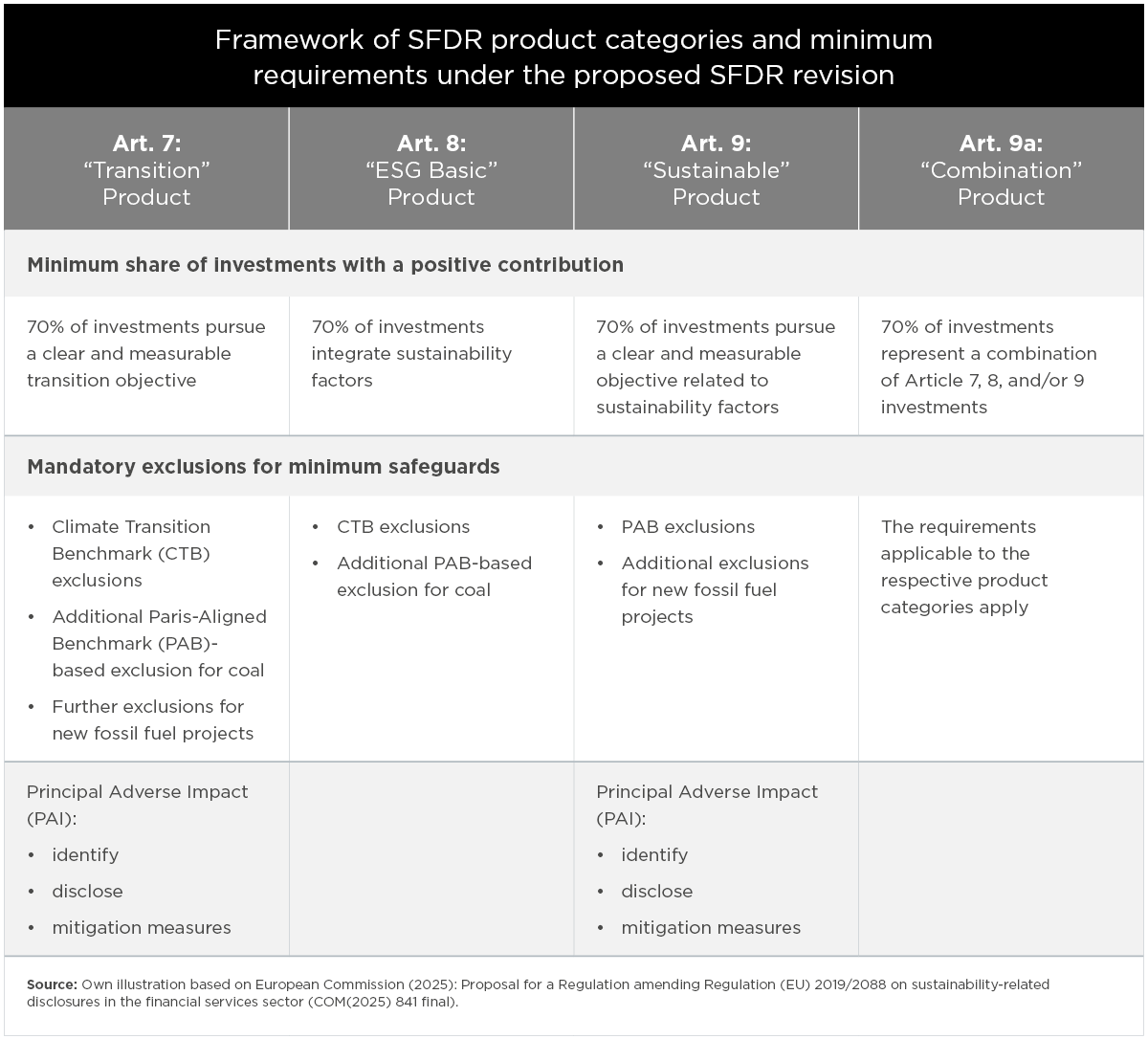
The proposed structure highlights the increasing standardisation of sustainability criteria across product categories, while simultaneously raising the bar for data availability, methodological consistency, and auditability. Data requirements and according challenges are further discussed in the chapter “Data, Methodology and Operational Readiness”.
Regulatory timeline and implementation outlook
The revision of the Sustainable Finance Disclosure Regulation follows a staged legislative process, reflecting the broader recalibration of the EU’s sustainable finance framework[MA3.1]. This agenda builds on the EU’s Strategy for Financing the Transition to a Sustainable Economy and is reflected in the Commission’s 2025 proposal to amend SFDR, which aims to address shortcomings in the current framework by making sustainability-related disclosures simpler, more efficient, and better aligned with market realities. After the initial adoption of SFDR in 2019 and its phased application through Level 1 and Level 2 requirements, the European Commission initiated a comprehensive review of the framework, including a public consultation in 2023 and the publication of its findings in 2024.1,2
While exact timelines remain subject to the legislative process, the sequence reflects current regulatory expectations.
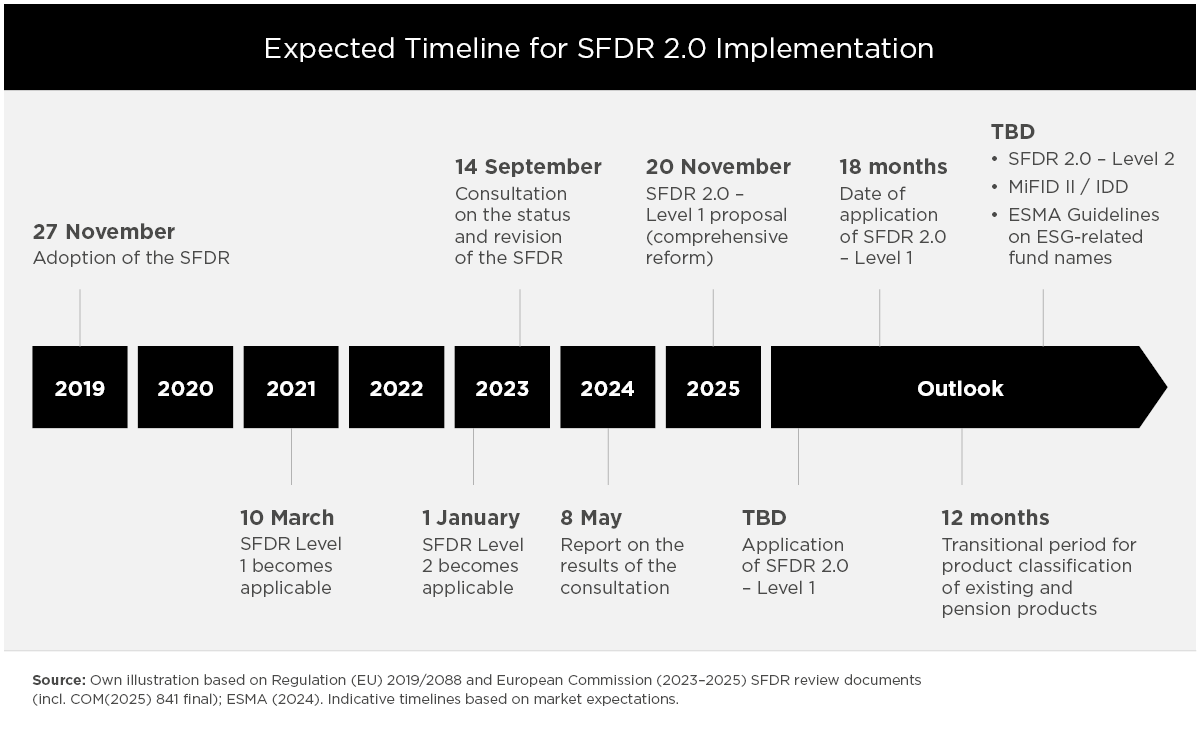
Current expectations suggest that SFDR 2.0 – Level 1 could become applicable approximately 18 months after its entry into force. [MA4.1]Given that the European Commission published its legislative proposal in November 2025 and the text remains subject to negotiation by the European Parliament and the Council, market observers currently view early to mid-2028 as the earliest plausible application window. This period represents the implementation window during which financial institutions would need to align their product frameworks, data infrastructures, and governance processes with the new requirements.
In addition, a dedicated transitional period is expected for specific product segments, particularly insurance and pension products. This transition phase, estimated at around 12 months, is intended to allow for the reclassification and adjustment of existing products under the revised product architecture.
The implementation of SFDR 2.0 will take place alongside parallel regulatory developments, including the integration of sustainability preferences under MiFID II and IDD as well as ESMA’s guidelines on ESG-related fund names, further increasing the complexity of the regulatory landscape.6 They also reflect a broader supervisory move towards simplification, consistency, and stronger investor protection. This is aligned with ESMA’s sustainable finance simplification approach, which seeks to reduce regulatory complexity, improve the usability of disclosures, and ensure that sustainability-related claims, product names, and client-facing information are more coherent across the EU framework.
The timeline below summarises the key regulatory milestones, distinguishing between legal effectiveness, application timelines, and transitional arrangements across product categories.
Data, methodology, and operational readiness
A defining feature of SFDR 2.0 is its reliance on robust ESG data and evidence-based validation.4 The framework increases the importance of quantitative thresholds, minimum investment shares, and auditability of sustainability claims.4
In this context, ESG data is evolving from a reporting input into a decision-relevant variable within investment and risk management processes.
ESG data challenges persist, including fragmentation, inconsistent methodologies, and gaps in biodiversity and social metrics.2 Institutions must therefore strengthen governance, traceability, and validation processes to define robust KPIs and KRIs and to ensure consistency in the data lineage.4
Implications for Asset Managers
SFDR 2.0 significantly impacts asset managers across product design, governance, and distribution.4 Product portfolios require reassessment, as existing classifications may not align with new criteria.4 Even before the final text is adopted, institutions can use the Commission proposal as a basis for a scenario-based portfolio assessment, testing how existing products would map to the emerging SFDR 2.0 architecture and where potential gaps may arise. Such an exercise can help identify products requiring repositioning, data remediation, revised exclusions, enhanced governance controls, or updates to client-facing documentation.
Governance frameworks must ensure consistency between sustainability objectives and investment practices.4 Distribution processes become more complex due to increased specificity of sustainability characteristics and MiFID II alignment.6 Taken together, these changes increase the need for end-to-end alignment across product design, portfolio management, risk, compliance, data, and distribution, effectively turning ESG from a disclosure and compliance topic into a core element of operating model design.
Conclusion
SFDR 2.0 signals a shift from disclosure to accountability. The regulation is expected to enhance comparability and restore investor confidence by linking product classification to measurable outcomes.1,4 However, increased complexity may drive consolidation and favour firms with advanced ESG capabilities.2 In this context, regulatory clarity may act as a catalyst for differentiation, rather than standardisation, across the asset management industry. Success will depend on translating regulatory requirements into robust product architectures supported by data, governance, and execution capabilities.4
How Capco can help?
As SFDR 2.0 transitions from regulatory proposal to implementation, financial institutions face a complex transformation across product strategy, data infrastructure, and governance frameworks. The challenge lies not only in interpreting regulatory requirements, but in operationalising them consistently across the organisation.
Capco supports asset managers and financial institutions in translating SFDR 2.0 into scalable and auditable operating models. This includes the redesign of product architectures, the integration of ESG data into investment and risk processes, and the alignment of governance frameworks with evolving regulatory expectations. Recent project successes include the development of semi-automated materiality heatmapping tools that can be used for CSRD materiality assessments or the implementation of systems to manage financed emissions, which can be used to create transition products.
By combining regulatory expertise with deep implementation capabilities, Capco helps clients move beyond compliance and establish sustainability as a measurable and decision-relevant component of financial performance.
References
2 European Commission (2024): Summary report of the public and targeted consultations on the implementation of the Sustainable Finance Disclosures Regulation (SFDR)
6 ESMA (2024): Guidelines on funds’ names using ESG or sustainability-related terms