

Hydrogen infrastructure investors face a familiar deadlock: nobody wants to commit first. This article argues that waiting for full demand certainty is not the safe option it appears to be, and sets out a five-question framework for deciding when to invest ahead of demand, when to stage commitments and when to hold back.
Europe's hydrogen challenge is no longer simply one of ambition. It is increasingly one of investment certainty. According to the International Energy Agency (IEA) Global Hydrogen Review 2026, more than 40,000 kilometers of hydrogen pipelines have been announced globally for 2035.1 Yet only 9% of this planned network is operational or backed by committed investment.
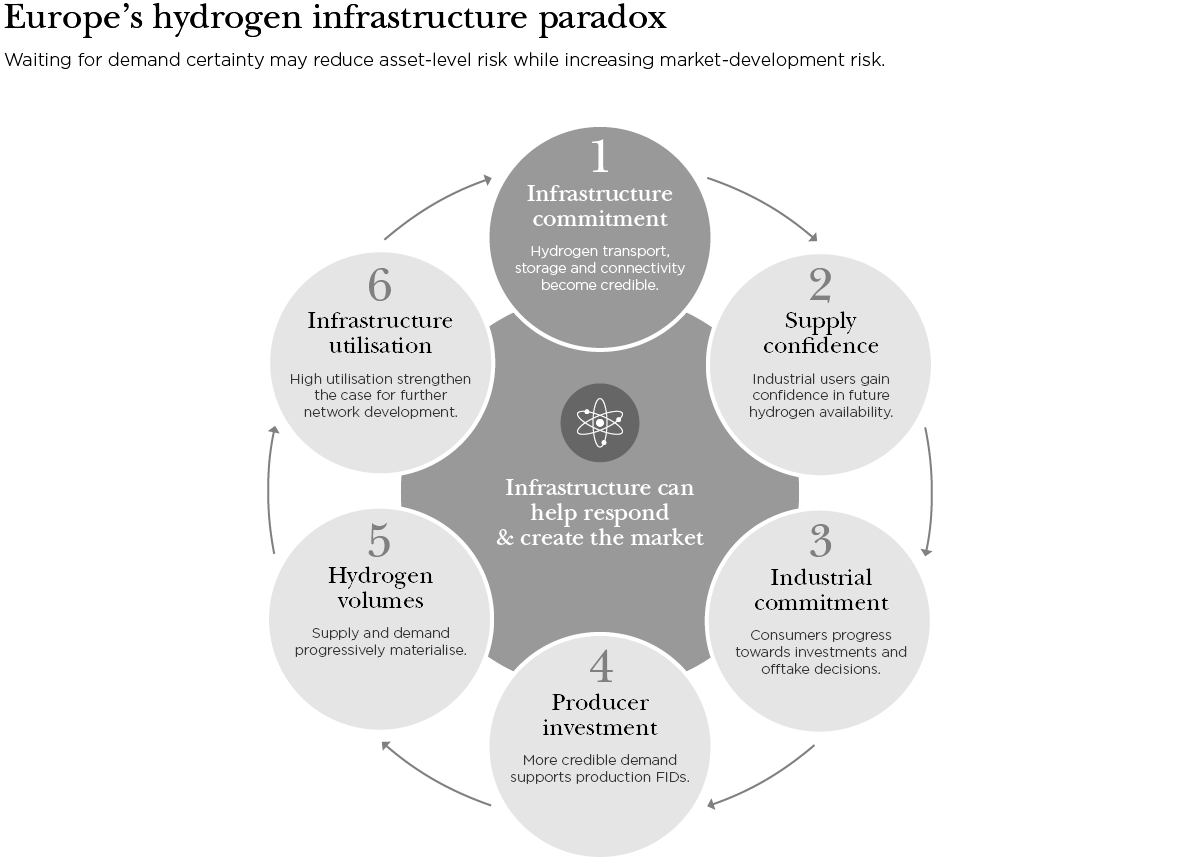
Behind this gap lies a fundamental market coordination problem:
- Industrial consumers need confidence in hydrogen availability before committing capital.
- Producers need credible offtake before reaching investment decisions.
- Infrastructure operators need visibility on future volumes before developing networks.
Everyone needs someone else to move first, and this is Europe's hydrogen infrastructure paradox: the demand required to justify infrastructure partly depends on that infrastructure being built.
Waiting for greater certainty can reduce individual investment exposure while simultaneously delaying the market development needed to create that certainty. Yet, building too early risks locking capital into underutilized assets. The strategic question is therefore not whether to build ahead of demand but which investments to advance, on what evidence and under what conditions.
Demand quality matters as much as demand quantity
Traditional infrastructure planning relies heavily on demand forecasts. In an emerging hydrogen market, projected volumes alone are insufficient. Demand derived from a long-term decarbonization scenario carries a fundamentally different investment signal from demand supported by industrial investment decisions, binding offtake agreements or firm capacity commitments.
Market interest is not the same as bankable demand. The European Commission's 2026 Hydrogen Mechanism illustrates this distinction.2 Its proposed infrastructure market-testing process allows operators to assess interest in planned pipelines and storage facilities through non-binding expressions of interest.
Such signals improve market visibility but do not eliminate commercial uncertainty. Infrastructure decisions therefore require a more sophisticated assessment of demand maturity, integrating expected volumes, timing, contractual commitments and dependencies across the hydrogen value chain. The same dependency chain shapes adjacent green molecules too: our analysis of e-natural gas shows production economics and funding timelines driving bankability in much the same way.3
Crucially, demand credibility must also reflect the economics of the underlying industrial transition. Infrastructure availability can unlock investment, but it cannot, on its own, make an uneconomic hydrogen application viable. For investors, the priority is shifting from forecasting potential demand to identifying demand capable of supporting investment decisions.
Different infrastructure roles require different investment thresholds
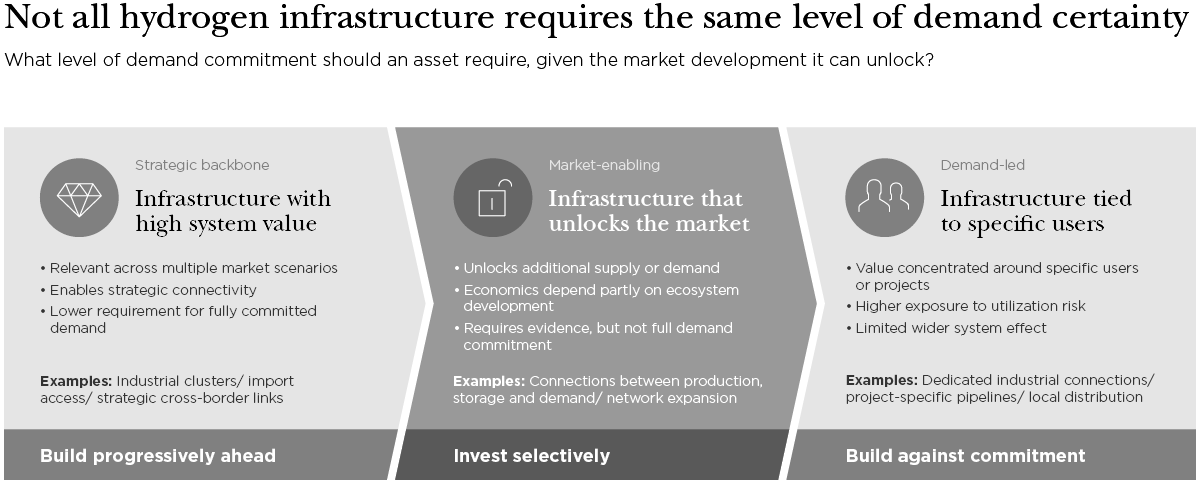
A uniform investment threshold is ill-suited to a market still taking shape. Hydrogen infrastructure can broadly be assessed through three investment archetypes:
- Strategic backbone infrastructure connects major industrial clusters, import facilities, storage and cross-border corridors. Where wider system benefits are demonstrable, these assets may justify development before all future volumes are contracted.
- Market-enabling infrastructure creates connectivity that could unlock additional production or consumption. Its initial utilization may understate its economic significance because the infrastructure itself can facilitate further investment across the ecosystem.
- Demand-led infrastructure serves more concentrated or project-specific requirements. Such assets typically warrant stronger customer commitments before capital is deployed.
These categories are investment lenses, not fixed classifications. An asset's strategic role does not remove the need for a robust business case. Rather, different infrastructure roles call for different investment thresholds, not different standards of investment discipline. The question changes from: ‘Is enough demand committed to justify this asset?’ to ‘What level of commitment should this asset require, given the wider market development it could unlock?’
Investment resilience should take precedence over forecasting precision
No single forecast will accurately capture Europe's future hydrogen system. Industrial demand, production economics, import routes and technology choices will evolve. Infrastructure portfolios must therefore remain economically resilient across several credible scenarios.
This gives strategic optionality tangible value: assets that can be developed in phases, expanded, interconnected or repurposed can reduce exposure to unexpected market developments. The same portfolio logic is now shaping how operators think about hybrid and SMR generation for AI data centers: no single technology but a mix built to perform across outcomes.4 That flexibility should be assessed as part of the investment case, alongside its additional cost, not treated merely as an engineering feature.
However, optionality does not eliminate underutilization risk, excessive risk born by infrastructure can constrain investment. Transferring too much cost to early users can undermine hydrogen competitiveness. Excessive public risk absorption can weaken investment discipline.
Risk must be managed, allocated and, where appropriate, distributed over time. Grid operators face a parallel calculus between resilience and cost, one we've set out in our paper on strengthening US grid reliability against climate change, energy transition and increasing costs.5
ACER's (EU Agency for the cooperation of energy regulators) 2025 recommendations on inter-temporal cost allocation recognize this challenge, proposing approaches to distribute infrastructure costs more fairly between early and future network users.6 The resulting investment strategy must balance three objectives: enabling market development, protecting capital and preserving affordability.
From market uncertainty to investment decisions
Addressing these challenges requires a more integrated investment framework.
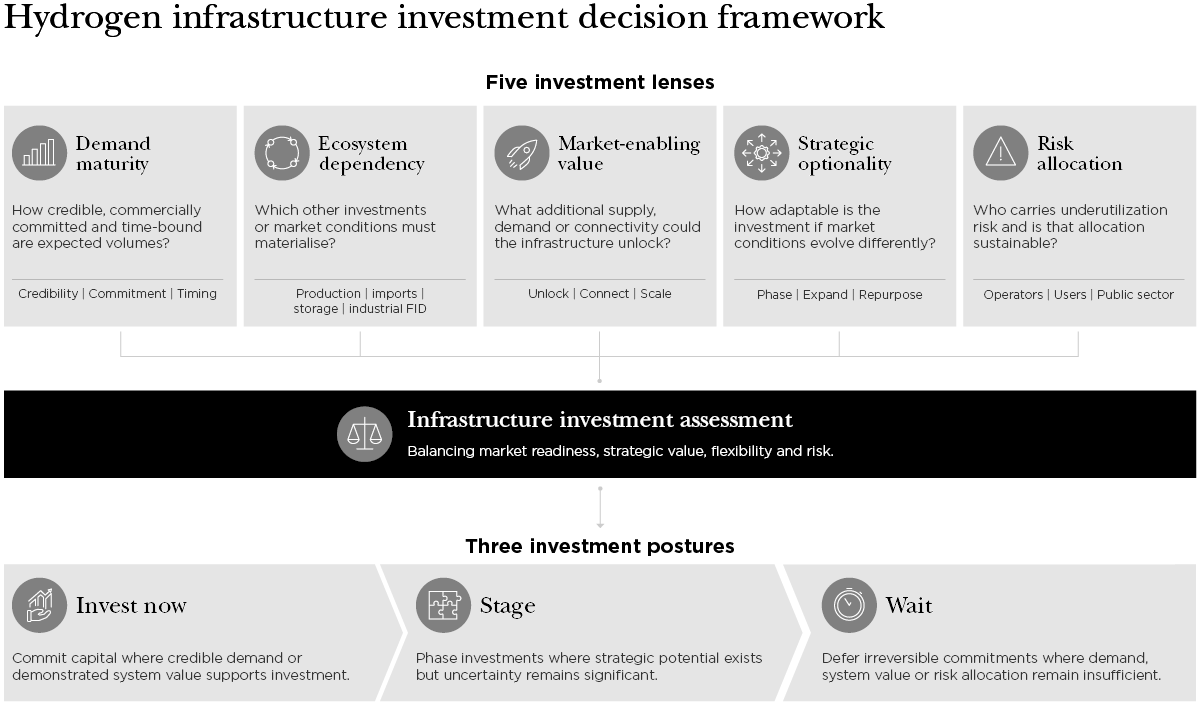
We believe five dimensions should systematically inform hydrogen infrastructure decisions:
- Demand maturity: how credible, commercially committed and time-bound are expected volumes?
- Ecosystem dependency: which production, industrial, storage or import investments must materialize?
- Market-enabling value: what additional supply, demand or connectivity could the infrastructure unlock?
- Strategic optionality: how adaptable is the investment if market conditions evolve differently?
- Risk allocation: who bears underutilization risk, and is that allocation economically sustainable?
Together, these dimensions support three investment postures:
- Invest now: where sufficiently credible demand or demonstrated system value supports an economically justified commitment, with dependencies and risks appropriately addressed.
- Stage: where strategic potential is significant but market commitments remain immature, preserving optionality through phased investment and defined decision milestones.
- Wait: where demand credibility, wider system value or risk-sharing arrangements remain insufficient to justify irreversible capital deployment.
Conclusion: build ahead of demand, not ahead of evidence
Europe cannot wait for a mature hydrogen market before developing the infrastructure that market requires. However, ambitious demand forecasts cannot justify investment regardless of economic reality.
The next phase will demand more than infrastructure planning. Operators will need to:
- Translate evolving market signals into investment priorities
- Align infrastructure development with commercial commitments
- Adapt market mechanisms as the hydrogen ecosystem matures.
Belgium's Commission for Electricity and Gas Regulation (CREG) 2026 hydrogen transmission market-model study, designed to accommodate evolving market and regulatory conditions, reflects this broader transition towards adaptable market structures.7 We believe connecting market intelligence, investment strategy, regulatory economics and operational transformation will be central to navigating that transition.
The organizations that lead Europe's hydrogen transition will not be those that forecast future demand most accurately. They will be those that build investment strategies resilient enough to succeed when those forecasts inevitably prove wrong.
This hydrogen framework extends a line of thinking we have applied elsewhere in the energy transition: to Europe's shift from predictable to weather-driven power grids, and to energy sovereignty and cyber resilience. Each asks the same underlying question in a different register: how do you commit capital and infrastructure to a system whose future you cannot fully forecast?
How Capco can help
Capco helps energy infrastructure operators translate imperfect market signals into disciplined investment and transformation decisions. By combining energy domain expertise with strategy, data, technology, regulatory and delivery capabilities, we support clients from assessment through execution. In hydrogen, this can include evaluating demand maturity and ecosystem dependencies, developing scenario-based investment roadmaps and decision gates, shaping commercial, regulatory and operating models, and establishing the data and governance foundations required as the market evolves. We do not replace engineering expertise; we connect investment strategy, market design and execution helping clients determine where to commit capital, where to stage investment and where to preserve optionality.
Frequently asked questions
References
1 https://www.iea.org/reports/global-hydrogen-review-2026/trade-and-infrastructure2 https://energy.ec.europa.eu/news/eu-hydrogen-mechanism-call-interest-test-hydrogen-infrastructure-2026-07-22_en
3 https://www.capco.com/intelligence/capco-intelligence/e-natural-gas-present-future-presence
4 https://www.capco.com/intelligence/capco-intelligence/the-rise-of-hybrid-and-smr-generation-for-ai-data-centers
5 https://www.capco.com/intelligence/capco-intelligence/strengthening-us-grid-reliability-against-climate-change
6 https://www.acer.europa.eu/news/acer-recommends-flexible-and-transparent-inter-temporal-cost-allocation-support-hydrogen-investments
7 https://www.creg.be/en/publications/study-f3104