
Regulation


European banking regulators are not simply refining the rulebook, they are progressively streamlining parts of the prudential, supervisory and reporting framework that have become fragmented, duplicative or operationally burdensome over time. This article maps the evolving European simplification landscape across the ECB and EBA initiatives, illustrating credit risk as a first applied case and highlighting practical implications for banks.
Nearly two decades of post-financial-crisis intensive regulation have strengthened the resilience of the European banking system but also led to duplication, fragmented reporting, overlapping supervisory processes and high operational costs for both banks and their regulators.
As such, European authorities are seeking to remove unnecessary complexity, sharpen proportionality and make the framework easier to operate for both supervisors and banks, while preserving prudential safeguards.
This intent is now taking shape as a coordinated set of initiatives pursued through different channels and at different levels of the European framework. These initiatives, mainly driven by the European Banking Association - EBA (review of the rulebook and its own regulatory products) and the European Central Bank - ECB (redesign of how supervision is executed in practice), will affect key elements such as capital, reporting, internal models and supervisory mechanism across the banking sector. Simplification and efficiency, not to be seen as a deregulatory agenda, will be embedded by design in the regulatory framework, rather than being addressed as isolated fixes.
Key takeaways
Several layers of simplification and efficiency are now visible within the European agenda that can be analyzed through four complementary clusters:
At the top sits a political and legislative layer represented most clearly by the ECB's High-Level Task Force (HLTF) on simplification. Created in March 2025 and endorsed by the Governing Council in December 2025, the HLTF examined sources of complexity in the European prudential, supervisory and reporting framework and formulated high-level recommendations on the capital stack, the treatment of smaller banks, the Single Rulebook, supervisory processes and the reporting framework. Its operationalization is explicitly linked to further work involving the European Commission, the EBA, the SRB (Single Resolution Board), the ESRB (European Systemic Risk Board), as well as the reporting-related initiatives already under way at the ECB, the EBA and the JBRC (Joint Bank Reporting Committee).
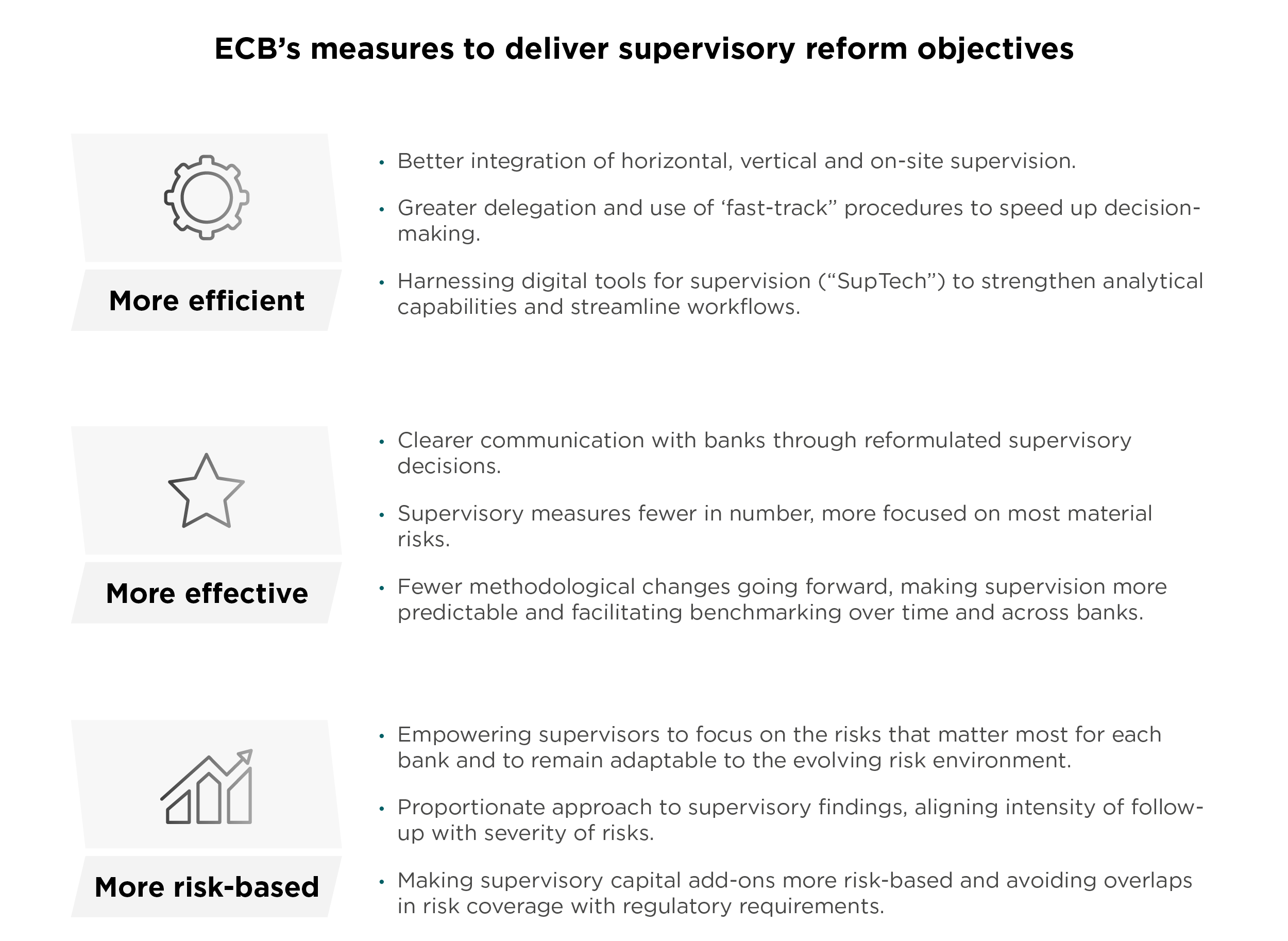
This second layer of operationalization mainly relies on the work undertaken by the ECB and the EBA. The former set out its supervisory agenda in its December 2025 publication ‘Streamlining supervision, safeguarding resilience’. This agenda addresses the functioning of supervision within the framework already in place (rather than redesigning the legal architecture of prudential regulation that would go through longer legislative timelines) and is organized around reform of the SREP (Supervisory Review and Evaluation Process), the next-level supervision projects (namely decision-making, internal models, stress testing, capital-related decisions, reporting and on-site inspections), supervisory culture and the measurement of supervisory effectiveness.
On the EBA side, the relevant starting point is the October 2025 Report on the Efficiency of the Regulatory and Supervisory Framework, which contains the 21 recommendations from the Task Force on the Efficiency (TFE), structuring them around key areas, such as Level 2 and Level 3 products, reporting requirements, the EBA's contribution to the prudential framework and internal working arrangements. This diagnosis has then been further translated, in the EBA 2026 Work Program, into a set of specific actions to be pursued and monitored over time.
Adjacent developments in the resolution framework and broader institutional governance extend the simplification agenda beyond the prudential core. Initiatives such as the Joint Bank Reporting Committee's work on common definitions and semantic standards aim to enable integrated reporting and facilitate the reuse of data across supervisory, statistical and resolution functions. While these efforts are less central than the core EBA and ECB initiatives, they should contribute to greater consistency and interoperability across the European regulatory architecture, reinforcing a shared trajectory towards simplification.
To make the simplification agenda easier to navigate, we have mapped the ECB HLTF recommendations against the EBA TFE recommendations and grouped them into four complementary clusters mentioned earlier. This presents a simplified view of the core ECB/EBA agenda.
We have also estimated the likely areas of impact for banks, providing a clearer view of where simplification may affect prudential architecture, reporting, supervisory interaction and operating models most directly.
Credit risk offers a useful illustration of the way these layers intersect. In February 2026, the EBA launched its consultation on the simplification and assessment of the credit risk framework as the first building-block review under the 2025 efficiency report.
The paper examines how the credit risk framework can be made more coherent and easier to navigate, exploring options affecting both the Standardized Approach and the IRB (Internal Ratings-Based) framework. In parallel, the ECB's supervisory reform agenda has already introduced a faster approach to certain material model changes in credit risk, moving in many cases from an ex-ante to an ex-post process from October 2026, subject to safeguards.
The two initiatives operate through different channels, but they address closely related sources of complexity. One concerns the design and organization of the framework itself while the other concerns the supervisory handling of that framework in practice.
The implications of the simplification agenda are likely to differ across the European banking landscape, particularly between large systemic institutions and other institutions.
For large institutions, the first effects are likely to be felt in the conduct of supervision itself, through a more focused SREP (Supervisory Review and Evaluation Process), faster treatment of certain model changes, more targeted stress testing and a clearer distinction between matters that require intensive supervisory review and those that can move through lighter processes. In parallel, the EBA's work on the Single Rulebook and on selected prudential building blocks (such as credit risk or capital stack) suggests that parts of the framework that have become difficult to navigate or costly to maintain may be simplified over time. That combination is likely to reduce some recurring frictions, while also raising expectations around internal consistency, governance and evidentiary readiness.
For non-significant and smaller institutions, the agenda is more closely associated with proportionality, integrated reporting and the prospect of a simpler prudential treatment in selected areas. Beyond lowering the reporting burden, it might result in a more stable framework, with fewer duplicative requests and a clearer alignment between the scale of requirements and the risk profile of the institution. At the same time, simplification may reduce the space for bespoke practices and may shift more institutions toward common definitions, standardized processes and shared data structures, paving the way for greater comparability and more disciplined execution.
For banks, a key implication is the need to manage simplification as an active transition rather than a narrow regulatory change. This requires coordinated mobilization across risk, finance, data, IT and regulatory affairs functions, as ECB and EBA initiatives simultaneously affect supervision, reporting, data and capital frameworks.
A first priority is to develop a structured view of the impact of the reforms. Banks should map the different simplification initiatives, assess their timelines and interdependencies, and translate them into forward-looking impacts on capital, operations and reporting. Scenario-based assessments can support key strategic choices, including the positioning between internal models and standardized approaches, while also informing contributions to ongoing consultations.
A second priority is to progressively align internal data and reporting capabilities with the direction of travel of the framework. As simplification initiatives aim to increase consistency, standardization and reuse, banks should focus on making prudential data more structured, auditable and interoperable across functions, supported by more integrated reporting architectures.
A third priority is to actively steer the transition. This includes reviewing the sustainability of existing frameworks (including model landscapes where relevant), prioritizing implementation efforts and establishing clear transition plans. Strong governance and coordination will be essential, with clear ownership, effective decision-making and proactive supervisory engagement to manage evolving expectations.
Further guidance and calibration are expected, and banks that approach simplification as a structured and forward-looking program will be better positioned to adapt while maintaining control over implementation.
Further Capco publications will expand on selected components of the simplification agenda, providing deeper analysis of key recommendations, including areas such as credit risk, and their practical implications for banks.
A simplification portfolio is difficult to manage through conventional regulatory monitoring alone, as it requires the coordination of several related regulatory streams, involving multiple owners and timelines. The key task is to translate a converged but dispersed European agenda into a coherent institutional response that links prudential interpretation, reporting architecture, supervisory readiness and transformation delivery.
Capco supports this through our regulatory intelligence and compliance capabilities, providing structured regulatory watch and early insight across ECB, EBA and other related initiatives. This enables banks to anticipate change and perform targeted regulatory impact analysis, assessing implications across capital, reporting, supervisory engagement and operating models. Building on this, we help institutions move from interpretation to execution by embedding a consistent regulatory compliance framework, aligned with supervisory expectations and internal governance.
Data is a central enabler of the simplification agenda, as evolving European requirements increasingly emphasize standardization, traceability and reuse. In this context, we leverage our data framework and architecture expertise to support the design of integrated data and reporting architectures that enhance data quality, strengthen lineage and ensure alignment with emerging regulatory expectations.
This combined approach allows Capco to support end-to-end transformations from regulatory insight to implementation, helping our clients simplify operations while maintaining control, compliance and strategic optionality.
References
To find out more about working with Capco and how we can help you overcome any potential challenges, contact our experts or subscribe for the latest insights below.

