

Digital assets began as retail-driven use cases and proof-of-concept applications for decentralized finance. As market infrastructure and regulatory clarity improve, financial institutions are shifting from experimentation and pilots to actively integrating digital assets into their core operations.
Digital assets are any type of digital or virtual instrument that holds economic value such as cryptocurrencies and tokenized securities. These assets are created, stored and exchanged using distributed ledger technologies like blockchain, enabling them to be bought, sold or transferred like traditional financial instruments.
Canada’s digital asset sector is expected to generate USD 81.6 billion by 2030.1 This growth trajectory has spurred the rise of digital asset service providers (DASPs): companies that create, trade or safeguard digital assets and related services, spanning exchanges, custodians, fintechs and asset managers.
As financial institutions express more interest and adoption grows year over year, an important question emerges for DASPs: How can they scale effectively to support institutional adoption while managing risks?
This paper maps out answers to this question. For firms looking to establish leadership in the market, we explore key opportunities arising from how regulation, technology and market infrastructure are about to converge. At this intersection, firms must not only identify the operational risks that could destabilize progress but also define the governance and operating models that enable them to scale effectively.
Canada’s digital asset market – from experimentation to regulated infrastructure
The next phase in Canada’s digital asset journey is being shaped by three forces: participation in the market by regulated institutions; technology and product innovation, and emerging regulatory clarity.
Institutional participation shifts from observation to controlled implementation
Canadian institutional participation is being driven by the need to modernize market infrastructure. Shortened settlement cycles and demand for 24/7 market access are prompting market participants to explore how digital assets such as tokenized assets and stablecoins can strengthen market efficiency and liquidity.
- Tokenized assets enable near-instant transfer of ownership, which aligns with shortened settlement cycles.
- Stablecoins can facilitate on-chain settlement which also support accelerated settlement and movement of collateral outside traditional banking hours.
There is a growing business imperative for integrating digital asset infrastructure within traditional markets. In March 2026, several organizations – the Ontario Securities Commission (OSC), Canadian Investment Regulatory Organization (CIRO), Royal Bank of Canada (RBC), TD Bank, Bank of Canada, and Export Development Canada (EDC) – successfully completed a bond issuance experiment on distributed ledger technology as part of Project Samara.2
EDC issued Canada’s first tokenized bonds using the Samara Platform, which is built on DLT infrastructure – in this case, using Hyperledger Fabric. The experiment was conducted to understand how DLT technology can improve bond issuance and full end-to-end lifecycle management. The results revealed potential benefits such as efficiency gains through automation, reduced reconciliation and T+0 settlement, while certain complexities around governance, decentralized architecture and integration signaled the need for further experimentation.3
The experiment has helped move the discussion from theoretical benefits to practical questions around operating model design, governance and integration with existing infrastructure.
Technology and product innovation
The adoption of distributed ledger technology (DLT) and smart contracts, potentially transforming financial market infrastructure, is anchored in three core capabilities:
- A unified, shared system of record across multiple stakeholders significantly reduces manual reconciliation and single points of failure. By replicating transaction data across multiple nodes, DLT enhances transparency, integrity and operational resilience.
- Embedded programmability and automation via smart contracts enable precise handling of complex financial operations such as corporate actions, collateral movements and dividend payments based on embedded rules, with minimal intervention and risk of error.
- Flexible custody and ownership models supported by DLT enable innovative asset ownership and control frameworks that can align with regulatory expectations while benefiting from decentralization.
In Canada, these capabilities are increasingly demonstrated in practical product and infrastructure developments, as the following two examples highlight:
1) In May 2026, Tetra Trust Company announced that CADD, a Canadian dollar backed stablecoin, received regulatory approval from the Alberta Treasury Board and Finance, representing a significant milestone by introducing a digital money instrument that can operate on blockchain rails under regulatory oversight.4 CADD is structured with asset protection in mind. Funds used for minting are kept in trust and exclusively held for redemption, helping to manage institutional expectations around transparency and compliance. The go-live in May followed significant testing efforts in late 2025 where CADD was able to successfully move between National Bank of Canada and Wealthsimple, validating this proof of concept.
2) In March 2026, BMO, in collaboration with CME Group and Google Cloud, announced a roadmap to launch tokenized cash and deposit capabilities to enable institutional settlement more easily and securely. The planned tokenized cash capability is expected to be available to mutual BMO and CME clients, offering institutional settlement for regulated FIs operating in capital markets and commercial banking to support margin funding and collateral movement (where traditional banking hours can create funding gaps).5 Launch of these capabilities is expected in the second half of 2026, subject to regulatory approval.
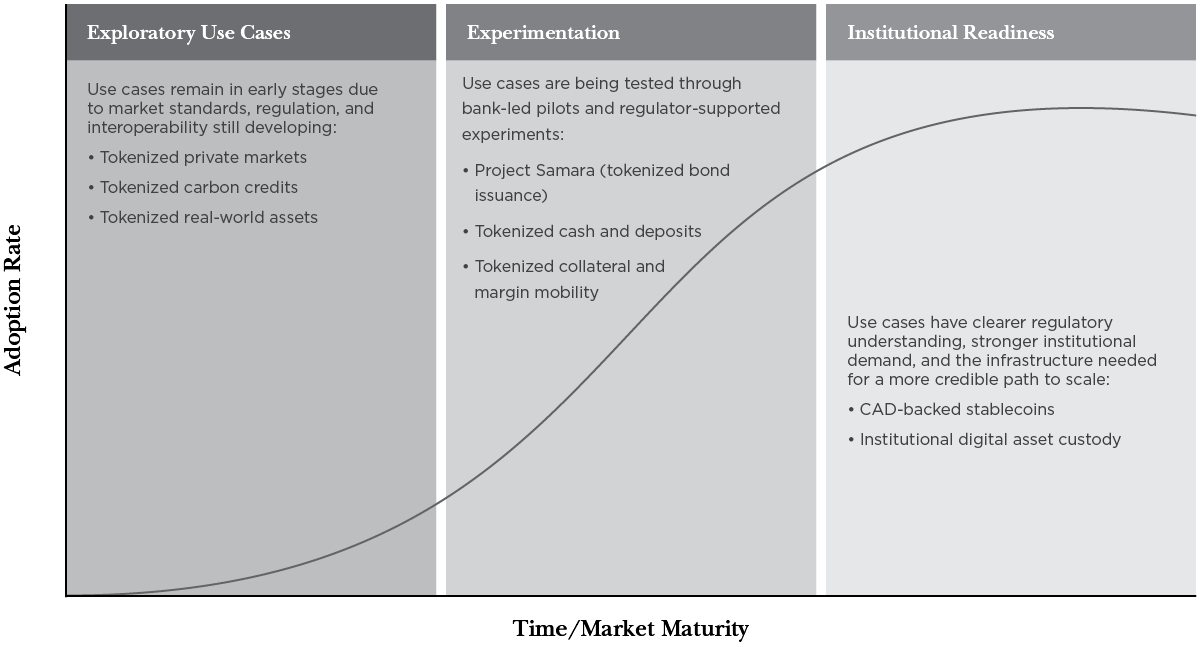
Canada’s digital asset maturity is not advancing uniformly across all use cases. As the above examples suggest, the most advanced activity is concentrated on use cases that augment existing regulated financial activity: bond issuance, settlement, money movement and institutional custody.
Digital asset maturity – from exploration to readiness
Emerging regulatory clarity
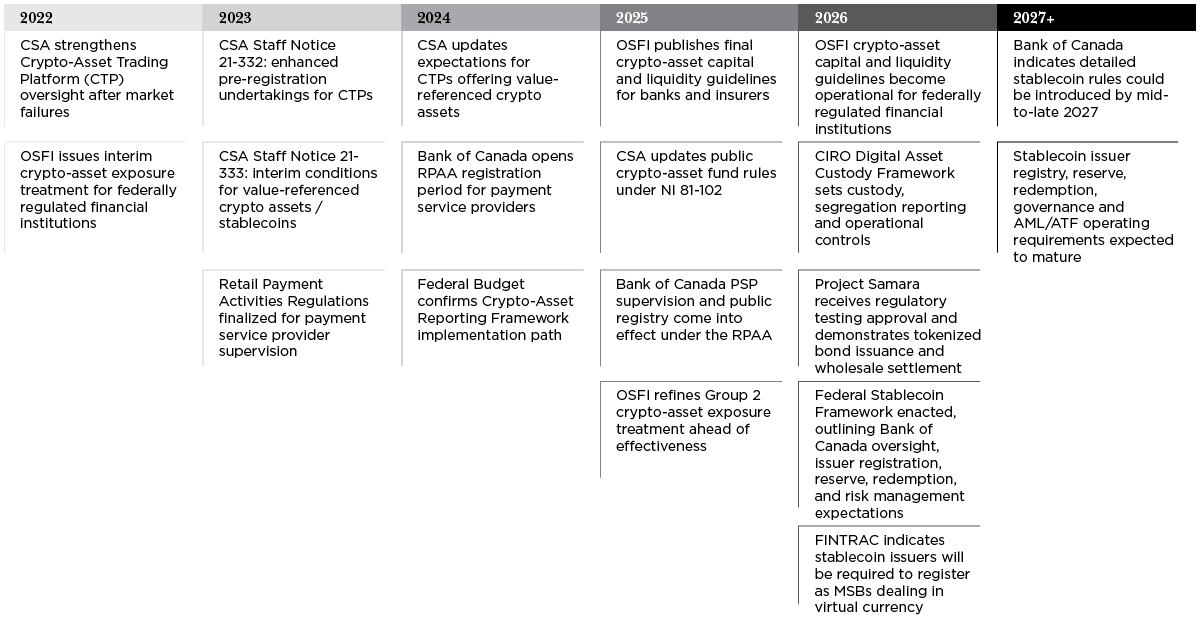
Over the last couple of years, regulatory activity around digital assets has significantly increased. Regulators are taking a technology-neutral stance when providing guidance, i.e. focusing on regulating the function and risk of an activity rather than the technology enabling it.
The figure below summarizes some of the key regulatory trends. The move to clarify expectations across a range of areas – e.g. crypto-asset trading platforms, custody, payments, AML and market infrastructure – signals that Canada is establishing conditions in which regulated institutions can participate in the digital assets market with greater confidence.
Recent regulatory activity around digital assets – highlights
From startup to scale: operational growing pains
When starting out, DASPs tend to be small, cross-functional teams that can prioritize market entry. This agile, start-up style model enables firms to bring minimum viable products (MVPs) to market quickly, capturing early adopters and responding flexibly to market sentiment.
As the pressure to scale increases, however, this start-up model tends to create barriers to adoption as financial institutions demand greater integration, clear separation of duties, robust control frameworks and auditable compliance processes.
- Fragmented infrastructure and processes. Early-stage platforms tend to consist of home-grown applications and bespoke tools that do not integrate seamlessly – and the diversity of architectures make integration challenges difficult to address.6 This might mean one system for custody, another for trading execution, and another for reporting, with no shared data definitions or standardization.
As auditability expectations grow, these gaps translate into risk. Reports are harder to produce reliably and quickly without discrepancies, inviting client dissatisfaction or regulatory scrutiny.7 Fragmented infrastructure also increases technical debt: each custom integration or bespoke solution carries future maintenance costs.
- Limited integration with traditional finance (TradFi) systems. In the early phase of digital asset development, platforms evolved as largely self-contained ecosystems, designed to prioritize speed to market and capture retail participation. Now that institutional adoption is accelerating, the ability to connect seamlessly with custodians, settlement networks and collateral management systems in TradFi has become a challenge.
The integration required is significant: settlement connectivity, interlocking with enterprise architecture and data models, and accurate tax and cost accounting, are a few of the many challenges. Without developing these integrations, DASPs risk further isolation from TradFi and slower mainstream adoption.
- Risk and compliance gaps. DASPs start with lean compliance functions that tend towards being reactive rather than proactive. This can lead to minimal KYC/AML screening, limited transaction monitoring, inadequate counterparty risk assessment and underdeveloped controls and incident management processes.
- Manual operations and limited automation. Processes such as reconciliation, client onboarding and reporting are often largely manual and may depend on spreadsheets, manual data transfers and custom scripts. Manual workflows cannot keep pace with institutional transaction volumes or audit expectations.
Scaling strategically: key considerations
DASPs – especially new players in the market – need to consider how they can scale while building a sustainable long-term business. This may include defining a fit-for-purpose Target Operating Model (TOM), building infrastructure that enables scale, and making strategic technology decisions.
Defining a fit-for-purpose Target Operating Model (TOM)
As firms evolve from start-ups into mature organizations, it becomes essential to define a Target Operating Model (TOM) that both supports their growth vision and preserves an innovative culture. Bridging high-level strategic intent and day-to-day operations, while offering a clear vision of the desired future state, a TOM should not be viewed as a rigid framework that stifles creativity, but rather as a dynamic structure that enables innovation through clarity, alignment and scalability.
For example, a DASP serving high-net-worth clients must evaluate its core business capabilities, such as customer service, product innovation and regulatory reporting. By assessing current processes, identifying areas for improvement and then defining an optimal target state, the organization can drive efficiency, consistency and scalability.
Organizational structure is equally critical. Clearly defined roles, responsibilities, governance frameworks and reporting lines ensure that the right talent is in place and that accountability is embedded throughout the organization. To manage the tension between maturity and agility, it is important to design operating models that introduce structured governance without compromising nimbleness and innovation in execution and decision-making.
Build infrastructure that enables scale
To scale effectively, DASPS should implement a flexible, microservices-based infrastructure using cloud-native technologies. This allows trading or custody systems to scale independently, ensuring ease of integration with emerging technologies including blockchain and AI.
Scalable infrastructure requires a strong data foundation, however. Centralized data lakes and real-time analytics will be needed to support regulatory reporting, client servicing, and risk management. Automating key workflows including KYC, trade reconciliation and compliance can help eliminate manual bottlenecks and support growth.
Scalability must go together with cybersecurity, regulatory agility and client-centric design, e.g. layered security, adaptive compliance frameworks and responsive client portals to deliver seamless experiences to many users.
Buy vs build: strategic tech decisions
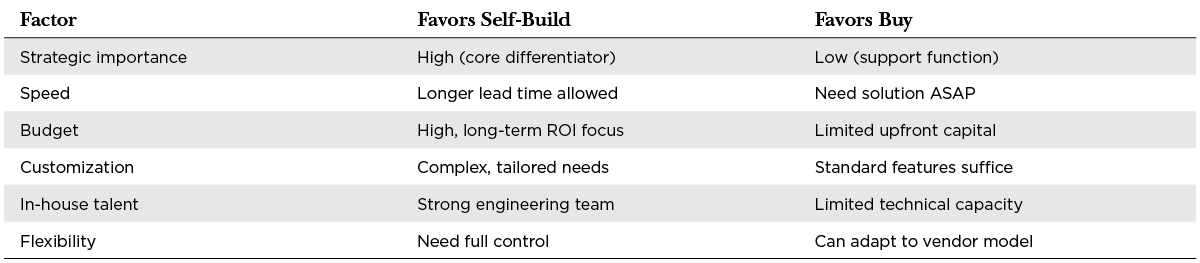
When making strategic technology decisions, DASPs must weigh the trade-offs between custom-built and vendor-sourced solutions, beyond a mere assessment of cost and functionality. This should include evaluating speed to market, level of customization, ongoing maintenance, compliance needs and integration requirements. Equally important is leveraging market expertise to assess solution options and navigate the vendor landscape effectively.
Custom-built solutions can be aligned with a firm's unique workflows, regulatory obligations, and strategic objectives. They enable full control over system architecture, user interface, data management and the long-term development roadmap – allowing firms to differentiate themselves through proprietary technology and to integrate deeply with emerging technologies such as blockchain or artificial intelligence.
However, custom solutions come with significant challenges such as substantial investment in infrastructure, development and specialized talent – and continuing internal support for maintenance, upgrades and security. Time to market is typically longer, with development cycles that can extend over several months. Moreover, poor early design choices can lead to technical debt, limiting the solution’s scalability and requiring costly re-architecting in the future.
Vendor solutions, typically pre-built, allow for faster time to market and minimal configuration to deploy. The lower upfront cost makes them appealing, especially for firms looking to avoid the complexity of building internal systems. Vendor support often includes regular updates, bug fixes, customer service and compliance features – reducing the need for a dedicated in-house maintenance team.
For all those benefits, vendor solutions may offer limited flexibility, fail to meet highly specific business requirements and lock DASPs into third-party pricing, feature roadmaps and integration capabilities. This can constrain long-term adaptability and make it difficult to tailor the solution as the business grows or regulatory conditions evolve.
The decision to build or buy should be grounded in the strategic importance of the capability in question. If the technology directly supports the firm’s competitive advantage, such as client experience or trading algorithms, a custom build may be warranted. If the functionality is more operational or supportive, such as payroll, accounting or regulatory reporting, vendor solutions can offer sufficient value without diverting internal resources.
For example, a DASP serving family offices and high-net-worth clients might choose to build a customized client portal and mobile app, since customer experience is core to its value proposition. At the same time, the firm may opt for a vendor solution for regulatory reporting and back-office functions, where standardization and compliance are more critical than differentiation.
The vendor market is also broad. As an example, for a specialized domain such as crypto accounting, there are over a dozen providers offering varying levels of functionality, integration capabilities, support models and pricing. To navigate this landscape, DASPs should consider partnering with experts who understand both the vendor ecosystem and the firm’s internal requirements. These advisors can guide vendor selection, assist with defining service level agreements, support contract negotiations, and ensure a smooth implementation process tailored to the organization’s needs.
Building the foundations for the next phase of digital finance
After a prolonged ramp-up followed by explosive growth, digital finance is no longer a nascent sector. It is beginning to establish a firm foothold within the broader financial landscape, particularly as greater regulatory clarity emerges.
As the industry transitions from pioneering innovation to professional execution, adopting a long-term perspective becomes essential. Operational maturity fosters trust among counterparties, regulators and clients alike. A clearly defined Target Operating Model and robust technology systems are not just internal tools, they are enablers of capital raises, mergers and acquisitions, and strategic partnerships.
Taking a long-term view helps DASPs scale without relying on reactive overhauls. It creates flexibility to onboard new asset classes, serve different client types, and expand into new jurisdictions swiftly and compliantly.
Strategic foresight across operating models, infrastructure, and technology will serve as a lasting source of competitive advantage. Ultimately, the organizations that invest in operational excellence today will be the leaders of tomorrow’s digital finance ecosystem.
References
1 https://www.cpaalberta.ca/Services/Online-Resource-Centre/Blockchain
2 https://www.bankofcanada.ca/2026/03/bank-canada-export-development-canada-rbc-td-successfully-complete-bond-issuance-experiment-distributed-ledger-technology/
3 https://www.bankofcanada.ca/wp-content/uploads/2026/03/sap2026-8.pdf
4 https://www.businesswire.com/news/home/20260504197679/en/Tetra-Digital-Group-Launches-CADD-Canadas-First-CAD-Backed-Stablecoin-Issued-by-a-Financial-Institution
5 https://newsroom.bmo.com/2026-03-24-BMO-Introduces-Tokenized-Cash-and-Deposit-Platform-with-CME-Group-and-Google-Cloud
6 1.-full-report-impact-of-dlt-in-cap-mkts-final-1.pdf
7 https://www.ciro.ca/newsroom/publications/notice-ciros-digital-asset-custody-framework
8 https://reports.weforum.org/docs/WEF_Asset_Tokenization_in_Financial_Markets_2025.pdf
9 https://www.millerthomson.com/en/insights/financial-services/crypto-assets-and-digital-finance-regulation-evolving-legal-landscape-for-banking-and-lending-in-canada/
10 https://www.osfi-bsif.gc.ca/en/guidance/guidance-library/capital-liquidity-treatment-crypto-asset-exposures-banking-guideline
11 https://www.finextra.com/blogposting/24941/blockchain-and-the-scalability-challenge-solving-the-blockchain-trilemma
12 https://www.researchgate.net/publication/384081094_Systemic_Risk_in_the_Digital_Assets_Ecosystem
13 https://www.sciencedirect.com/science/article/pii/S0148296324004910
14 https://www.imf.org/en/publications/wp/issues/2024/02/02/asap-a-conceptual-model-for-digital-asset-platforms-544387
15 https://www.iosco.org/library/pubdocs/pdf/IOSCOPD809.pdf
16 https://www.nasdaq.com/articles/fintech/tokenization-and-collateral-management-how-digital-assets-open-door-mobility-optimization