


In this article, Brent DeLeo offers a personal assessment of the challenges posed by legacy payment transformation initiatives, and how to establish a payments vision for future-proof innovation.
In my 30 years in the payments industry, I can’t count how many times I’ve been in the middle of “modernizing” – aka fixing – a payment process only to be called into a boss’ office to be told: “stop what you’re doing, it’s time to bolt on something new”.
The new shiny thing or the latest risk of becoming irrelevant in the market will always capture our attention. Yes, when it comes to the world of payments, we must stay at the forefront of technology and customer demand. However, we also need to be an industry of “and” not “or”, as we are now seeing what happens if we do not implement efficient and streamlined payment solutions.
After years of parallel and often highly siloed implementations of ACH, RTP, and Wires, financial institutions are carrying technical debt that until now has been manageable and funded. However, it is becoming clear that this legacy of redundant payment implementations – whether from separate portfolio builds or from separate sub-banks after mergers – has now come home to roost.
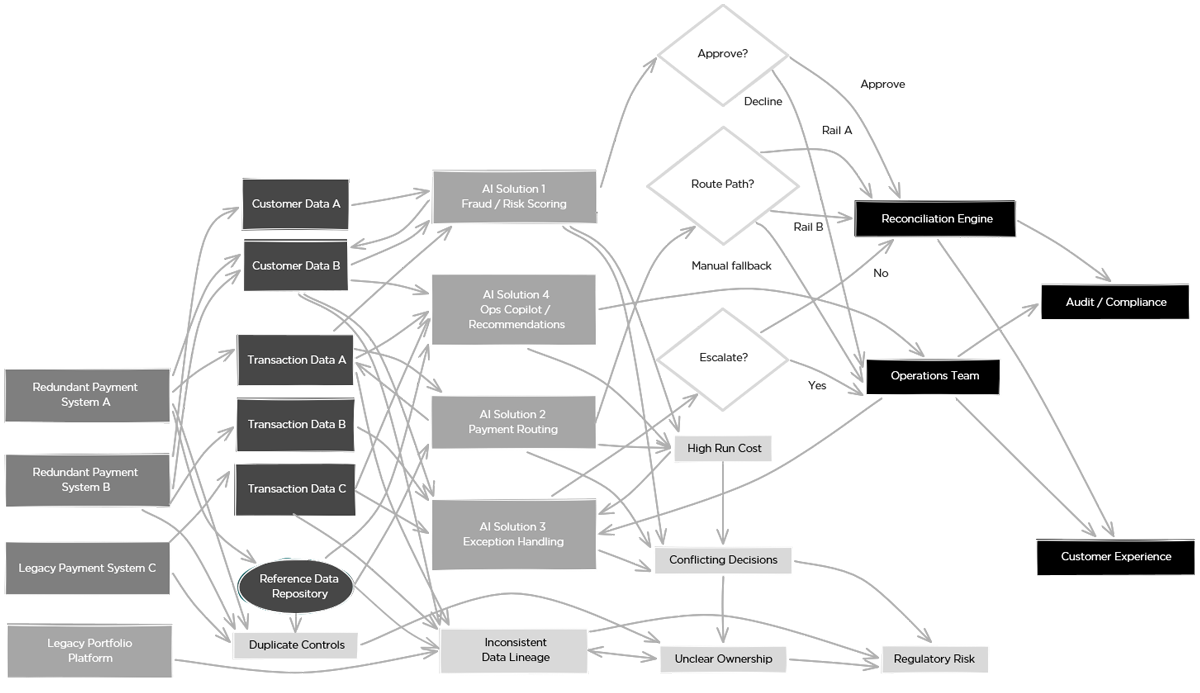
Why? Well, it’s a common story of advances in technology and volume. As new technology is introduced, we naturally find the fastest and cheapest way to introduce it, but not necessarily the most strategic approach. Regulators see the ‘spaghetti chart’ of payment solutions, customer confusion and ambiguous fee structures. They look to set boundaries, but these regulatory changes are more difficult than ever to implement across redundant systems.
Meanwhile, banks are feeling the cost burden of duplicative – yet slightly different – operations functions, back-office processes, and data structures. All while fielding calls to cut costs, implement AI efficiencies… and, oh yes, adopt stablecoin while you’re at it.
We must remember that redundant payment instances often mean redundant systems management, redundant operations, redundant fraud/risk screening, redundant AML/Sanctions screenings, redundant exception flows, redundant reconciliations and settlement, redundant regulatory changes, redundant business continuity plans – and now redundant AI solutions.
Sure, you may have solved some of these challenges already – but likely by bolting on a complex structure that brings in multiple data feeds and tries to harmonize these elements, over and over. Simply put, change remains expensive and cumbersome.
So, what to do? Anyone telling you to stop and fix your problems first isn’t living in the real world. Progress waits for no one. I’ll say it again, we need to be an industry of “and”, not “or”. What is essential is a solid, enterprise-specific – and crucially, achievable Payments Vision.
Figure out your surviving payment instances and set the course toward eliminating or drastically reducing redundancy. Focus on those elements that allow you to leapfrog forward, not just progress in tiny steps: core payment instances, operational consolidation, data structures, and customer experiences.
Then aggressively simplify your target state payment ecosystem with AI and future-ready operational solutions while simultaneously working towards migration to your target state.
The buzz phrase these days is ‘future-proofing’ and that’s a very accurate call to action. What happens when you buy another bank or portfolio in the future? Are you ready to truly integrate, consolidate, streamline and reap the full benefits around costs, efficiencies and risks?
There is no one-size-fits-all here. Every financial institution has its own fingerprint, its own personality and its own legacy. However, we all have the same goal – stay relevant, stay efficient, be purposeful, institutionalize knowledge and delivery the best customer solutions as we enable growth.
Get in touch
To find out more about working with Capco and how we can help you overcome any potential challenges, contact our experts or subscribe for the latest insights below.