
AI & RPA
Tokenomics
Falling token prices have not led to smaller AI bills. Tokenomics helps organizations uncover what is driving AI costs, optimize consumption and connect spend to measurable business outcomes.


AI is transforming how financial institutions accelerate innovation, but it comes at a price. In this article we explore Tokenomics – the economics of AI-enabled work – and how consumption, cost, outcomes and value interact as AI becomes embedded in enterprise work.
Historically, enterprise technology costs have largely been priced and structured in ways that are clear, measurable and traceable. Software licenses, for example, are well understood by technology teams and accepted by CFOs.
The first wave of enterprise AI was sold the same way. Buy the license at a fixed cost, give people access, encourage adoption and productivity would follow. The higher your level of activity, the more perceived value you extract from your license.
That story has now changed, with a rapid shift towards variable and consumption-based pricing – the more tokens you use, the more you pay – and many organizations have been caught off guard. (The FinOps Foundation defines a token as “typically represent[ing] a sub-word fragment, a character cluster, or a discretized segment of audio, image, or video data”.)1
There is an upside to this shift. Organizations do not necessarily need to make one large upfront vendor or platform commitment. They can access a wider range of models and services, experiment quickly and scale what works. This flexibility is one of AI’s great advantages, but it also means organizations need to understand and manage how consumption, cost and value change as usage scales.
The new economics of AI
Recent research suggests that achieving a given level of AI performance is becoming around five to ten times cheaper each year across areas including knowledge, reasoning, maths and software engineering. Yet cheaper intelligence does not automatically mean a lower AI bill, as many are rapidly discovering.
OpenAI's enterprise data shows weekly ChatGPT Enterprise messages increasing approximately eightfold. Average consumption of reasoning tokens – the cost of the hidden work the model undertakes to reach its final response – has increased per organization approximately 320-fold over a 12-month period.2
The direction of travel is clear: while the unit cost of intelligence has fallen, the volume of tokens that organizations consume has also risen rapidly – and their bills have reflected that upward trajectory. The budget impact can all too easily sneak up on them.
Uber has spoken publicly about maxxing out their entire 2026 AI coding tools budget in just four months after consumption far exceeded expectations when the firm instituted an internal usage leaderboard to boost employee adoption.3
It is not a matter of AI being ‘too expensive’. It means AI cannot be managed like a more traditional technology rollout, where the primary focus is simply on maximum access and adoption. Organizations need to understand how consumption, cost and value change as usage scales. For financial institutions, three questions increasingly matter:
1. What does AI actually cost us?
2. Are we spending wisely?
3. What does value mean in the context of our AI deployment?
Together, these questions are at the heart of Tokenomics.
Tokenomics is bigger than tokens
As the units that models use to process and generate information, tokens matter because they provide a way of understanding and pricing model consumption. However, enterprise Tokenomics needs to go further than that single number to connect across three levels (see Figure 1).
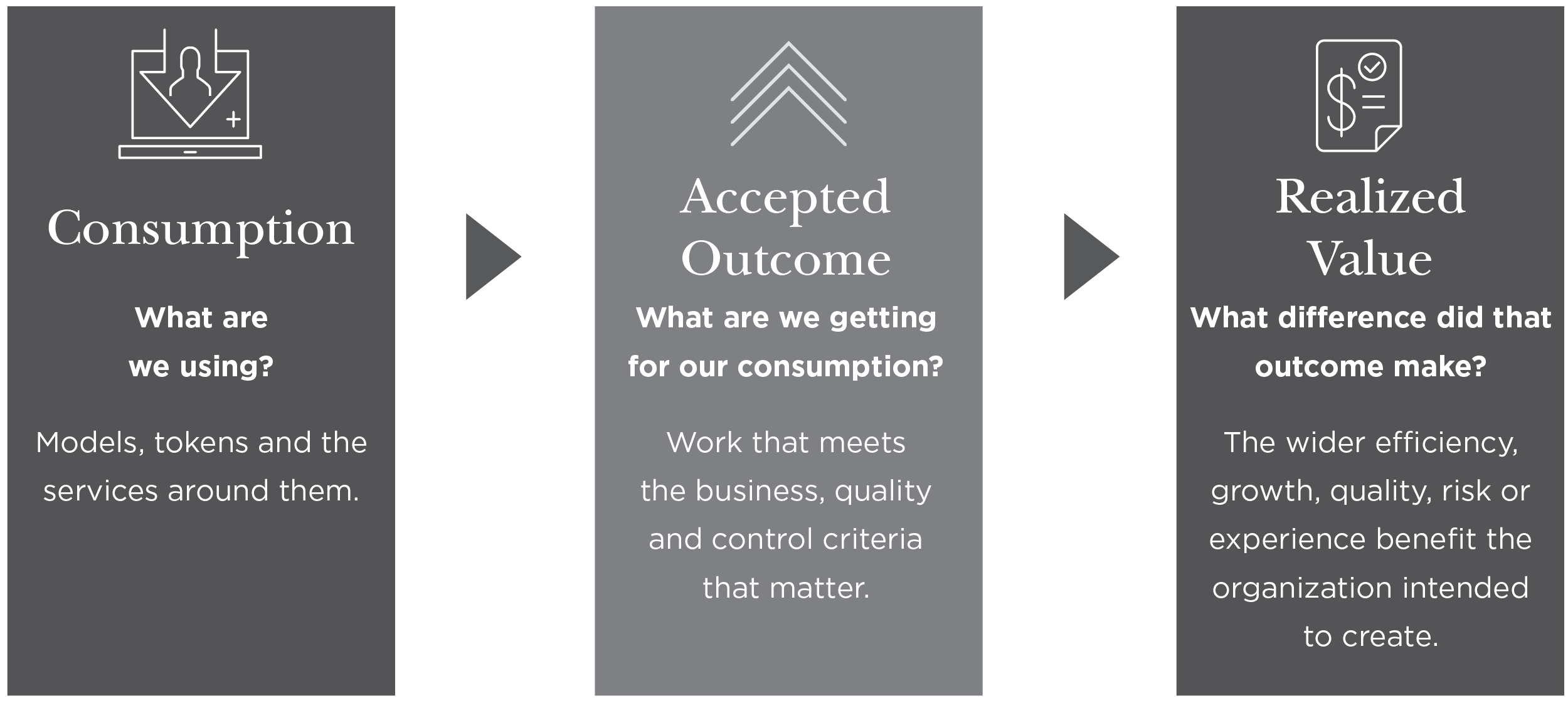
Right now, organizations face a more immediate challenge: understanding what rising AI consumption actually represents.
Adoption is easier to measure than value
Evidence of the rapid acceleration of AI adoption is everywhere. Active users, prompts, tokens consumed, licenses deployed, pilots launched and the use cases created are all relatively easy to count and can offer a reassuring impression of forward momentum.
However, they do not tell us whether cycle time has fallen, quality has improved, operational risk has reduced or meaningful capacity has actually been released.
Users are inclined to select the most powerful model because they assume it is the ‘best’. They may upload far more information than a task requires because more context feels ‘better’. They may continue conversations long after the context has become unwieldy or they repeatedly input poorly scoped requests and hope for a better outcome.
None of these choices looks particularly significant on its own. Across thousands of employees and millions of interactions, they compound. As AI consumption increases, organizations need to distinguish between:
If rising consumption cannot be separated into valuable and avoidable usage, the response can quickly become blunt limits, restricted model access or tighter budgets. Valuable usage risks being constrained alongside the waste those controls were intended to address.
Start with the problem, not the model
AI literacy increasingly needs to include economic literacy. The question should not be, “Where can we use more AI?” but rather, “Where can AI materially improve the economics or outcomes of work that matters?”.
A problem-first approach starts with the elements – decisions, hand-offs, controls, data and/or customer interactions – where cost, quality, speed or risk management are under pressure. It will then consider whether AI can materially change that work.
Sometimes the answer will be a more capable or smaller model. Sometimes it will be better data, process simplification, workflow automation or better use of technology the organization already owns.
Within financial services, that decision also needs to reflect the controls, evidence, oversight and risk requirements that dictate whether an outcome is in fact viable. It is not simply about whether AI can perform the task from a purely technical perspective.
Spending wisely is not the same as spending less
The most powerful model is not necessarily the right model for every task – but nor is the cheapest automatically the right answer either. This is where Tokenomics moves beyond the price of individual tokens towards the economics of the work itself.
One useful measure is cost per accepted outcome – connecting AI cost to work that meets defined business, quality and control criteria. We will explore how to calculate this, and why the cheapest model does not always produce the cheapest outcome, in the next article in this series.
The objective is not cheaper AI. It is better AI economics.
Cost is only half the equation. Was the investment worthwhile? AI value is not universal. For Operations it may mean capacity or lower cost-to-serve; for Risk & Compliance, greater accuracy or reduced risk; for the Front Office, better insight or increased client-facing capacity.
Cost can be calculated, value must be designed. There is no universal AI value equation. An organization first needs to decide what outcome it is trying to achieve – and how it will know whether that value has been realized.
Cost reduction is not value. A use case can become cheaper without becoming more valuable. Equally, spending more may be entirely justified if the outcome creates enough value in return.
That question deserves its own treatment and will be explored later in this series.
From managing AI adoption to managing AI economics
Tokenomics should not become another exercise in reducing technology spend. As AI penetrates deeper into financial institutions, organizations need to focus on three imperatives:
The objective is not to make AI as cheap as possible or to limit consumption. It is to understand enough about its economics to make informed decisions about where to invest, what to scale and where to intervene.
The winners in the next chapter of enterprise AI will not necessarily be the firms that consume the most tokens or the least. They will be the firms that understand where and when that consumption is worth paying for.
References
1 https://www.finops.org/insights/token-economics-the-atomic-unit-of-ai-value/
2 https://openai.com/business/guides-and-resources/the-state-of-enterprise-ai-2025-report/