

Hong Kong's insurers wrote HK$827 billion in gross premiums in 2025, up 29.7% on the year, according to the Insurance Authority.1 The first quarter of 2026 continued that momentum – HK$291.6 billion, a rise of 32.3%.2 Growth on that scale is forgiving. It absorbs duplicated platforms, competing change portfolios and operating models that were never designed to work as one.
When the top line moves 30%, nobody audits the cost of complexity. Look around the region and the cushion disappears, however. LIA Singapore reported S$6.53 billion in total weighted new business premiums for 2025, up 11.3%.3 Thailand's Office of Insurance Commission put total direct premium at THB969.1 billion, up 3.15% overall with life at 3.51% and non-life at 2.33%.4
In Malaysia the pressure is not on growth at all but on margin: LIAM told the Public Accounts Committee that medical inflation ran at an average of 16.1% a year between 2021 and 2023 against industry profit margins of roughly 10%.5
Four markets, in many cases comprising the same insurers, but different experiences of the same underlying dynamic. While these markets are cited as examples, these issues effect all country operations. Where growth is strong, fragmentation is affordable and therefore invisible. Where growth has flattened, fragmentation is the first thing to appear in the expense ratio. Hong Kong is not exempt from the problem. It is early in it.
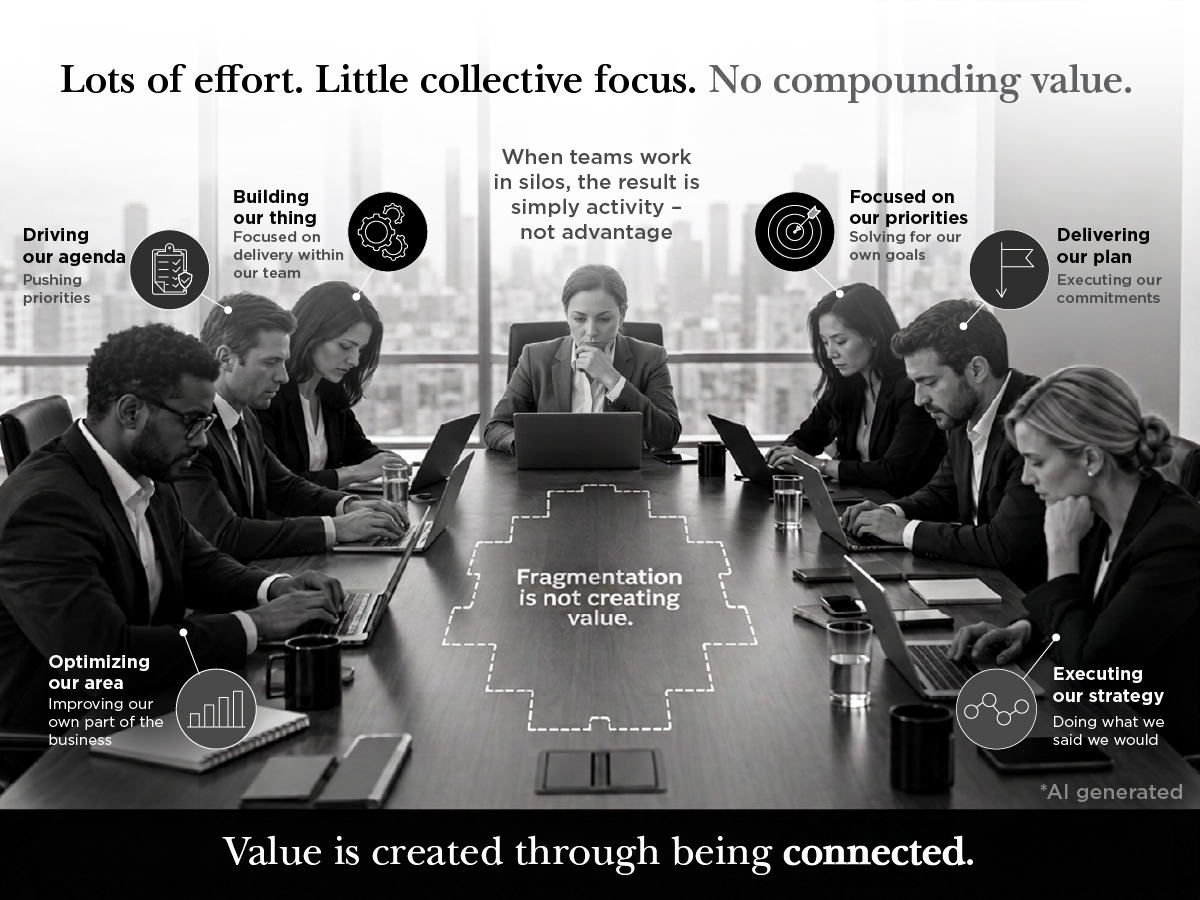
Four teams, four scorecards
Ask an insurer in this region who owns the customer and you will get four answers, all of them sincere.
The customer team is measured on engagement, retention and advocacy. The digital team on platforms delivered, adoption and app performance. Operations on service levels, cost per policy, productivity and operational risk. Technology on availability, incident volume and the cost of run – keeping the lights on and doing so cheaply.
Every one of those objectives is legitimate. Every one is achievable without the others. And not one of them is the outcome the business actually sells: a customer who buys, stays, claims and is paid out without having to explain themselves three times.
Consider a football club run on the same basis. The striker is paid on goals. The keeper on clean sheets. Nobody is paid for the pass that made the goal possible, because the pass appears on no one's scorecard. The Club will tell you they have a strategy, as will the Manager and the coaching staff, what it has is four strategies sharing one stadium. Is the communication to the players consistent to enable them to seamlessly execute as a team?
Competing priorities
The change portfolio is the arena where those four strategies and scorecards meet, and there is no referee in sight.
Each function arrives with a business case that is individually sound. The portfolio ends up weighed down by more initiatives than the organisation can deliver – more than the architecture can absorb, more than employees can staff. Sequencing becomes negotiation, and negotiation is won by whoever has the strongest sponsor rather than the strongest case.
Scope is then protected as scope is always protected: by cutting the connective work first. The integration. The data alignment. The process that spans two functions and belongs to neither. In short, precisely the work that would have made the initiatives add up to something.
The end result is four programmes that each meet their own success criteria but collectively move very little and whose benefits are seemingly impossible to identify.
The cost of fragmentation
The level of spend is not in question. Gartner forecasts global insurance IT spending of $256.8 billion in 2026, up 9.4% year on year on a curve that has been rising for a decade. 6
The return is another matter. Capgemini's World P&C Insurance Report 2026 found that only around one insurer in 10 has scaled artificial intelligence beyond pilots – and that 42% track no AI metrics at all. 7 Read that second figure again. Almost half the industry is investing in the most consequential technology in a generation without any means of knowing whether it works and is creating or destroying value.
AI represents a totally different way to build, infuse and amplify capabilities and outcomes to create value in organisations. Yet operating models in organisations remain unchanged. That is not a technology failure. It is misalignment and a measurement failure, and both are functions of the operating model. When a capability is commissioned inside a silo, it is measured inside that silo or not measured at all – leading to frustration for CFOs looking to identify or articulate the value created.
This is sharply illustrated in Malaysia, where LIAM's own data puts the average annual increase in medical claims at 14.34% over seven years, with a spike of 33.7% in 2022. 8 This was driven, according to the Association, mostly by volume rather than by the cost of care. Volume is the interesting word here. Underwriting sets the risk appetite. Product designs the benefit. Distribution sells it. Claims pays it. Provider management negotiates the network. Five functions, five levers, one number – yet no single owner of that number.
The prize for getting it right is far from modest. The same report associates the leading group with up to 21% higher revenue growth and roughly 51% greater share price appreciation over three years. 9
Why fragmentation never surfaces…
There are two reasons, one on each side of the executive table.
For the CFO, transformation is not a line item. Change spend is capitalised, distributed across functional budgets or absorbed into run cost. The management accounts show expense ratio, combined ratio, new business value. They do not show the cost of building the same customer view three times or reconciling between systems that were individually delivered on time and on budget. You cannot manage what the P&L is not constructed to display.
For the CEO, fragmentation is nobody's KPI. Most executives can hit their objectives in a year even when the enterprise outcome does not improve. Failure is collective but collective failure is attributable to no one.
This is why fragmentation persists. Not incompetence – close to the opposite in fact. Fragmentation is most stubbornly embedded in organisations where every individual is performing well against the objectives they were set.
…why it repeats
Legacy is often singled out as a problem, but it is more a symptom than the cause. Each siloed transformation programme leaves behind a system optimised against one function's scorecard but not another’s – a digital front end that does not write cleanly to policy administration, a claims workflow blind to servicing history, a data platform built to satisfy one team's reporting.
Those overseeing the next programme then find the estate too tangled to work across effectively, which becomes the justification for another contained, single-function build. The constraint drives the behaviour that reinforces the constraint. That is the loop, and the reason the conversation in board rooms across Hong Kong, Singapore, Bangkok and Kuala Lumpur sounds the same as it did five years ago.
Insurers in this region are not failing to modernise. They are modernising repeatedly, only in fragments – and paying for it each time.
The question worth asking
Every insurer in these four markets knows its estate is fragmented, and most already have a programme running trying to address it. Will that programme will be scoped by one function, funded from one budget and measured against one set of KPIs – exactly how the previous items were scoped?
The bigger question is not what to modernize next. It is determining what needs to be true for our teams to be incentivized for the same outcome, and how to align that outcome with the very people who determine growth – customers.
That is where a connected operating model begins, and the subject of the next article in this series.
References
1 https://www.ia.org.hk/en/infocenter/press_releases/20260424.html
2 https://insuranceasia.com/insurance/in-focus/hong-kong-insurance-premiums-jump-323-38b-in-q1-2026
3 https://www.insurancebusinessmag.com/asia/news/life-insurance/singapore-life-insurance-sees-11-growth-565052.aspx
4 https://en.moneyandbanking.co.th/2025/216005/
5 https://www.insurancebusinessmag.com/asia/news/life-insurance/malaysias-insurers-and-hospitals-caught-in-a-costshifting-cycle-580331.aspx
6 https://www.gartner.com/en/documents/7112630
7 https://www.capgemini.com/ca-en/insights/research-library/world-property-and-casualty-insurance-report/
8 https://codeblue.galencentre.org/2025/06/liam-ceo-claims-medical-insurance-portfolio-loss-making-despite-overall-profits/
9 https://www.capgemini.com/in-en/insights/research-library/world-property-and-casualty-insurance-report/