

Financial literacy has a vital role to play in reducing wealth inequality and improving financial wellbeing, with AI emerging as a powerful enabler. We explore how agentic AI moves beyond simple question answering to help individuals turn financial understanding into action, offering five key use cases for the defined contribution (DC) retirement industry.
The United States faces a growing income and wealth inequality gap. In 1963, the wealthiest US families had 36 times the wealth of families in the middle of the wealth distribution – in 2022, the disparity was 71 times.1 Addressing this gap requires concerted bi-partisan efforts, which may be currently challenging to initiate.
While policy solutions remain essential, technological innovation can play a role in addressing wealth inequality. Artificial intelligence has quickly evolved from an emerging technology to a practical tool capable of supporting decision-making, personalizing experiences, and automating complex tasks – including those around financial education, the focus of this article.
Financial education is positively associated with individuals’ financial wellbeing: research shows that greater financial literacy supports better financial decisions around borrowing and retirement planning.2 During the 2008 financial crisis subprime borrowers with lower numerical ability were more likely to default on their loans.3
The broader consequences of financial literacy
The benefits of an individual’s financial well-being extend beyond wealth accumulation. Studies have linked a person’s state of financial well-being to their mental and physical health in areas such as depression and coronary heart disease risk.4 Other studies have found that financial management behaviors can impact the quality of couples’ relationships.5
Research shows that lower debt literacy may be linked to high-cost borrowing, higher fees, and over-indebtedness.6 Though these outcomes start at an individual household level, when aggregated across millions of households, a broader pattern of financial insecurity and inequality emerges.
Financial knowledge and preparedness may account for approximately 30-40% of retirement wealth inequality, demonstrating that financial literacy is not merely an individual benefit but a crucial factor in shaping broader patterns of financial accumulation.7
The need for personalized financial education
Although the benefits of financial literacy are well established and there is a widespread demand for financial education, a significant gap in knowledge persists. Traditional financial education programs often adopt a one-size-fits-all approach, failing to account for differences in individual circumstances, learning preferences, risk tolerance and prior knowledge.
At the same time, Americans are expected to navigate an increasingly complex financial landscape. Over recent decades, responsibility for financial decision-making has increasingly shifted from institutions to individuals, raising the importance of financial literacy as a public concern.
Individuals must make consequential decisions regarding retirement savings, debt management, insurance, tax planning, and an expanding range of investment opportunities, including emerging digital assets like cryptocurrency. Unlike previous generations, many workers can no longer rely on employer-sponsored defined benefit pension plans to provide retirement security, placing greater responsibility on individuals to manage their own long-term financial futures through defined contribution plans and personal investments.
Additionally, concerns about the long-term solvency of the Social Security Trust Fund have heightened uncertainty surrounding retirement income. Together, these factors underscore the growing need for accessible, personalized financial education that equips individuals to make informed financial decisions throughout their lives.
Applying AI for defined contribution plans
Given the breadth of the financial services industry, this paper focuses on practical applications of AI-driven financial literacy for the defined contribution (DC) retirement plan market. Employer-sponsored DC plans such as 401(k), pensions and similar retirement vehicles represent one of the largest pools of investable assets in the US. There are approximately $14 trillion in assets under management (AUM) as of the end of 2025.8 For millions of Americans, these plans constitute their primary, and often only, exposure to long-term investing.9
Participation in retirement plans provides one of the most accessible pathways to building long-term wealth. For example, the historical average return of the S&P 500 over the past 80 years is around 7%.10 This combination of widespread participation and financial decision-making makes the DC ecosystem an ideal environment in which AI can be applied to expand access to personalized financial education and ultimately help narrow wealth disparities.
Traditional approaches to financial education, such as static educational materials and one-on-one advising, are often resource-intensive, difficult to tailor to individual needs, and inaccessible to many participants when financial decisions must be made. AI has the potential to overcome these limitations by analyzing large volumes of information, adapting educational content to an individual's circumstances, and providing timely, on-demand support.
Rather than replacing financial professionals, AI can complement their expertise by handling routine educational interactions, enabling advisors to dedicate more time to complex planning and personalized guidance. As AI capabilities continue to evolve, financial institutions and retirement plan providers have an opportunity to make financial education more accessible, responsive and effective for a broader population of participants.
Frontier AI Is reshaping financial decision-making
AI is already changing how individuals learn about and make financial decisions. Consumers are increasingly using AI assistants to research financial products, while brokerage platforms are beginning to integrate AI agents with the ability to execute investment decisions.11 FINRA's National Financial Capability Study also found that one in five US adults are interested in receiving financial advice from AI.12
As AI makes financial information and investing more accessible, trusted financial education becomes increasingly important to ensure participants make informed, long-term financial decisions rather than relying on generic or unsuitable recommendations.
Transforming financial literacy with agentic AI
Until recently, AI applications mostly helped organizations analyze, predict, or generate content. These systems typically operated on one task, depending on people to gather context, prompt, make decisions, and carry out actions across enterprise systems.
Agentic AI shifts that model by combining reasoning, memory, enterprise knowledge access, and system integrations (tools) to decide, coordinate, and interact with business workflows under human oversight and defined guardrails. Applied to financial literacy, this means AI can move beyond simple question answering to deliver more contextual and actionable support that helps individuals turn their new understandings into action.
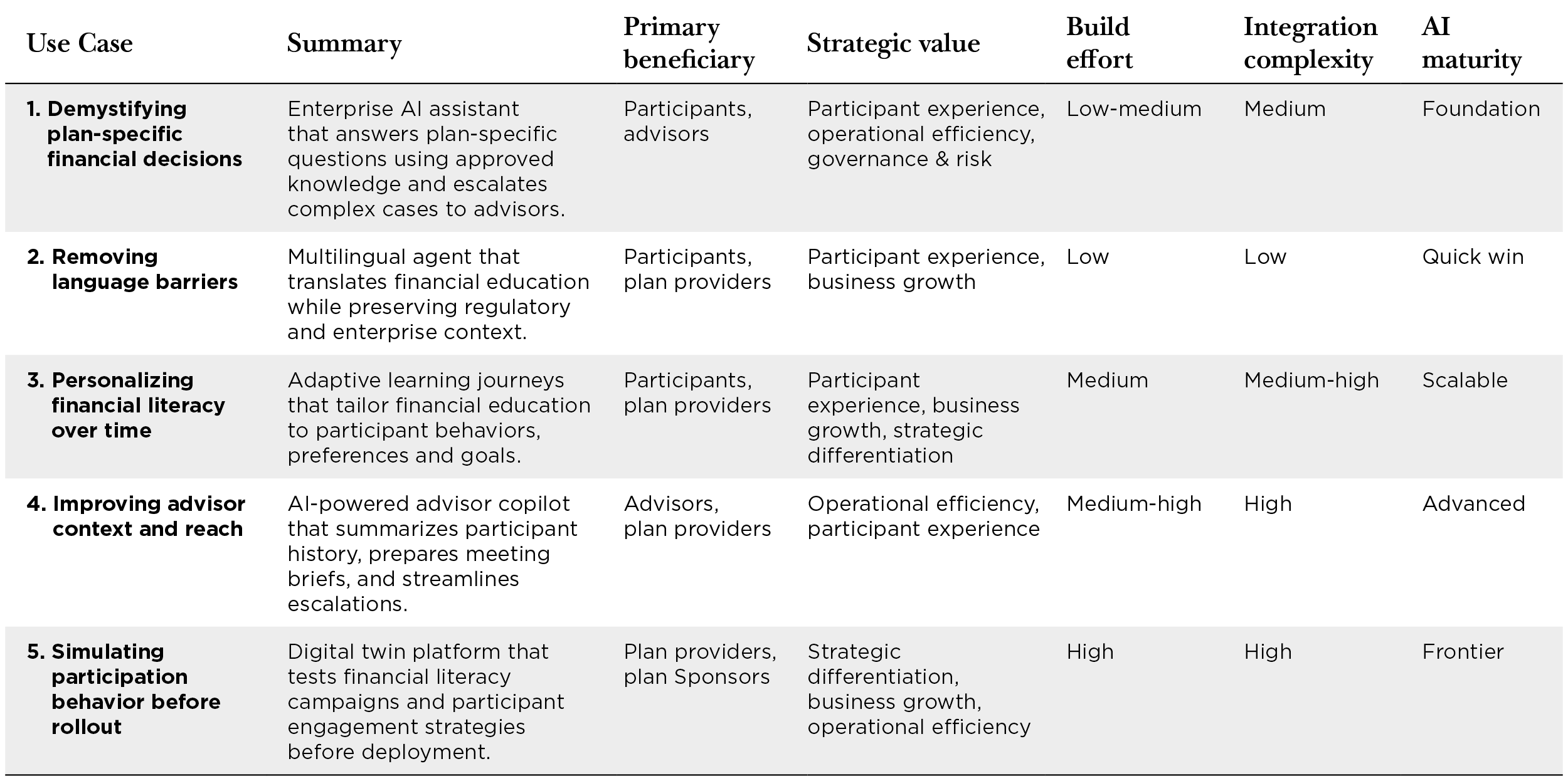
The illustrative use cases below explore the progression from quick wins to complex, high-value systems; all the names used are fictional.
Use case 1: Demystifying plan-specific financial decisions
Late in the evening, Jake opens his company’s 401(k) portal and asks, “How does ‘employer match’ work in my plan?” The assistant pulls from approved plan documents, FAQs, disclosures, and educational materials to explain how the employer matches the contributions that Jake makes, with simple analogies to explain the match structure and calculations to show how he may be missing out on additional money.
More nuanced questions, and those that come close to offering regulated financial advice, are escalated to a human financial advisor when needed. With AI freeing up advisors from repetitive, surface-level questions, they can focus attention on deeper advice where their experience shines.
This foundational solution is a quick win because it creates a governed intelligence layer that can provide consistent support to both participants and advisors and serves as a starting point for broader agentic capabilities. According to Vanguard’s 2025 paper on investment advice, 73% of participants in an industry survey say they’d like some form of personalized guidance to help them manage their money.13 Vanguard goes on to note that advice helps participants define savings goals, make better financial decisions, and stay on course through behavioral coaching.
Use case 2: Removing language barriers
At lunch, Maria opens a notification from her company’s 401(k) app and sees a message in conversational Spanish explaining that she may be missing out by not taking best advantage of her ‘employer match’. When explaining investment concepts, the system responds with simple explanations that feel culturally and contextually familiar, while staying grounded in her employer’s relevant approved educational materials and disclosures.
According to recent US Census Bureau data, nearly 68 million people in the US speak a language other than English at home, making multilingual communication an increasingly important consideration for employers serving diverse workforces.14
As Maria’s confidence builds, the AI begins to include more technical financial terms, providing a supportive interaction that helps her move from awareness to comprehension, and finally to taking action, such as choosing to increase her contribution rate.
This type of solution is a strong quick win because it expands self-service financial literacy access by building on enterprise AI layers. For plan providers, it can improve engagement and trust with traditionally underserved populations, while avoiding the need to manually localize educational content.
Use case 3: Personalizing financial literacy over time
Over several months, the system learns that Jake responds best to short evening prompts, has had discussions with his financial advisor about balancing retirement savings with home buying, and tends to engage more with visual explanations instead of long text.
Rather than delivering a generic experience, the platform builds a personalized financial literacy journey aligned with the literacy team's educational goals. Jake’s dashboard reflects that journey, curating educational content, planning tools, personalized insights, and relevant financial news based on his goals, learning progress, and engagement patterns. As the platform develops a richer understanding of his needs, it can proactively surface the right learning opportunities and resources before key financial decisions arise.
For plan providers, this elevates educational materials and helps them move on from static content and one-off campaigns. Better understanding is urgently needed: the US Government Accountability Office found that 40% of 401(k) participants do not fully understand required fee disclosures, 45% cannot correctly use those disclosures to determine investment costs, and 41% incorrectly believe they pay no 401(k) fees.15
Because the hurdle to understanding is so high, additional features like dashboards are important advances. They transform literacy efforts into an adaptive process guided by participant behavior, increasing the chances that education turns into measurable action.
Use case 4: Improving advisor context and reach
Building on use case 1, this model helps bridge scalable digital education with scarce human advisor capacity and improve reach. Capco recently engaged with a leading financial services firm to build an AI platform to streamline the highly manual data gathering process that is a key part of preparing for client meetings.
The platform quickly provided insights across historical context, current affairs, unstructured inputs, and targeted research questions, based on information across multiple systems, while continually improving through user feedback. As a result, the team was able to reduce the preparation time per meeting by 80-90% and focus more time on applying the insights to support more detailed conversations. In addition, the final pre-meeting brief provided historical edits, versions and compliance tracking.
The same concept can be applied to help defined-contribution plan advisors. With detailed, context-aware profiles of clients, advisors would be able to use their time in meetings more effectively.
Use case 5: Simulating participation behavior before rollout
Before launching a new campaign encouraging participants to increase contributions, a plan provider uses a simulation environment built on synthetic agents representing employee segments, different personas, and historical engagement patterns. The platform lets teams experiment with several messaging styles, content formats, and channels on a digital twin of the workforce.
Through this, ideas can quickly receive feedback and action statistics for targeted iteration while minimizing expensive trial and error. Importantly, this is not a replacement for real audience feedback. Human-run interviews can then focus on deeper, nuanced responses and emotions that AI can’t capture.
Use case summary
Integrating guardrails: Safety, privacy and governance considerations
For any use case, it is essential to have the right guardrails in place to prevent harmful or unintended effects, especially when dealing with sensitive financial matters. Agentic AI for financial literacy should be built on a governed architecture that combines approved enterprise knowledge, scoped participant context, and human oversight for sensitive recommendations and escalations.
This should follow a layered approach that integrates enterprise knowledge retrieval, specialized AI models, and controlled workflows so each component accesses only the information required for its role. With strong data governance and role-based access controls, this approach minimizes risk while enabling meaningful personalization.
These systems are designed to complement, not replace, the role of financial advisors by scaling routine education and equipping advisors with the richer context they need to generate higher-value conversations. With thoughtful integration of technology and human expertise, organizations can deliver more accessible and personalized financial literacy experiences.
Impact beyond defined contribution plans
Though the advent of the AI era is increasing concerns in areas such as privacy, environmental costs and mental health, this technology is here to stay. We hope this paper has helped readers envision one of the key financial industry benefits: how AI and agentic AI can be applied to improve financial literacy and help deliver greater financial well-being.
We are excited about how obstacles such as the language barriers that hinder financial empowerment can be addressed through AI, and in this paper, we have set out other key use cases in relation to the DC pensions industry. Similar use cases can be applied in other areas, such as the mortgage and healthcare industries, where a lack of knowledge also leads to significant inequalities.
References
1 https://apps.urban.org/features/wealth-inequality-charts/
2 https://www.cambridge.org/core/journals/journal-of-financial-literacy-and-wellbeing/article/financial-literacy-and-financial-wellbeing-evidence-from-the-us/318307008828D2D7932C13E04B90DD88; https://gflec.org/wp-content/uploads/2014/12/economic-importance-financial-literacy-theory-evidence.pdf
3 https://www.pnas.org/doi/10.1073/pnas.1220568110
4 https://doi.org/10.1371/journal.pone.0233359
5 https://pmc.ncbi.nlm.nih.gov/articles/PMC7068402/
6 https://www.cambridge.org/core/journals/journal-of-pension-economics-and-finance/article/abs/debt-literacy-financial-experiences-and-overindebtedness/6140546AF9CA1BAC33FAE47F35C5C178
7 https://www.journals.uchicago.edu/doi/10.1086/690950
8 https://www.ici.org/statistical-report/ret_25_q4
9 https://www.ebri.org/retirement/content/the-status-of-american-families%27-accumulations-in-individual-account-retirement-plans--an-analysis-of-the-2022-survey-of-consumer-finances
10 https://www.investopedia.com/ask/answers/042415/what-average-annual-return-sp-500.asp
11 https://robinhood.com/us/en/agentic-trading/
12 https://www.finra.org/media-center/newsreleases/2025/finra-foundation-releases-sixth-wave-national-financial-capability
13 https://workplace.vanguard.com/content/dam/inst/iig-transformation/insights/pdf/2025/participant-advice-and-the-prudent-fiduciary.pdf; https://content.schwab.com/web/retail/public/about-schwab/schwab_2023_401k_participant_survey_findings.pdf
14 https://www.census.gov/library/stories/2022/12/languages-we-speak-in-united-states.html
15 https://www.gao.gov/products/gao-21-357