

Fund lifecycle management is increasingly becoming a strategic control tower capability for asset managers. Firms that modernize and optimize this capability will reduce operational risk, accelerate time-to-market, improve product governance and create a more scalable foundation for growth, distribution, regulatory reporting and handling of fund lifecycle events.
This papers examines:
- Fund management complexity and design faults
- Why lifecycle velocity with control is becoming a management priority
- What good looks like in a fund lifecycle control tower
- Where value is created and how data is governed
- Key benefits of a fund lifecycle management control tower
- Enabling architecture
- Our recommended approach.
The challenge: hidden complexity behind every fund
From the outside, a fund is designed to look simple. It has a name, a strategy, a prospectus and a place in a product range. For investors and distributors, this simplicity is essential. It allows the product to be understood, compared, assessed and eventually selected.
Inside an asset manager, the same fund is one of the most complex operating objects the firm manages. Every lifecycle event creates a trail of decisions, data, documents, approvals, controls and external dependencies. When the fund lifecycle is not governed end-to-end, complexity becomes a constraint on growth, control and scalability.
The next performance frontier is fund lifecycle velocity with control: the ability to launch, change, govern, report on, distribute and close funds faster, without weakening accountability. For asset managers, this is no longer a narrow operational improvement topic. It is becoming a critical execution capability.
Asset managers have industrialized investment processes, distribution channels and reporting outputs. Many have not yet industrialized the fund lifecycle management process itself. That gap is now becoming visible in delayed launches, duplicated operational effort, inconsistent product data, weak management visibility and slower adoption of controlled automation.
This rticle is not about investment management. It is not about how portfolios are built or how performance is generated. It is about the operating capability around the fund as a product that needs to be managed and maintained from end to end: how it is created, approved, launched, maintained, changed, reported on, distributed and closed.
That distinction matters: the administrative and governance-heavy work around funds is often less visible than investment management, but it is critical to growth, control, client experience and regulatory resilience. A fund range cannot scale if every launch, change or reporting cycle is handled as an ad-hoc project and depends on fragmented coordination and individual memory.
The speed at which AI is being adopted throughout organizations reinforces this point: the more lifecycle information becomes digital and traceable, the more it can support AI-enabled document intelligence, exception detection, workflow assistance and decision support. But AI is an enabler, the strategic question is whether asset managers have the lifecycle operating model, data foundation and governance to use it safely and effectively.
Controlled AI adoption means using AI inside governed workflows, on approved data sources, with clear ownership, traceable outputs, human review and documented controls. Without these foundations, AI may improve local productivity but will struggle to create reliable enterprise value.
The strategic question is therefore not whether individual fund lifecycle activities can be digitized. It is whether asset managers can establish the missing operating layer around the fund: a lifecycle control tower that connects decisions, data, workflows, controls, documents and third-party dependencies across the full product journey. This is the capability required to support growth and resilience and enable AI adoption within a governed operating model.
The problem: lifecycle work is fragmented by design
Most asset managers have historically optimized around investment management, performance generation and distribution growth. That is understandable, as these are the areas most directly linked to growth, revenue and market positioning. Fund lifecycle management has often remained the administrative layer around the product; the result is not simply inefficient processes, it is structural fragmentation.
Fund lifecycle management work is spread across product teams, legal, compliance, operations, reporting, finance, risk, distribution, fund administrators, custodians and other service providers. Each function owns a legitimate part of the process, but the end-to-end lifecycle is often not owned, orchestrated or governed as one capability.
The typical operating model reflects this history: fund launches and product changes may be tracked in spreadsheets; approvals may sit in email chains; documents may be stored across shared folders, document repositories, and local drives; product data may be duplicated in a mix of internal and external static-data tools; controls may exist, but they are often embedded locally rather than connected across the lifecycle.
The practical consequences are familiar. The same product data is entered multiple times. Data points do not always match across systems. Teams spend time reconciling what should already be consistent. Approvals are slow because ownership is unclear. Evidence is collected late, often when audit, compliance, or reporting teams request it. Key individuals become the real operating model because they know where information sits and which handoffs matter.
The impact is practical. A fee change may be updated in one static-data tool but not reflected consistently in factsheets, distributor feeds, regulatory templates and internal reporting. A new share class may be approved commercially but delayed operationally because document production, provider setup, data creation and market registration are not managed through one lifecycle view. A board or audit request may trigger manual reconstruction because decision history and evidence were not captured as work was performed.
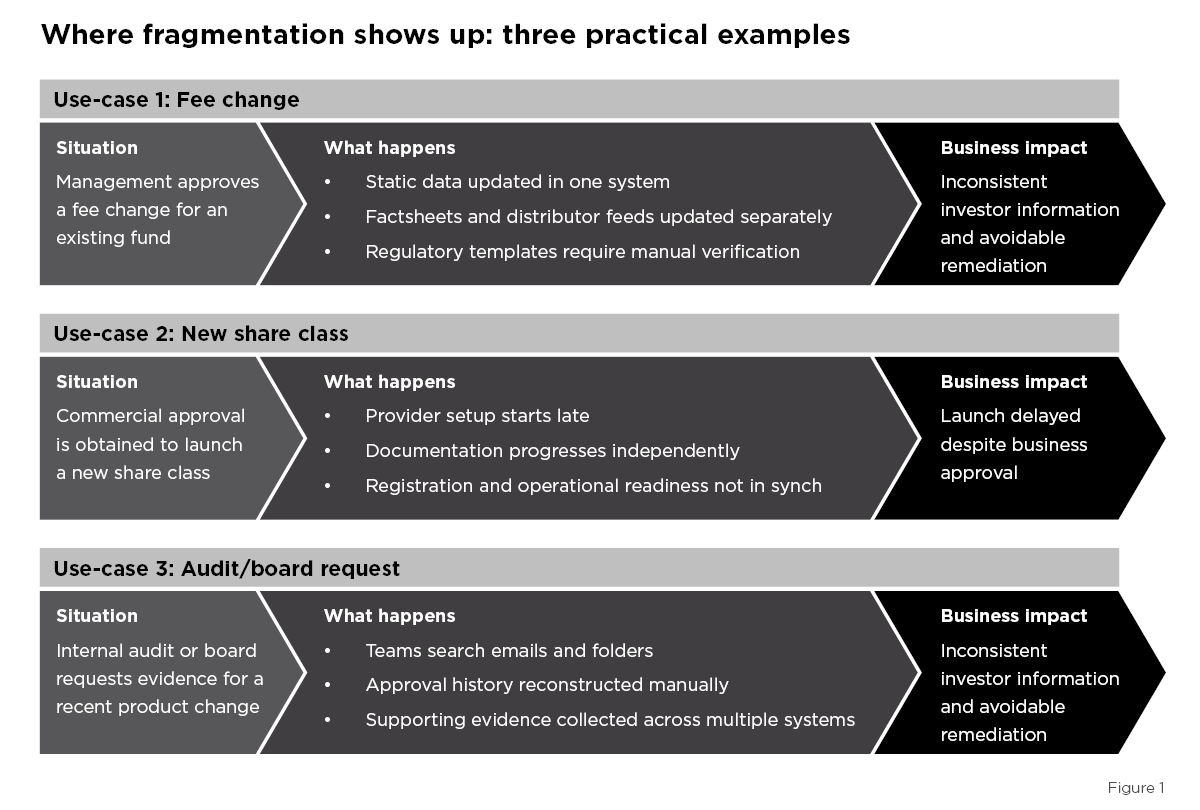
Many firms have digitized individual steps. They have workflow tools, data warehouses, reporting platforms, document systems and service provider portals. Yet the fund lifecycle itself remains poorly orchestrated. The industry has digitized many components of fund operations, but it has not established the operating layer that connects them across the fund lifecycle as a whole.
This is the missing role of the fund lifecycle control tower: to connect functional ownership, workflow execution, governed product data, documents, controls, evidence and external dependencies into one coordinated capability. Without this layer, firms may continue to improve individual tools while leaving the underlying fragmentation intact.
The same limitation constrains AI readiness. AI cannot reliably summarize, recommend or support execution across a lifecycle with weak data ownership, inconsistent evidence and fragmented process metadata. In that environment, AI may accelerate inconsistency rather than solve it.
Why now: fund lifecycle management is moving from back-office process to strategic capability
Fund lifecycle management can no longer be treated as administrative plumbing. The cost of fragmentation is now visible at executive level: delayed launches, slower product changes, inconsistent regulatory evidence, duplicated cost, weak management visibility and constrained AI adoption.
What used to be a coordination problem is becoming a strategic execution problem. The pressure is coming from four directions: growth, control, cost and AI readiness.
- Growth Firms need to launch, adapt, register, and distribute products faster, while managing more domiciles, wrappers, share classes, ESG variations, and white-label structures. A slow lifecycle model directly limits commercial responsiveness.
- Control Disclosures, regulatory templates, investor communications, and governance processes all depend on accurate, consistent, and traceable product data. When lifecycle data is fragmented, reporting becomes remediation and control becomes dependent on manual reconstruction.
- Cost Teams spend too much time rekeying data, reconciling inconsistencies, chasing approvals, and reconstructing evidence after the fact. The cost is often hidden because it is absorbed across functions, but it is material.
- AI readiness AI-enabled productivity will not scale safely unless it is connected to governed workflows, trusted data, controls, and clear ownership. Without those foundations, AI remains a set of isolated productivity experiments rather than an enterprise capability.
Senior management expectations are also changing. Executives do not only want to know whether a fund was launched. They want to know where each lifecycle event stands, what is outstanding, where risk is building, and which decisions have already been made.
AI and automation create further pressure. Many firms are experimenting with AI to improve productivity, but isolated experimentation will not create enterprise value unless it is connected to governed workflows, trusted data, controls and clear operating model ownership.
This is why lifecycle velocity with control is becoming a management priority: firms need to move faster across launches, changes, registrations, reporting cycles and lifecycle events, without reducing governance discipline. As product ranges become more complex, lifecycle fragmentation no longer creates only operational inefficiency. It increasingly compresses operating margins and determines how quickly the firm can convert product strategy into revenue.
What good looks like: the fund lifecycle control tower
Modern fund lifecycle management requires a control tower. This is not a monolithic system and not a dashboard on top of fragmented processes. It is the operating layer that connects product decisions, lifecycle data, workflow execution, document production, control evidence and third-party dependencies across the full product journey.
Its purpose is not only to show what is happening. It is to make fund lifecycle management execution repeatable, auditable and scalable. It should help the firm answer practical questions quickly:
- What is the status of this launch or change?
- Which approvals are outstanding?
- Which product data is missing or inconsistent?
- Which documents need to be updated?
- Who owns the next action?
- What evidence exists for audit, compliance, board review or management oversight?
In Capco’s view, the FLCM Control Tower is not primarily a technology construct. It is a domain-led operating-model and data capability, enabled by technology. Its effectiveness depends on five connected capabilities that together provide the framework for lifecycle modernization:
- Workflow orchestration Lifecycle activities need clear steps, owners, handoffs, service levels, approvals, escalations and exception paths. This does not remove local expertise. It makes it visible and repeatable.
- A single source of product truth Fund lifecycle execution depends on product data that is consistent, reusable and governed. The control tower should not create another data silo, it should connect to golden sources and expose trusted lifecycle data to the teams, systems, reports and documents that need it.
- Embedded controls and auditability Controls should sit inside the lifecycle rather than after it. Evidence should be captured as work is performed. Approval history, decision rationale, document and data versions and exceptions should be traceable by design.
- Integrated document and report production Fund documents and reports should reuse governed product data wherever possible. Prospectuses, key information documents (KIDs), factsheets, regulatory templates, distributor packs and committee papers should not be recreated from disconnected sources.
- Open integration with the asset management ecosystem Fund lifecycle management depends on a multitude of external partners and stakeholders (fund administrators, custodians, transfer agents, data providers, reporting vendors, regulators and distributors). The FLCM Control Tower must connect internal teams with external dependencies in a controlled way.
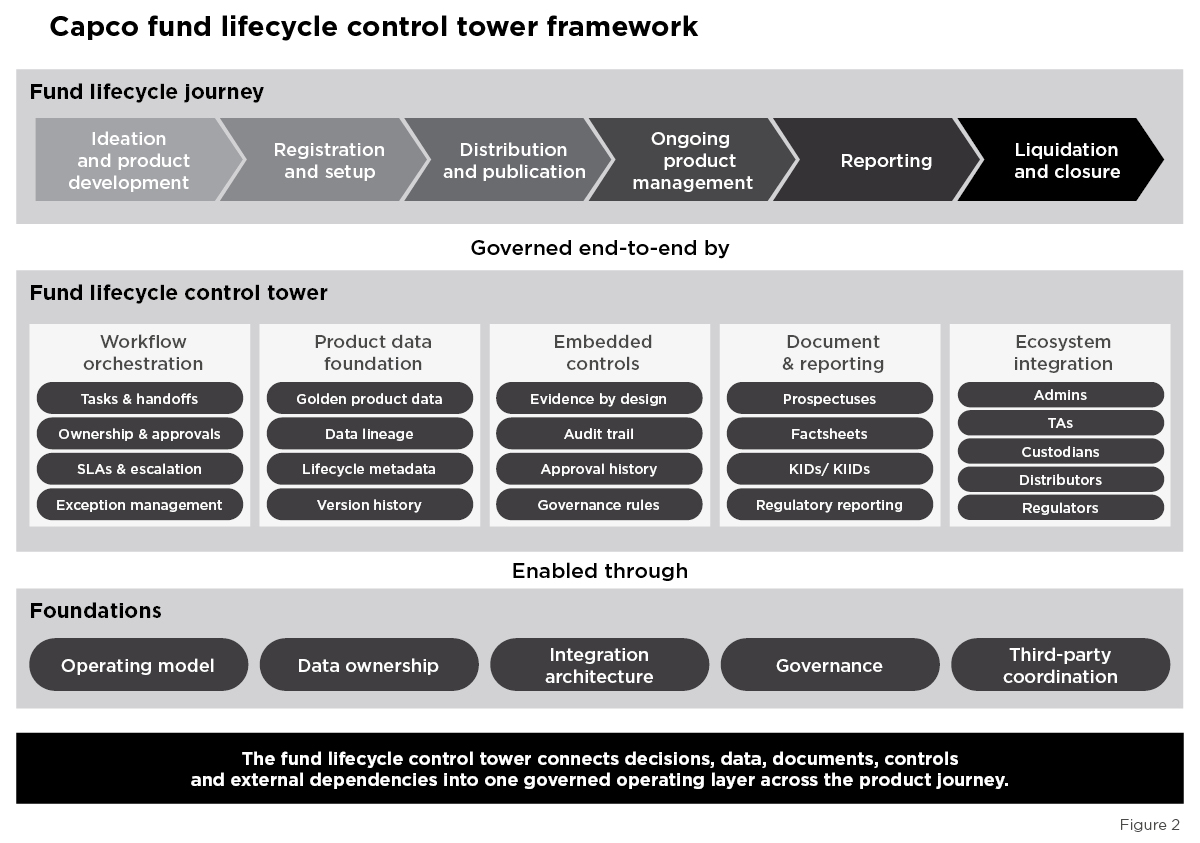
In practice, this means that a proposed product change should show the impacted share classes, documents, reports, distributor feeds, service provider actions, approvals, evidence requirements and target completion dates in one controlled workflow.
AI can strengthen this model when it is embedded into the governed lifecycle. Relevant use cases include launch-status summarization, document comparison, missing-data detection, exception analytics, draft committee materials and workflow assistance.
At a more advanced level of maturity, selected fund lifecycle processes could be supported through controlled agentic execution. In this model, a user interacts with an AI agent that can analyze documents, assemble information, invoke approved deterministic tools and coordinate next actions within defined workflow stages, policy rules, approval gates and escalation paths. The agent provides flexibility in handling the circumstances of an individual lifecycle case, while the process boundaries and control requirements remain fixed.
These capabilities should support accountable teams; they should not replace product approval, regulatory sign-off, data ownership, risk acceptance or other material judgement. This principle also applies to controlled agentic execution: an agent may prepare a case, coordinate permitted actions and recommend the next step, but defined decisions and exceptions must remain with product, legal, compliance, risk, data and governance owners. This boundary is essential if AI is to improve speed and consistency without weakening control.
The FLCM Control Tower is therefore not a technology slogan or an additional application. It is the operating model through which asset managers create lifecycle transparency, embed control, coordinate execution and scale product complexity. The following sections examine where this model creates value and the data, technology and governance foundations required to make it work.
The lifecycle lens: where value is created
The lifecycle lens matters because value is created across the full product journey, not only at launch. A modern lifecycle capability should improve decision quality, market readiness, change execution, reporting reliability and closure discipline.
Value is not created by optimizing one step in isolation. It is created by managing the fund lifecycle as an end-to-end chain of decisions, data, documents, approvals, controls and external dependencies. The opportunity is to improve how the firm moves from product idea to market launch, from launch to ongoing change, from change to reporting and eventually from reporting to closure.
The lifecycle perspective shows where fragmentation creates delay, risk, rework and weak visibility – and where a more governed lifecycle capability can create value.
- Ideation and product development: Firms need to capture the commercial rationale, target investors, investment strategy, share-class needs, distribution ambition and feasibility constraints. A stronger lifecycle model creates structured business cases and decision records. AI can support this stage by summarizing market inputs, comparing proposals with the existing product range, identifying potential overlaps and drafting committee materials. Final decisions should remain with accountable product and investment governance bodies.
- Registration and setup: The operating model must coordinate application packs, regulatory submissions, launch readiness checks and operational dependencies. This is where fragmentation is often most visible. AI can assist by checking completeness, comparing submitted documents against approved product data and identifying missing or inconsistent information.
- Distribution and publication:The challenge shifts to market readiness. The firm must manage distributor onboarding, market registrations, data dissemination and document publication. The right data and documents must reach the right markets, channels and investor segments. AI can help identify market-specific documentation gaps and summarize distribution readiness by jurisdiction.
- Ongoing product management: Lifecycle work becomes continuous: static data changes, fee updates, structural changes, board approvals, mergers, restructurings and share-class rationalization all need controlled execution. A lifecycle control tower can show which systems, reports, distribution channels and provider obligations are impacted by a proposed change.
- Reporting: Reporting is another area where fund lifecycle modernization creates visible value. Regulatory, client, management, tax and template-based reporting should reuse governed lifecycle data rather than recreate and reconcile it each time. AI can support reporting narratives, variance explanations and anomaly detection, but sign-off must remain controlled.
- Liquidation and closure: These activities should be treated as a lifecycle process, not an ad hoc project. The firm must manage investor and regulator communications, final NAV and accounting activity, provider termination, final reporting, document retention and evidence packs. AI can help generate closure checklists and identify outstanding obligations, but the process still needs clear ownership and controls.
The data foundation: the FLCM Control Tower depends on a governed fund lifecycle data model
The FLCM Control Tower cannot operate effectively without a governed fund lifecycle data model. Workflow visibility alone is not enough if the underlying product data remains duplicated, inconsistent, weakly owned or disconnected from documents, reporting obligations and lifecycle events.
This is where many transformation efforts under-deliver: they digitize tasks but leave the underlying data model unchanged. The result is faster movement of inconsistent data across more screens. That is not lifecycle transformation; it is the automation of fragmentation.
Product data is broader than traditional static data. It includes the fund hierarchy, legal structure, domicile, share classes, fees, investment restrictions, service providers, distribution permissions, documentation status, regulatory obligations, lifecycle events, reporting dependencies and closure evidence. It also includes commercial and governance context, such as product rationale, decision records, review outcomes and change history.
For example, a lifecycle data model should not only store the fund name, domicile, ISIN and share-class attributes. It should also connect those data points to approval status, document versions, distribution permissions, reporting dependencies, service-provider obligations and change history.
The data model must support operational execution, regulatory reporting, product governance, document generation, management information, analytics and AI-enabled assistance. It must also handle variation across domiciles and operating structures. Cross-border asset managers need data models that can support Switzerland, Luxembourg, Ireland and other fund hubs without redesigning the lifecycle for each location.
This matters especially for AI: document comparison requires trusted reference data; summarization requires reliable source documents and version control; exception detection requires complete and consistent historical records; workflow recommendations require process metadata, ownership, and business rules; reporting assistance requires lineage, approved calculations and clear sign-off points.
AI does not fix weak data foundations but rather exposes and amplifies them. If product data is incomplete, duplicated, inconsistent or poorly owned, AI will not remove the problem, it will rather scale it.
Historization, lineage, reconciliation, validation and access control are therefore not technical extras, they are core business requirements. The target state is not one big database. It is a governed, reusable, traceable lifecycle data layer that can be consumed by workflows, documents, reports, analytics and controlled automation.
The enabling architecture: a composable FLCM Control Tower, not a monolithic platform
The FLCM Control Tower does not require another monolithic platform. It requires a connected lifecycle architecture that orchestrates the systems and capabilities asset managers already have. Most firms operate portfolio platforms, reporting tools, document repositories, data warehouses, administrator feeds, custodian interfaces, risk systems, regulatory reporting engines and distribution platforms. The challenge is usually not the absence of technology. It is the absence of an operating and integration layer that connects these components across the lifecycle.
The technology architecture supporting the FLCM Control Tower should therefore be composable, not monolithic. It should connect existing capabilities where they are fit for purpose and standardize the lifecycle layer where the firm needs consistency, transparency and control.
The architecture should support modular services, open APIs, workflow engines, reporting integration, role-based access control, audit monitoring and third-party connectivity. It should be flexible enough to support different combinations of domiciles, asset classes, fund wrappers, service provider models and management company structures.
In Capco’s view, technology choices should follow the operating model and data choices, not the other way around. The firm first needs to define which fund lifecycle capabilities should be common, where local variation is justified, which data should be governed centrally, and which controls must be embedded into the workflow. Technology should then enable that model through integration, automation and management visibility.
AI-enabled components should be added selectively, where there is clear value creation and a controlled operating model. The use cases should also be sequenced by maturity.
- Assistive intelligence is the natural starting point: document classification, extraction, comparison, summarization, retrieval across governed product data and policies and AI-assisted drafting for committee papers, change summaries, regulatory packs and reporting commentary.
- Exception intelligence comes next: missing-data detection, anomaly detection, readiness-gap identification and exception analytics across lifecycle events, documents, reports and provider dependencies.
- Controlled agentic execution is the more advanced stage: for suitable lifecycle processes, a user can interact with an AI agent to progress a specific case. The agent can analyze documents, assemble information, invoke approved tools, coordinate tasks, propose next actions and evaluate whether defined completion criteria have been met.
The agentic loop combines different types of capabilities. AI components can support activities such as document analysis, drafting, synthesis and interaction. Deterministic tools should perform calculations, rule-based checks, validations and other activities where precision and reproducibility are required. The agent then uses the resulting information to progress the case, repeat an activity, request input or escalate an exception.
This should not be interpreted as autonomous lifecycle management. Controlled agentic execution operates inside predefined workflow stages, permissions, policy rules, approval gates and escalation paths. Product approval, regulatory sign-off, risk acceptance and other material decisions remain with accountable human owners.
These capabilities should sit inside the governed lifecycle architecture, not outside it as uncontrolled productivity tools. For controlled agentic execution, the firm must define which data, systems and tools the agent may access; which actions it may perform; which completion criteria it may evaluate; and where it must stop, request approval or escalate.
Human approval gates, evidence capture, action logs, control checks, monitoring and fallback procedures are non-negotiable when lifecycle activities are automated or AI-assisted. The architecture must also allow the firm to reconstruct what information the agent used, which tools it invoked, what outputs were produced and which human decisions were taken.
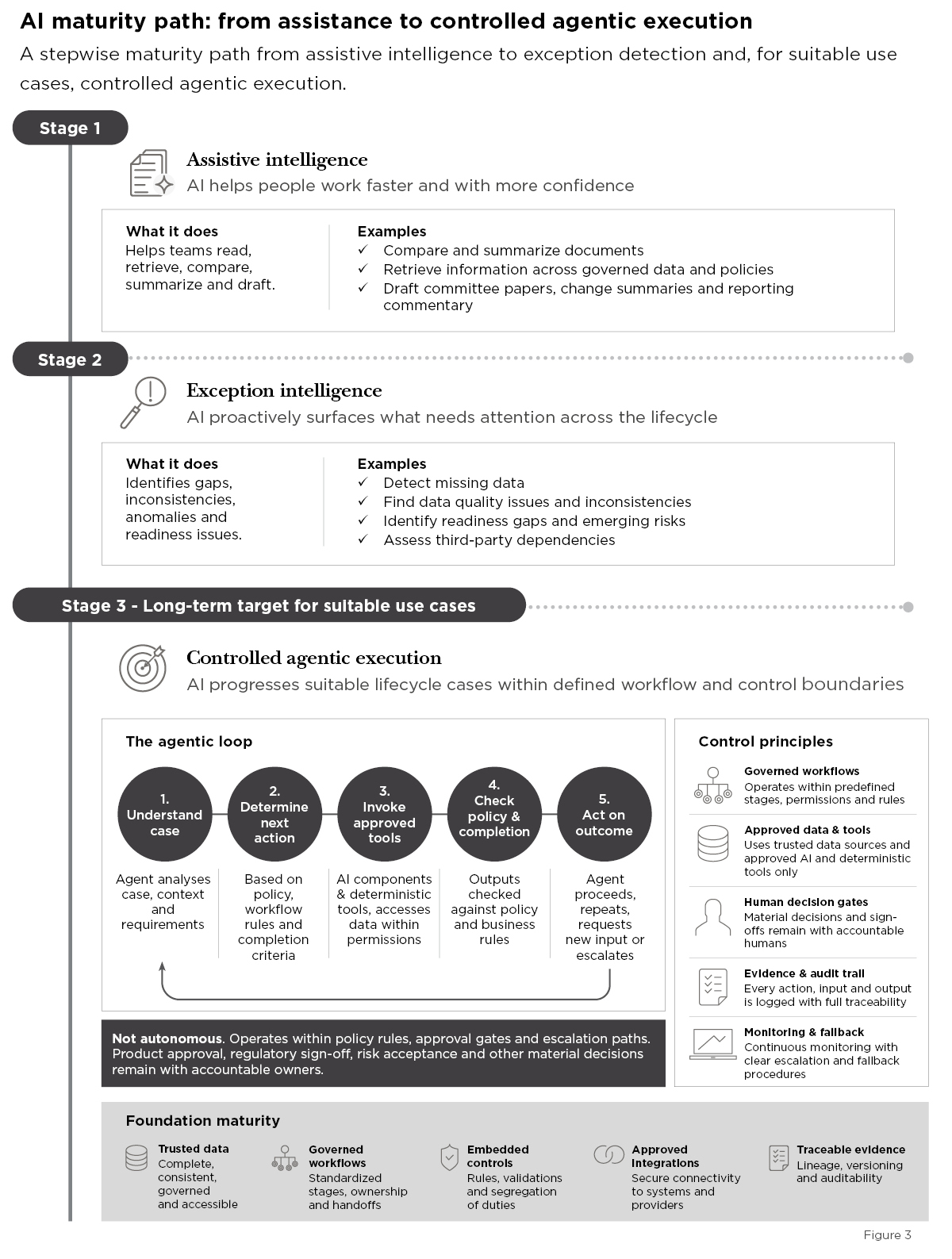
Controlled agentic execution should therefore be treated as a credible advanced destination for selected processes, not as the starting point for lifecycle modernization. Its effectiveness depends on the workflow, data, integration, control and evidence foundations established in the earlier stages of maturity.
Firms should avoid big-bang replacement where possible. Existing systems should be retained where they work. New capabilities should be introduced around clear value pools, such as fund launches, static data changes, regulatory document production, reporting readiness or lifecycle events.
The implication is simple: the lifecycle control tower should be enabled through a connected, composable architecture, not delivered as another isolated application.
Benefits: what executives should care about
The business case is fund lifecycle velocity with control: the ability to move faster across product launches, changes, registrations, reporting cycles and closures, while reducing the manual effort, evidence gaps and coordination risk that usually come with scale. For executives, the value is not only process efficiency, it is improved management of product complexity.
The FLCM Control Tower improves four outcomes that matter directly to executives: speed, cost, control and scalability. These are not separate benefits delivered by isolated initiatives. They result from the same underlying operating capability: fund lifecycle work becomes visible, product data becomes reusable, controls are embedded into execution, and cross-functional and third-party dependencies become actively manageable.
- Faster product moves: A governed fund lifecycle model reduces the time lost between commercial decision and operational readiness. Launches, new share classes, fee changes, market registrations, document updates and lifecycle events can move through predefined steps, with clearer ownership and fewer late-stage surprises. Executives gain better visibility of where delays are building, which dependencies are blocking progress, and where intervention is required.
- Lower hidden cost: Much of the cost of lifecycle fragmentation is absorbed across functions rather than visible in one budget line. Product, legal, compliance, operations, reporting, distribution and provider teams spend time re-keying data, reconciling inconsistencies, chasing approvals and reconstructing evidence. A stronger lifecycle model reduces this hidden effort by reusing governed data, standardizing repeatable workflows, and capturing evidence as work is performed.
- Stronger control: Lifecycle control improves when approvals, decision history, data changes, document versions, exceptions and evidence are embedded into the workflow rather than collected after the fact. This strengthens audit readiness, regulatory confidence, board reporting and management oversight. It also reduces reliance on individual knowledge, because the operating model no longer depends on a small number of people knowing where information sits and which handoffs matter.
- Scalable growth: Growth becomes harder to manage when every new fund, domicile, share class, distribution arrangement or lifecycle event adds another layer of manual coordination. A governed lifecycle capability creates reusable patterns across products, jurisdictions, providers, documents, reports and controls. This allows firms to scale complexity more deliberately, without adding proportional headcount or creating new local workarounds for every market or product variation.
The same control-tower capability also creates the foundation for controlled AI adoption. AI-enabled document comparison, exception detection, reporting support and workflow assistance are more useful when they operate on trusted data, clear ownership, documented decisions and traceable evidence. This turns AI from a set of local productivity experiments into a capability that can support lifecycle execution at enterprise level.
Management should be able to track the health of the fund lifecycle through practical indicators: cycle times, open bottlenecks, data-quality exceptions, evidence completeness, document readiness, provider dependencies and status by fund, domicile, lifecycle event or reporting cycle. This is where lifecycle modernization becomes an executive management capability, not only an operational improvement.
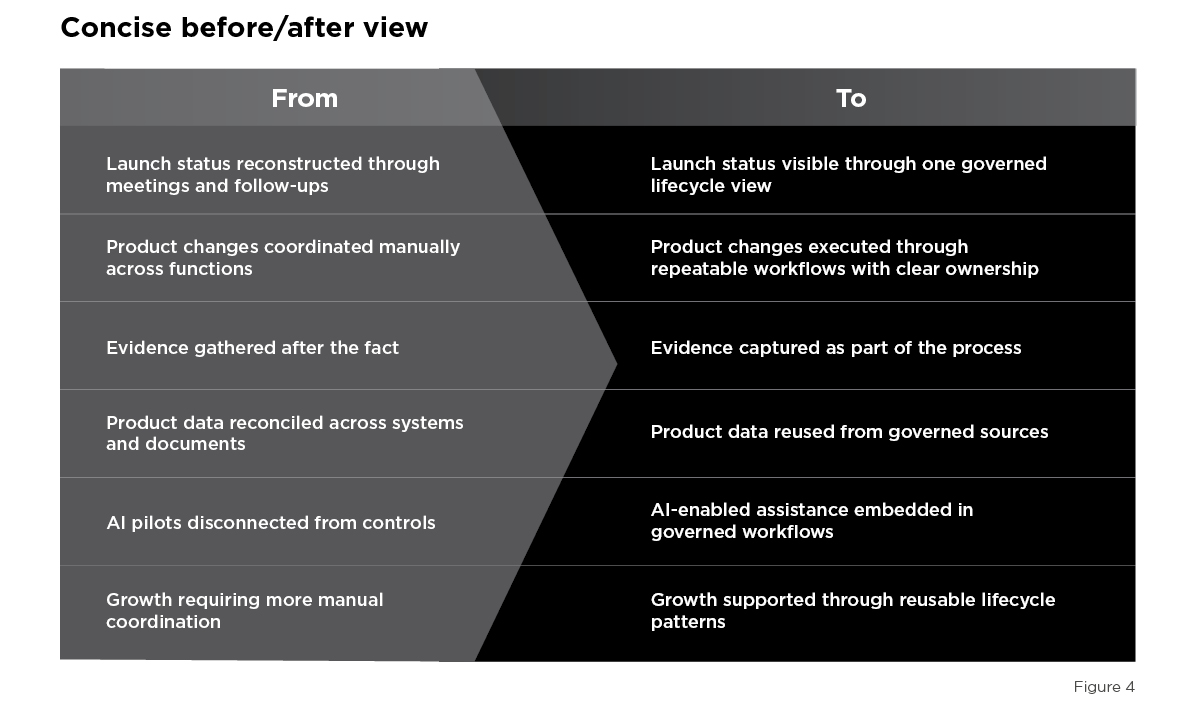
Capco’s recommended approach
Capco’s view is that the winners will not be the firms that simply digitize more fund lifecycle tasks. They will be the firms that establish a true fund lifecycle control tower: a governed, data-led operating capability that connects execution across the product journey and embeds AI selectively as the underlying workflow, data and control foundations mature.
Capco helps asset managers move from fragmented fund lifecycle activity to a controlled, AI-ready lifecycle capability through seven practical moves. The sequence matters: the work starts with understanding where fragmentation creates value leakage, then builds the operating model, data foundation, governance and integration layer required to scale.
1. Diagnose lifecycle fragmentation
The starting point is to map how lifecycle work actually happens today: where decisions are made, where data is created, where documents are produced, where controls sit, and where evidence is captured. The objective is not to document processes for their own sake. It is to identify where fragmentation creates delay, risk, rework, data-quality issues or reliance on individual knowledge.
2. Define the target lifecycle capability model
Firms need to be clear about which fund lifecycle capabilities should be standardized and where variation is required by domicile, asset class, product type or operating structure. This is where the lifecycle control tower should be defined in practical terms: which capabilities it owns, which activities it orchestrates, how it interacts with functional teams and providers, and how it gives management a reliable view of lifecycle status, risk and performance.
3. Build the product and lifecycle data foundation
Fund lifecycle management modernization depends on trusted product data. Asset managers need to clarify ownership, golden sources, data standards, lineage, history, access rights and reuse across workflows, documents, reports and controls. This foundation is also what determines whether AI can be used safely for document intelligence, exception detection, reporting support and workflow assistance. For controlled agentic execution, governance must extend to the actions the agent is permitted to perform. These boundaries should be embedded into the workflow and evidenced as the case progresses.
4. Prioritize workflow use cases
The best starting point is usually not the full fund lifecycle at once. Firms should select high-friction journeys where better orchestration can create visible impact, such as fund launches, static-data changes, regulatory document production, distributor onboarding, fund events or reporting readiness. Each use case should be designed with clear roles, controls, data inputs, approval gates and evidence requirements.
5. Modernize through integration, not replacement alone
Most asset managers already have many of the required technology components. The challenge is to connect them into a coherent fund lifecycle architecture. Existing platforms should be retained where they work, while new capabilities should be introduced where the firm needs better workflow orchestration, data reuse, document production, reporting integration or controlled AI enablement.
6. Embed governance into the operating model
Fund lifecycle management modernization only works if accountability is explicit. Roles, decision rights, service levels, exception paths, control points and evidence requirements need to be built into the way work is performed. The same principle applies to AI-enabled use cases: they require clear ownership, approved data boundaries, testing, monitoring, documentation and human oversight.
Capco helps firms separate AI use cases that can be scaled safely from those that should remain experimental until data quality, evidence, controls and ownership are stronger. This is where domain expertise matters: the value of AI depends not only on the model or tool, but on whether the lifecycle process around it is controlled enough to absorb it.
7. Scale iteratively through reusable building blocks
Finally, asset managers should start with a small number of priority use cases, prove value, and then extend across products, jurisdictions, asset classes and lifecycle stages. Each release should create assets that can be reused: process patterns, data models, control libraries, workflow components, reporting templates, integration capabilities and approved tool services.
Controlled agentic execution should be treated as an advanced destination for suitable lifecycle processes. It should be introduced once the relevant workflow stages, data inputs, decision rights, controls, evidence requirements, integrations and escalation paths have been established and proven. Firms should not place an agent on top of a fragmented process and expect it to compensate for the absence of an operating model.
For asset managers, the priority is not to add another tool to an already fragmented landscape. It is to build the operating model, data foundation, governance and integration layer that make lifecycle execution faster, safer and more scalable.
This is where Capco is positioned to help: combining asset management domain knowledge with operating-model, data, AI, technology and delivery expertise to design and implement the lifecycle control tower and progressively enable more advanced forms of controlled automation.
The objective is not simply to improve individual workflows. It is to help firms establish the operating layer that connects product decisions, governed data, controls, documents, reporting and third-party dependencies across a repeatable and scalable lifecycle model.
The opportunity is not simply to make fund lifecycle management work more efficient, it is to turn fund lifecycle management into a platform for product growth, regulatory resilience and controlled automation.
Contact us to discuss how we help your firm along this journey.