

Wealth managers and private banks are under unprecedented pressure to rethink their business models as competition intensifies and market conditions shift. Those who act decisively, starting with a targeted redesign of front-office capabilities, can unlock an important opportunity to strengthen customer loyalty, capture greater wallet share and drive sustainable growth with existing and new customers.
With client profiles evolving and margins shrinking, competitive and market pressures continue to mount on the wealth management sector. More specifically, the challenges include:
- Fee pressures: passive products, significantly reduced brokerage fees and more transparent pricing compress margins, eroding historic revenue pools
- Next-generation client demographics: inter-generational wealth transfer and next gen digital natives bring new demands and higher expectations
- Demand for comprehensive services and top quality of advice
- Competitive landscape shifting towards digitalization to meet escalating customer demands
- Growing need for hyper-personalized customer experiences.
Mastering data-driven and hyper-personalized engagement and offering the right product, to the right client at the right moment in time will improve new-business generation and enhance client relationships while increasing revenues.
We believe this requires strengthening front office processes with a particular focus on sales effectiveness through a more strategic, more structured and more systematic approach to sales, service and operations.
Challenges in front-office effectiveness and strategies for change
The wealth management industry faces several pressing challenges that impact revenue growth and client satisfaction, despite an overall rise of private household wealth.
Capturing AuM from existing and new customers and defending/increasing revenues
Many institutions struggle with inefficient front-office processes, weak client engagement strategies and a lack of structured prospecting approaches.
Firms must find ways to attract new customers in an increasingly competitive market and secure money transfers from other institutions or after liquidity events. At the same time, they need to attract new assets from existing clients. Given that clients typically use several banks and are constantly approached by competition, the attraction of new money from existing clients is not easy. On top of that, banks and wealth managers need to defend their gross margin, i.e. their return on assets (RoA).
Client and asset attrition risks
Attrition risk is rising across the industry, as many institutions lack a well-defined strategy for identifying at-risk clients and managing these relationships effectively. Without clear retention frameworks in place, firms face the danger of losing high-value clients and assets to more proactive competitors. Given that many HNW and most UHNW clients have several banking relationships, they can shift assets easily to another bank without going through a new onboarding process.
Moreover, there is an increasing interest in alternative and partially non-financial assets. Clients who want to invest in non-traditional or even non-financial assets will cause asset attrition unless the bank is able to offer access to such assets or asset classes.
Changing client expectations
Expectations, especially among HNW and UHNW client segments, are rapidly evolving. Clients increasingly demand more personalized, digitally enabled and proactive advisory services. To remain relevant, private banks and wealth managers must transition from a product-centric to a client-centric model that responds to the questions and challenges clients truly care about.
Relationship managers are expected to be available when their advice is most needed, think beyond financial products and adopt a holistic view of each client’s situation, needs and ambitions. Increasingly, clients also expect financial advice to incorporate broader family and estate considerations.
Inefficiencies in sales and relationship management
Many firms face persistent inefficiencies in their front office and client interaction processes. They lack the tools and structured frameworks required to achieve strong sales-force effectiveness, support systematic lead generation and fully capture cross-selling and up-selling opportunities.
Our experience shows that to remain competitive, private banks and wealth managers need to optimize their front office capabilities and operations. Strategies will include:
- Enhancing sales force effectiveness: Apply systematic lead generation, structured client acquisition and advanced service strategies to support the conversion of opportunities into new business.
- Improving client experience: Every client touchpoint should be optimized to deliver superior service, increase engagement and should be seen as an opportunity to deepen the relationship.
- Identifying new opportunities: Understand the client (or the entire family of a client) and their evolving needs and goals along the client lifecycle to spot opportunities to deepen the relationship across multiple solution areas.
- Being relevant: Relationship managers and entire front office teams must offer insights and advice that are truly meaningful to the client.
- Leveraging data and technology: Follow a data-driven approach to enhance decision-making, enabling proactive relationship management and revenue growth.
- Strengthening operating models and processes: Establish an agile and efficient front office organization that improves overall effectiveness.
In all the above-mentioned areas AI can make a profound difference.
Turning strategy into results: key imperatives for front-office effectiveness
We have identified key imperatives that tackle the main areas where traditional wealth management business models often fall short.
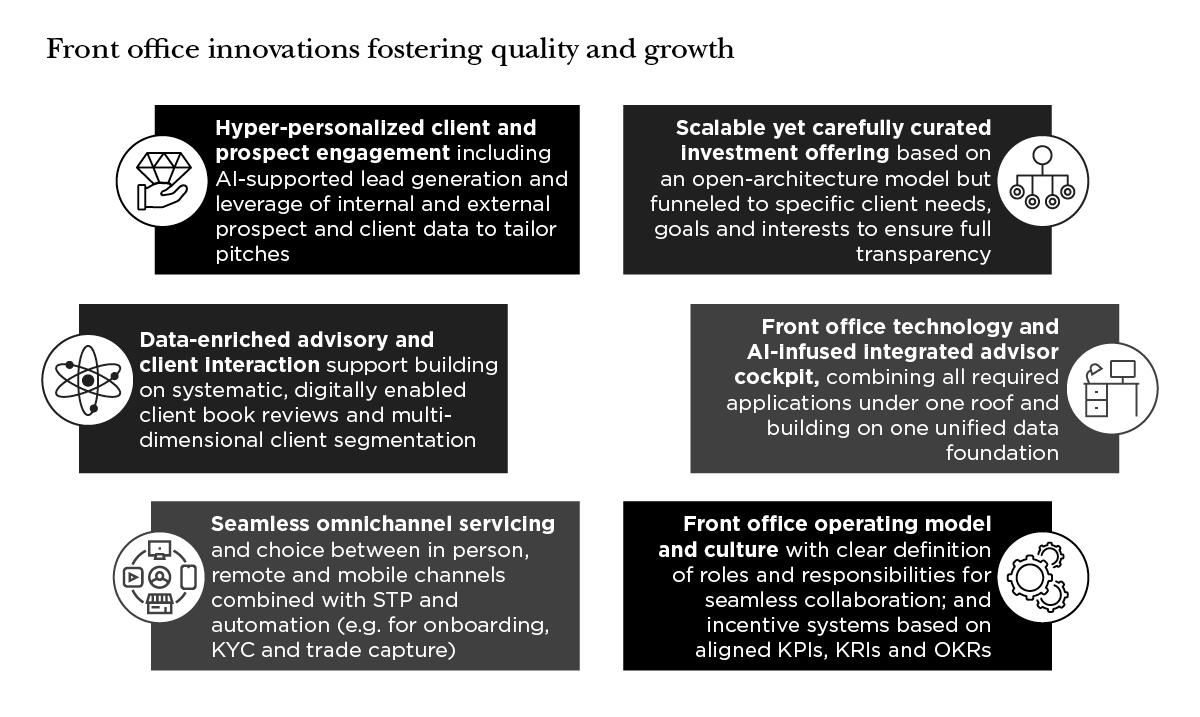

Growing the business requires a strong client acquisition and opportunity conversion engine. Lead generation should not rely solely on existing RM networks but should also systematically incorporate multiple relevant lead sources. Technology and AI can make a big difference to identify leads with high potential and high conversion likelihood.
Prospect and client engagement should be tailored to the individual client as much as possible. Leveraging all available data on clients and prospects allows to tailor pitches and proposals to the specific needs.
It is important for relationship managers to approach clients at the right moment, with the right messages and solutions, in the right way. Offering the right solutions, but not framed and communicated in the right way or at the wrong time will not help to win the client’s heart and mind.
In terms of client and relationship benefits, hyper-personalized and fully tailored client interaction will lead to increased loyalty, higher wallet share, stronger product penetration, more referrals and lower attrition.

Conducting systematic client book reviews is nothing new, however most banks lack the required discipline to perform them with the required rigor. Reviewing clients with regards to their current positions, investment portfolio, recent changes in volumes (or other factors such as maturing investments or loans, particular exposures, trading behaviours, unusual transfers to other bank accounts, changes in family situations, access to next generation, event participations, complaints, etc.) allows to spot opportunities and risks. In the past this was done manually on paper or in Excel spreadsheets, if at all. Nowadays banks can use digitally supported client-book reviews and deep client data analysis to surface untapped opportunities and emerging risks.
This enhanced client understanding allows for more sophisticated client segmentation, which should be performed along multiple dimensions, such as client life stage, source of wealth, personal characteristics and behavioural patterns or preferences, rather than relying solely on AuM or business volume at the bank. This requires leveraging behavioural analytics to better understand and profile clients and their families, which in turn allows to develop tailored client engagement and action plans that address identified opportunities or relationship risks.
These activities should be underpinned by a consolidated data lake that blends internal and external data and by delivering AI-powered insights directly at the point of client interaction along with proactive recommendations.
Better client understanding also increases advisory productivity and improved risk control, enabling RMs to approach clients with the right solutions, at the right time, in the right way and allowing them to offer a broader but tailored range of solutions, maximizing conversion probability.

Multichannel servicing is a given in today’s business environment, although the range and quality of digital services and the way in which they are combined with traditional services vary significantly between wealth managers. This reflects differences in both capabilities and strategy.
Where wealth managers offer integrated multichannel services, it is critical for them to have a unified data, CRM and workflow ‘backbone’ to ensure consistent and seamless transitions between personal client interactions, front office teams, remote banking and mobile channels. In parallel, critical and time-consuming tasks such as onboarding, KYC and trade capture should always be done with straight-through processing and with as much automation as possible.
In terms of advice, wealth managers should move towards hybrid-advice capabilities, ensuring that clients receive consistent service and advice across channels. Tangible benefits will include faster time to serve/respond and more scalable coverage models.

Ultimately, wealth management is about offering the right products and services to wealthy individuals. While some wealth managers can build on a large and comprehensive offering, others have only basic in-house capabilities. Some provide niche product capabilities in a few selected areas, while others have hardly any proprietary capabilities at all. However, it is important for all wealth managers to have access to best-of-breed investment products.
To facilitate this, wealth managers should provide an open-architecture platform that gives access to third-party solutions and allows to identity the best solution for each client demand. On this basis wealth managers can offer modular discretionary and advisory propositions with flexible bundling and also integrate ecosystem partners to further diversify the offering while keeping inhouse complexity and cost under control. From a client perspective, this allows for a broader offering, a transparent comparison of solutions and ultimately better investment management outcomes.

Advisors and relationship managers require an integrated ‘cockpit’ that brings together all essential functionalities such as core banking functions, investment intelligence, CRM, client lifecycle management, account opening support, prospect management and sales management as well as KYC review functionality.
Not all technology needs to be available in one system, but applications need to be integrated in one front office environment, based on the same common and consistent data foundation, to enable smooth interaction.

The culture and focus of wealth managers and private banks need to be geared towards true client value while adhering to internal standards and regulatory requirements.
Maximum client orientation and optimal client outcomes can only be achieved if all client facing individuals seamlessly work together, and knowledge about the client is fully leveraged to collectively bring the right solution to the right client at the right time.
In the spirit of client-centricity, the RM should be the closest to the client, orchestrating the blend of all available solutions and experts. Experts include investment advisors, lending/credit advisors, financial planning and wealth structuring experts, alternative assets specialists, etc. All experts need to work in harmony, while incentives need to foster collaboration and avoid cannibalization.
This can only be achieved when the envisioned behaviours are lived, demonstrated and requested from the top in an organization, and when teams and individuals are trained and coached accordingly. A key element is a suitable incentives system that is based on the right KPIs (key performance indicators) and KRIs (key risk indicators) and translated into OKRs (objective and key results). It is critical that incentives and performance metrics are aligned to holistic client outcomes.
Prerequisites for successful transformation
The following are the main prerequisites for a successful transformation journey that leads to the envisioned results in terms of an efficient and effective front office organization:
- Full transparency on financial and client outcomes
- Front office behaviours in line with the above-mentioned objectives
- Clear operating‑model design in terms of processes, organization, roles and responsibilities, governance, systems and data, fully aligned to business objectives
- Progressive legacy decoupling and migration roadmap to enable modern capabilities, technology and scalability
- Strong data governance, privacy and ethics by design
- Culture of client centricity, teamwork and result orientation
- Senior sponsorship and coherent change narrative.
Conclusion
Wealth management is at a strategic inflection point. Margin pressures, evolving client expectations, generational shifts and digital disruptions are fundamentally challenging traditional, product-centric business models. At the same time, rising global wealth presents a significant growth opportunity for institutions that can modernize decisively.
Sustainable success will depend on transforming the front office into a data-driven, client-centric and highly effective growth engine. Hyper-personalized engagement, AI-supported advisory capabilities, seamless omnichannel servicing, scalable product platforms and an integrated front-office technology environment are no longer optional enhancements, they are core strategic imperatives.
However, technology alone is insufficient. True impact requires aligned operating models, disciplined sales processes, transparent performance management and incentive systems that reward holistic client outcomes rather than product push.
Ultimately, wealth managers that combine advanced analytics, structured relationship management and a strong culture of collaboration and accountability, will be best positioned to increase wallet share, reduce attrition and strengthen long-term client loyalty. Those who act early and execute consistently will not only defend their margins but redefine their competitive positions in a rapidly evolving market.
Capco’s unique offering
Capco differentiates through a unique combination of key capabilities such as strategic and operational business expertise, understanding of business drivers and key processes and the ability to build and implement tailored advanced technology and AI solutions.
In the context of wealth management business model innovation and front office effectiveness, Capco can help design front office business capabilities and processes around client acquisition, client understanding, client advisory excellence, opportunity identification and conversion as well as handling clients at risk, cross selling and product penetration, price realization and smooth client lifecycle management.
We help clients design target models and build technology solutions to ensure these models come to life.
Capco is also the right partner to fully implement business and technology solutions and drive the related change processes, including training and coaching programs for front office employees and line managers at all levels.