

Banks across the Middle East are operating in an environment shaped by rapid technological advancement, shifting customer expectations, geopolitical developments and growing resilience requirements. Financial institutions are balancing innovation with regulatory priorities while looking for new ways to improve efficiency, unlock growth and remain competitive. With many technologies now moving beyond the pilot stage, the focus is increasingly shifting from experimentation to scalable implementation and measurable business outcomes.
Against this backdrop, we see five themes shaping the banking agenda through 2026 and into 2027: the rise of Agentic AI and AI-enabled operating models; the evolution of cross-border payments and settlement infrastructure; the growing momentum behind tokenization and digital assets; the transformation of wealth management through personalization and changing client expectations; and the increasing importance of sovereign cloud as organizations prioritize resilience, control, and AI readiness. Together, these trends offer a view of how the region’s banks are preparing for the next phase of industry evolution.
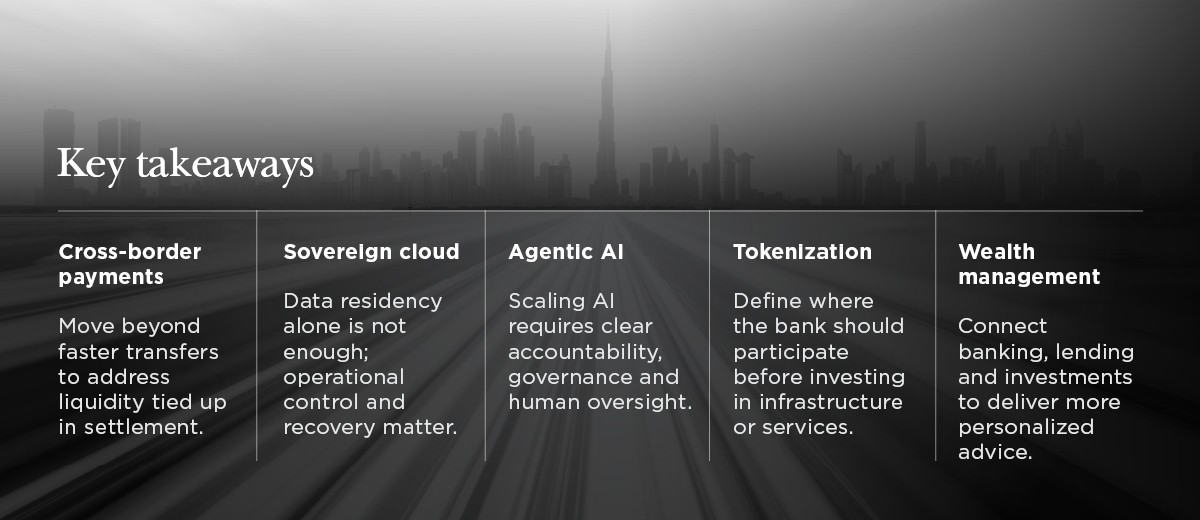
How are cross-border payments moving from messaging to intelligent settlement?
Cross-border payments have long been a critical part of the Middle East banking landscape. As one of the world's largest remittance corridors, the GCC processes billions of dollars in outbound payments each year, making payment efficiency a strategic priority for regional banks.
For decades, international payments have relied on correspondent banking networks and messaging infrastructure that can introduce delays, reconciliation complexity and significant liquidity requirements. Banks often need to maintain funds across multiple currencies and jurisdictions to support payment flows, tying up capital and increasing operational costs.
In 2026, that model is beginning to evolve.
Driven by advances in blockchain-enabled settlement and modernization initiatives from established payment networks such as SWIFT, banks are exploring new ways to improve the efficiency of cross-border transactions. Traditionally, SWIFT's role has been to facilitate secure messaging between financial institutions. However, the industry is increasingly looking beyond messaging towards optimizing settlement itself through greater transparency, payment finality and improved liquidity management.
One of the most significant developments is the emergence of solutions that enable banks to net obligations across payment flows, optimizing liquidity usage and reducing the capital tied up in cross-border payments. For GCC banks, where remittances represent a major business line, this could significantly reduce one of the largest cost components of cross-border payments.
At the same time, newer settlement models promise faster reconciliation, improved payment tracking and greater visibility across the transaction lifecycle. Unlike earlier blockchain initiatives, many of these solutions are designed to work alongside existing payment infrastructure and standards, lowering implementation barriers and accelerating adoption.
Importantly, the market is now moving beyond experimentation. Documentation for new blockchain-enabled settlement frameworks was released in 2026, with industry pilot testing scheduled throughout the summer and initial go-live activity expected later in the year. This signals a shift from proof-of-concept discussions to practical implementation.
As customer expectations for speed and transparency continue to rise, banks are increasingly focused on reducing friction across the entire payment lifecycle. In 2026, the future of cross-border payments will be defined by smarter settlement, optimized liquidity and greater visibility across global payment flows.
How is sovereign cloud shaping the future of digital residency to digital resilience?
For years, cloud adoption in the Middle East was primarily driven by scalability, efficiency and cost optimization. Today, the conversation is evolving. As governments, financial institutions, energy companies and other critical industries become increasingly dependent on digital services, cloud is no longer viewed simply as a technology platform; it is becoming a core part of the region’s digital infrastructure.
Recent regional disruptions have reinforced an important reality: cloud services are supported by physical infrastructure, including data centers, connectivity networks and power systems. For organizations operating in highly regulated and business-critical sectors, resilience is becoming just as important as performance. Leaders are increasingly asking not only where their data resides, but how their operations can continue during periods of disruption.
At the same time, hyperscalers are adapting to these changing requirements. AWS, Microsoft and Google Cloud continue to expand their regional presence while introducing new capabilities around data control, encryption, local partnerships and sovereignty-focused operating models. These developments are helping organizations meet regulatory requirements while strengthening operational control and resilience.
However, sovereign cloud is no longer simply about selecting a local cloud region. Organizations are increasingly adopting a sovereign-by-design approach, embedding resilience, governance, security and operational control into cloud strategies from the outset. This means understanding where critical workloads sit, reducing concentration risk, strengthening access controls and ensuring services can recover quickly when disruptions occur.
The rise of AI is adding further momentum to this shift. As organizations look to deploy AI at scale, they must ensure sensitive data, models and workloads remain protected and aligned with local requirements. In many ways, sovereign cloud is becoming the foundation for the next wave of AI adoption, providing the trust, security and control needed to unlock greater value from data and AI initiatives.
Looking ahead, cloud strategy in the Middle East will be defined by more than migration and modernization. Organizations will increasingly focus on building digital environments that balance innovation with resilience, helping them maintain continuity, protect critical assets and support future growth. As this trend continues to evolve, organizations will need to translate sovereignty requirements into practical decisions around architecture, risk, governance and operating models.
How is AI Agents taking on banking operations? Balancing automation, governance and oversight
Artificial intelligence is entering a new phase in financial services. After several years focused on GenAI tools that help employees search, summarize, analyze and generate content, attention is now turning to Agentic AI – systems capable of executing tasks and coordinating workflows while operating within defined controls and human oversight. For banks across the Middle East, this represents a significant shift.
Despite continued investment in digital transformation, many operational processes still rely heavily on human orchestration. Activities such as onboarding, KYC reviews, customer service, fraud monitoring and technology delivery often involve multiple handoffs, manual interventions and complex decision-making processes. Agentic AI offers an opportunity to streamline these activities by handling repetitive and structured tasks, allowing employees to focus on judgement-intensive work, customer interactions and exception management.
Rather than replacing people, the emerging model is one of collaboration, where AI agents perform specific activities while humans remain responsible for oversight, validation and decision-making. This is why many institutions begin with targeted use cases. Areas such as onboarding and KYC are particularly attractive because they rely on structured data, follow defined workflow and have clearly measurable outcomes.
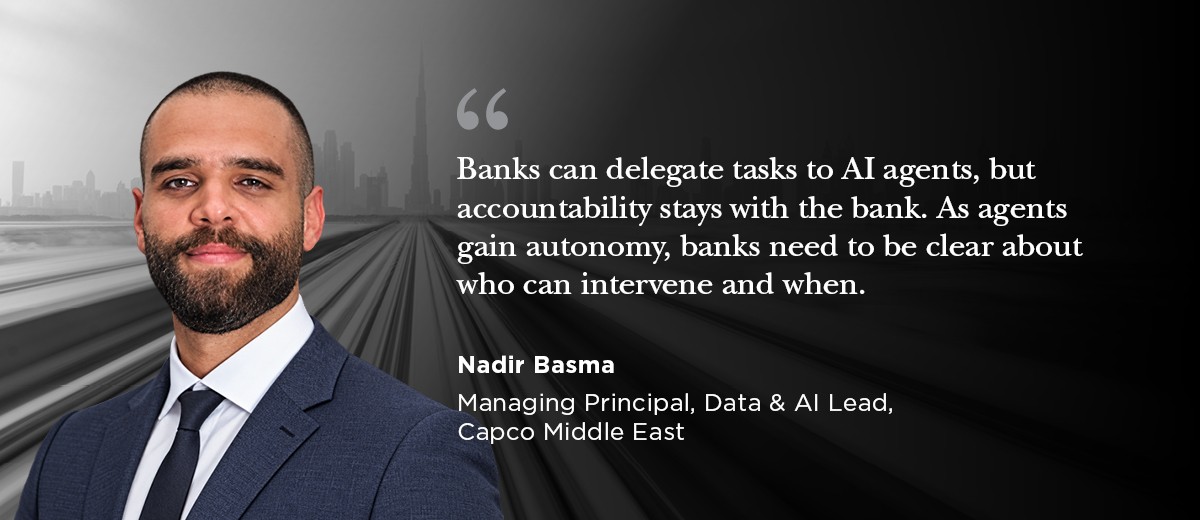
Early experimentation is helping organizations understand where agentic systems can create value while also revealing the operational and governance requirements needed to support adoption at scale. As AI takes on a more active role in execution, governance is becoming a key differentiator. Institutions must look beyond traditional concerns such as data quality and model accuracy to address broader questions around accountability, auditability, control and the interaction between AI agents and human operators.
As a result, the conversation is increasingly shifting from technology to operating model design. The institutions that succeed will not necessarily be those deploying the most AI agents, but those that establish clear governance frameworks, define effective human-in-the-loop controls and build operating models that allow AI and people to work together safely and effectively.
Looking ahead, Agentic AI is likely to become a key enabler of productivity and scalability across banking operations. As organizations move from experimentation to adoption at scale, success will depend on establishing the right balance between automation, governance and human oversight.
How is tokenization moving from innovation to infrastructure?
The Middle East is rapidly establishing itself as a global hub for digital assets and tokenized finance. Supported by evolving regulatory frameworks, growing investment in financial market infrastructure and ambitious digital economy strategies, markets across the region are creating the foundations for tokenization to move beyond experimentation and into mainstream financial services.
The UAE has been at the forefront of this development, fostering regulated ecosystems where banks, exchanges, technology providers and regulators can collaborate to develop tokenized financial markets. Momentum is also broadening across the region. In Saudi Arabia, initiatives led by the Capital Market Authority (CMA) and Saudi Central Bank (SAMA) are supporting the modernization of capital markets, financial infrastructure and digital financial services. In Qatar, the Qatar Financial Centre (QFC) is helping develop the regulatory and institutional environment for digital assets, reinforcing the country’s wider ambitions around financial innovation and institutional capital.
Across these markets, institutions are expanding tokenized investment products, digital liquidity solutions and custody capabilities, while market infrastructure providers continue to strengthen the supporting ecosystem through advances in settlement, governance and shareholder servicing. Together, these developments are helping bridge the gap between distributed ledger technology and traditional financial markets, providing institutions with greater confidence to move from pilots toward scaled adoption.
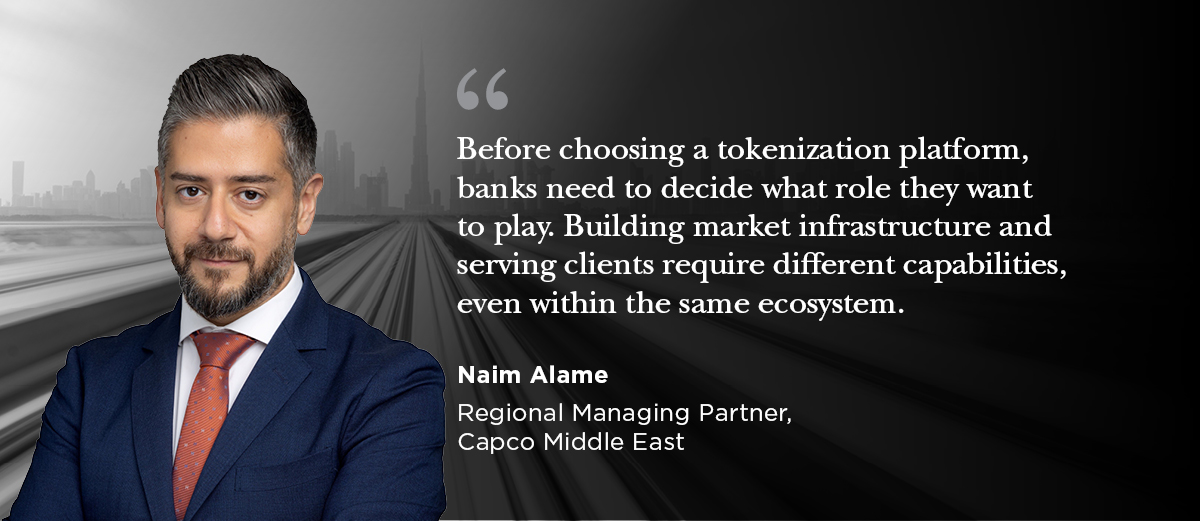
For banks in the Middle East, the strategic question is no longer whether tokenization will become part of the financial landscape, but where to participate within the emerging ecosystem. Some institutions will focus on developing the infrastructure that supports tokenized markets, while others will prioritize client-facing services such as digital asset custody, tokenized investment products and wealth solutions. Many are likely to adopt hybrid approaches that combine infrastructure participation with new distribution and servicing capabilities.
Looking ahead, tokenization is expected to become an increasingly important component of the region's financial infrastructure. However, realizing its full potential will require more than adopting new technology. Banks will need interoperable platforms, robust governance, trusted digital custody and operating models that integrate tokenized assets seamlessly into existing banking and capital markets ecosystems.
How is wealth management shifting from product-led to relationship-led growth?
For decades, wealth management in the Middle East has been built on preserving and growing assets for high-net-worth clients. Today, that proposition is expanding. Rapid wealth creation, intergenerational wealth transfer and the emergence of regional financial hubs are reshaping client expectations, creating new opportunities for banks to deepen relationships while diversifying revenue beyond traditional banking services.
At the same time, the region is becoming an increasingly important destination for wealth itself. Financial centers such as Dubai and Abu Dhabi continue to strengthen their position as global wealth hubs, while Saudi Arabia’s significant concentration of high-net-worth and family office capital is being reinforced by regulatory reforms aimed at deepening its capital markets and investment ecosystem. Qatar adds another dimension, with its strong focus on sovereign capital deployment and a growing institutional family office landscape.
Together, these markets are attracting and retaining more capital through evolving regulation, sophisticated financial ecosystems and growing investor confidence. As more wealth remains within the region, banks have an opportunity to deliver locally while supporting increasingly global and sophisticated investment needs.
Client expectations are also evolving. A new generation of affluent customers expects seamless, personalized experiences that bring together banking, lending, investments and payments within a single relationship. Rather than viewing wealth management as a standalone business, leading institutions are integrating wealth propositions across the broader banking journey, using data and AI to provide more proactive advice, tailored investment strategies and deeper client engagement.
Technology is accelerating this transformation. AI-powered relationship management, intelligent portfolio insights, digital onboarding and automation are improving both advisor productivity and client experience, while emerging capabilities such as tokenized assets and digital custody are beginning to expand the range of investment opportunities available to sophisticated investors. Yet technology alone will not differentiate market leaders. Success will depend on combining digital innovation with trusted advisors, integrated client data and operating models that deliver personalized experiences at scale.
Looking ahead, wealth management in the Middle East will increasingly become a strategic growth engine rather than a specialist banking service. As competition intensifies, institutions that can build connected wealth ecosystems, bringing together advisory, investments, payments and lending into a seamless client experience will be best positioned to strengthen client loyalty, unlock new sources of fee income and capture the region's next phase of wealth creation.
How Capco can help
Turning emerging trends into competitive advantage requires more than technology adoption. It demands the right strategy, operating model and execution capabilities. Capco partners with financial institutions across the Middle East to help translate innovation into scalable business outcomes.
In cross-border payments, Capco supports banks in modernizing payment ecosystems, optimizing liquidity strategies and preparing for the next generation of settlement infrastructure as the industry moves toward smarter, more transparent payment models.
For organizations exploring Agentic AI, Capco helps identify high-value use cases, strengthen governance frameworks and scale adoption in a controlled and measurable way. Through Capco Smart Suite and its broader AI capabilities, firms can accelerate value realization while maintaining appropriate oversight and control.
In sovereign cloud, Capco supports clients in designing resilient cloud strategies, evaluating hyperscaler and partner ecosystems, strengthening governance and controls, and building the foundations required to scale both cloud and AI adoption with confidence.
Capco helps financial institutions define their digital asset strategy, assess opportunities across the tokenization value chain and develop the operating models, governance frameworks and technology capabilities required to support institutional adoption of tokenized assets.
In wealth management, Capco helps banks navigate the evolving wealth landscape by aligning operating models, digital capabilities and client engagement strategies with changing customer expectations.
Our Experts


Kushal Dhammi
Managing Principal, Banking & Payments Lead, Capco Middle East
Kushal.Dhammi@capco.com
Mohamad Samih Majzoub
Managing Principal, Digital Transformation Lead, Capco Middle East
Sami.Majzoub@Capco.com
Muhammad Salman Sadaqat
Managing Principal, Data & AI Lead, Capco Middle East
Salman.Sadaqat@Capco.comGet in touch
To find out more about working with Capco and how we can help you overcome any potential challenges, contact our experts or subscribe for the latest insights below.
