

The rapid growth of digital assets has led regulators worldwide to strengthen oversight of the sector. As cryptocurrencies and tokenized assets become increasingly integrated into financial markets, concerns around money laundering, terrorist financing and market integrity have intensified. A central regulatory response to these concerns is the Crypto Travel Rule, which extends established anti-money laundering (AML) and counter-terrorist financing (CTF) requirements to virtual asset transfers. Alongside broader regulatory frameworks, the Travel Rule is contributing to the gradual alignment of digital asset markets with traditional financial systems.
Under the EU regulatory framework, Crypto-Asset Service Providers (CASPs) authorized under the Markets in Cryptoassets (MiCA) Regulation must comply with the Transfer of Funds Regulation (TFR). Internationally, the equivalent term used by the Financial Action Task Force (FATF) is Virtual Asset Service Provider (VASP). For consistency, the term VASP is used throughout this article.
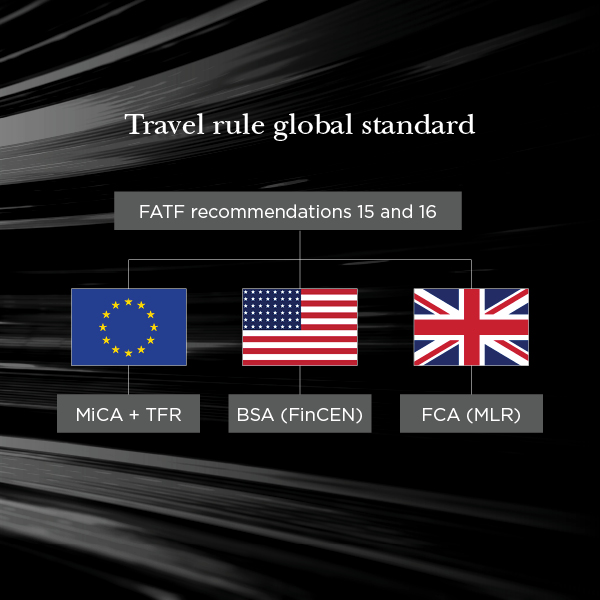
The Crypto Travel Rule refers to the application of FATF Recommendation 16 to virtual asset transfers.1 Originally designed for wire transfers, it now applies to virtual assets and VASPs.
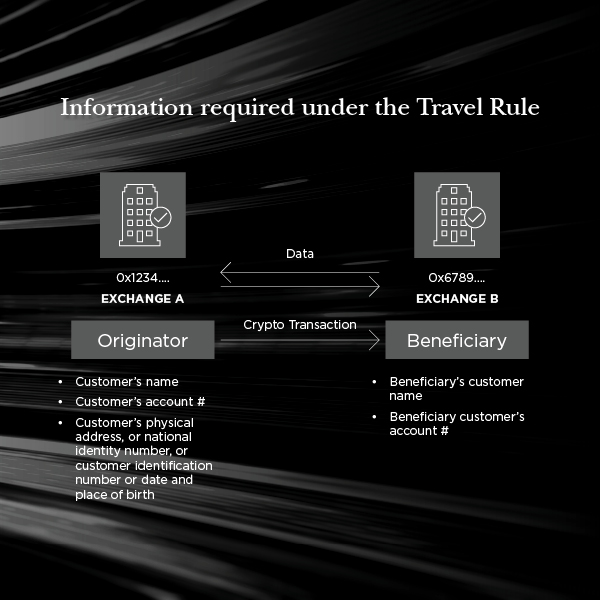
The rule requires that information about the originator and beneficiary accompanies a transaction. In practice, this means that VASPs must:
- Collect and verify customer information
- Share this information with counterparties where applicable
- Retain the information for compliance purposes.
The objective is to improve transparency and enable authorities to trace transactions and identify potential financial crime.
Why is the Crypto Travel Rule relevant?
The relevance of this topic has increased significantly due to a number of recent regulatory milestones. At a global level, FATF continues to refine its standards, including updates to Recommendation 16 in June 2025 on payment transparency.2
In the European Union, provisions of the Markets in Crypto-Assets Regulation became applicable on 30 June 2024, followed by the full application of MiCA on 30 December 2024. At the same time, the Transfer of Funds Regulation became applicable, extending Travel Rule requirements to crypto-asset transfers.
Looking ahead, further regulatory changes are expected, particularly in the United Kingdom, where a broader crypto regulatory regime is planned to take effect on 25 October 2027.
These developments indicate a transition from fragmented regulation toward more comprehensive and enforceable frameworks. As a result, the Travel Rule is no longer a future requirement but a current operational priority.
Scope and applicability
The Travel Rule applies to entities performing activities such as:
- Exchange between crypto-assets and fiat currencies
- Exchange between crypto-assets
- Transfer of crypto-assets on behalf of customers
- Custody or administration of crypto-assets.
The Rule application depends on the regulatory implementation in each jurisdiction and the type of transaction involved. Typical scenarios include VASP-to-VASP transfers and VASP-to-unhosted wallet transfers.
Key regulatory frameworks
European Union
The EU has established a comprehensive framework combining:
- MiCA, which introduces authorization, governance and investor protection requirements for crypto-asset service providers
- Transfer of Funds Regulation, which implements the Travel Rule for crypto transfers.
Both frameworks apply from 30 December 2024 and form the foundation of the EU’s regulatory approach.
United Kingdom
In the UK, crypto firms are currently regulated under AML requirements and must register with the Financial Conduct Authority (FCA).
The Crypto Travel Rule was passed into law in the UK on 21 July 2022. It entered into force on 1 September 2023. A broader regulatory framework is under development, with a new regime expected from October 2027, extending supervision to a wider set of crypto activities.
United States
In the United States, crypto activities are regulated under the Bank Secrecy Act (BSA) through the Financial Crimes Enforcement Network (FinCEN) guidance:
- Crypto exchanges and administrators are typically treated as Money Services Businesses (MSBs)
- The Travel Rule applies to transfers of funds above $3,000
- Firms must implement AML programmes and reporting processes.
Travel Rule solution providers
The implementation of the Travel Rule has led to the emergence of specialized solution providers offering infrastructure for compliant data exchange between VASPs. These solutions typically focus on secure transmission of originator and beneficiary information, interoperability and integration with existing compliance systems.
Examples of providers in the market include:
- Notabene
- TRUST (Travel Rule Universal Solution Technology)
- TRISA (Travel Rule Information Sharing Architecture)
- OpenVASP
- Sygna (CoolBitX)
- VerifyVASP
These solutions differ in their technical approaches, levels of standardization and interoperability. Market adoption remains fragmented, and interoperability between providers is still evolving. As a result, firms often need to evaluate multiple solutions and ensure compatibility with their counterparties.
Increasingly, institutions evaluate providers not only on functionality but also on interoperability with competing networks and support for standards such as IVMS101 (InterVASP Messaging Standard 101). IVMS101 has emerged as the de facto industry standard for structuring and exchanging Travel Rule data between VASPs and is often described as the common language of Travel Rule messaging.
Implications for market participants
The implementation of the Travel Rule has direct implications for financial institutions, fintechs and crypto-native firms.
Key areas of impact include:
- Operational integration: embedding KYC and data-sharing requirements into transaction flows
- Technology and infrastructure: implementing secure and interoperable data exchange mechanisms
- Cross-border compliance: managing differing regulatory requirements across jurisdictions
- Counterparty risk: ensuring that transaction partners are compliant with Travel Rule obligations
From a strategic perspective, compliance is increasingly becoming a core capability rather than a supporting function. Institutions need to treat Travel Rule readiness as part of their broader digital asset strategy, not as a standalone regulatory requirement.
One of the most significant operational challenges associated with the Crypto Travel Rule is the ‘Sunrise Issue’. Due to the uneven implementation of the Travel Rule across jurisdictions, firms often interact with counterparties that are not yet legally required or technically capable of exchanging Travel Rule information. As a result, institutions must establish risk-based processes to determine whether transactions can proceed while remaining compliant with applicable regulatory requirements.
Outlook and conclusion
The Travel Rule is expected to become a standard feature of global digital asset markets. As regulatory frameworks mature, further developments are likely to focus on greater standardization, improved interoperability between solution providers and increased alignment across jurisdictions.
The Crypto Travel Rule represents a structural shift in the regulation of digital asset markets. By requiring the collection and exchange of transaction-related information, it enhances transparency and supports financial crime prevention.
For market participants, the focus is shifting from interpretation to execution. Firms that are able to integrate compliance efficiently into their operating models will be better positioned to operate in an increasingly regulated and institutionalized digital asset environment.
Capco can support the design and implementation of Travel Rule-compliant operating models across regulatory, operational and technical dimensions. We have experience in regulatory gap analysis, target operating model design, vendor selection and the integration of Travel Rule solutions into existing digital asset frameworks. With this expertise, we support financial institutions in addressing Travel Rule compliance as part of a broader transformation of digital asset control environments.
References
1 Best-Practices-Travel-Rule-Supervision.pdf
2 FATF updates Standards on Recommendation 16 on Payment Transparency