

Setting out a proposed operational model to compress the Hong Kong cash market settlement cycle from T+2 to T+1 in Q4 2027, HKEX’s Consultation Paper on Accelerated Settlement has sparked considerable debate.
HKEX has positioned the initiative as a “futureproofing” move that will align Hong Kong with global developments and best practice while elevating the competitiveness of Hong Kong’s markets, “making transactions safer, faster, and more robust [and] laying the foundation for more infrastructure enhancements and innovations”.
However, the proposal also raises important questions around operational readiness, cross-border funding, time zone complexities, liquidity management, securities lending and technology readiness for one of the world's most internationally connected financial markets.
Drawing on lessons from previous T+1 implementations and ongoing discussions with market participants, Capco’s Ruben Sooriya, Executive Director and APAC Capital Markets Lead and Henning Bisschoff, Managing Principal, Capital Markets Hong Kong at Capco, discuss the key challenges firms are likely to face and share their perspectives on how APAC firms should prepare for accelerated settlement.
As the transition to T+1 settlement continues around the world, what are the impacts for APAC market participants, how are they adapting to this shift and which markets in the region are leading the way in adopting T+1?
Ruben Sooriya: T+1 settlement is no longer a theoretical discussion. With North America already operating under T+1 and Europe targeting implementation in late 2027, APAC institutions are increasingly preparing for a future where shorter settlement cycles become the global standard.
The region presents a more complex picture than other markets because multiple settlement models already coexist. India has successfully implemented T+1, while China operates under different settlement conventions depending on the market and product. Hong Kong has become the first major regional financial center to formally consult on a T+1 transition, potentially creating a catalyst for broader regional adoption.
Henning Bisschoff: For market participants, the impact extends far beyond settlement itself. Firms are reassessing operating models, client onboarding processes, funding arrangements, securities lending capabilities and cross-border workflows. Many institutions are also leveraging lessons learned from the US transition and ongoing European preparations to accelerate readiness programs before regulatory timelines become fixed.
What are the biggest operational and technology challenges that financial institutions face when moving to T+1 settlement?
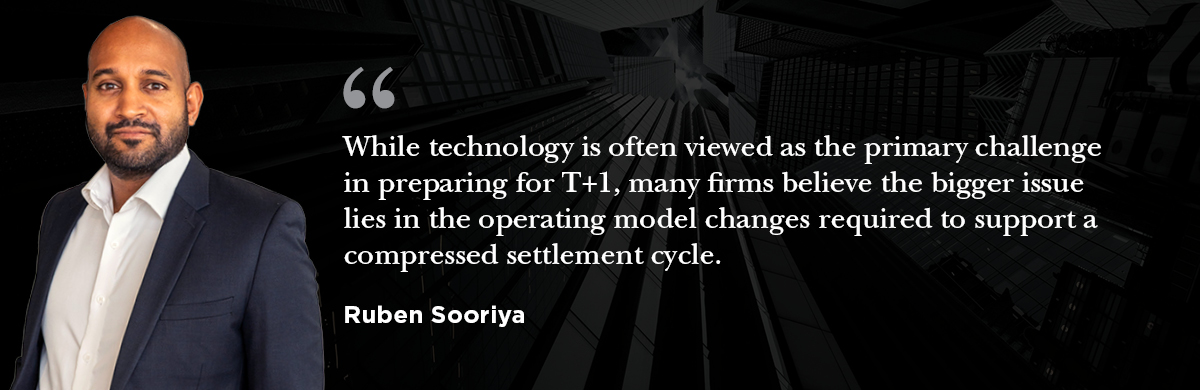
Ruben Sooriya: While technology is often viewed as the primary challenge, many firms believe the bigger issue lies in the operating model changes required to support a compressed settlement cycle.
The most immediate challenge is time compression. Activities that were previously completed across multiple days including allocations, affirmations, funding arrangements, securities borrowing, collateral management and exception handling must now be completed within a significantly shorter timeframe. For firms operating across multiple jurisdictions, this leaves less room to resolve breaks, source liquidity or manage operational exceptions before settlement.
Henning Bisschoff: A particular area of focus is funding, securities lending and collateral management. While allocation and affirmation processes can often be accelerated through automation, firms have much less time to determine client net positions, forecast funding requirements, source securities, arrange stock borrowing and calculate collateral obligations. As settlement cycles shorten, treasury, liquidity and securities finance teams are increasingly becoming central to T+1 readiness programs.
The challenge is further amplified in APAC by the region's global investor base and time-zone differences. Many international investors trading in Asian markets operate from Europe or North America, creating limited overlap during the business day to complete critical post-trade activities. What appears to be a T+1 settlement cycle can effectively become a near T+0 operating window for some participants.
Ruben Sooriya: Another complexity is that not all products and trading channels are expected to transition to T+1 simultaneously. Firms may need to manage T+1 and T+2 processes in parallel across different products, markets and cross-border trading channels. This creates additional challenges for liquidity forecasting, collateral management, reconciliation and operational controls, particularly for institutions supporting clients across multiple asset classes.
From a technology perspective, firms must ensure systems can support higher levels of straight-through processing, real-time visibility and automated exception management.
How does T+1 settlement impact liquidity management, risk reduction and overall market efficiency for firms across APAC?
Henning Bisschoff: One of the primary objectives of T+1 settlement is reducing the amount of risk that remains outstanding between trade execution and final settlement.
A shorter settlement cycle reduces counterparty exposure, lowers the duration of unsettled positions and can improve capital efficiency by allowing firms to access proceeds more quickly. These benefits have been widely cited following earlier T+1 implementations globally.
However, the liquidity implications are more nuanced. While firms benefit from faster settlement in the long term, they also have significantly less time to arrange funding, execute FX transactions and mobilize collateral. This creates new pressures on treasury functions, particularly for institutions managing cross-border trading activity.
Ruben Sooriya: For APAC participants, liquidity readiness may ultimately become a more significant challenge than trade processing itself. Funding decisions that previously benefited from overnight processing windows increasingly need to be made intraday. Firms that lack real-time visibility into cash positions, collateral availability and securities inventory may find themselves exposed to higher settlement risk.
The result is that T+1 becomes as much a liquidity transformation program as it is a settlement initiative.
With compressed timelines becoming the new normal, what role does automation, real-time data and digital transformation play in enabling successful T+1 adoption?
Henning Bisschoff: Automation is rapidly becoming the foundation of T+1 readiness. The experience of markets that have already transitioned demonstrates that organizations cannot simply add more people to manage compressed timelines. Success depends on removing manual processes, improving data quality and creating greater visibility across the trade lifecycle.
Real-time data allows firms to identify breaks earlier, understand funding requirements sooner and proactively manage exceptions before they become settlement failures. Automated workflows can accelerate allocations, affirmations, settlement instruction matching and collateral processing, reducing the operational burden on post-trade teams.
Ruben Sooriya: Digital transformation also supports better decision-making. Firms need a consolidated view of client activity, inventory positions, funding obligations and operational risk exposures across multiple products and markets. Without that visibility, managing T+1 becomes increasingly difficult as transaction volumes grow.
Ultimately, firms that invest in automation, workflow orchestration and real-time operational intelligence will be far better positioned to manage future settlement cycle compression than those relying on manual intervention and fragmented processes.
Looking ahead, what should capital markets firms in APAC prioritize today to stay future-ready for shorter settlement cycles and evolving regulatory expectations? What will be the key pain-points?
Ruben Sooriya: Preparations should begin now. The first priority should be understanding your firm's current operating model in detail. Rather than starting with technology, institutions should map their end-to-end client journeys, product flows and settlement processes to identify where time is currently consumed. Understanding when activities occur today and how those activities would need to shift under T+1 is often the most important first step.
Funding and liquidity management should also be a major focus area. Industry discussions increasingly suggest that funding readiness, securities lending and collateral management may represent some of the most significant challenges for APAC participants, particularly in markets with large international investor bases.
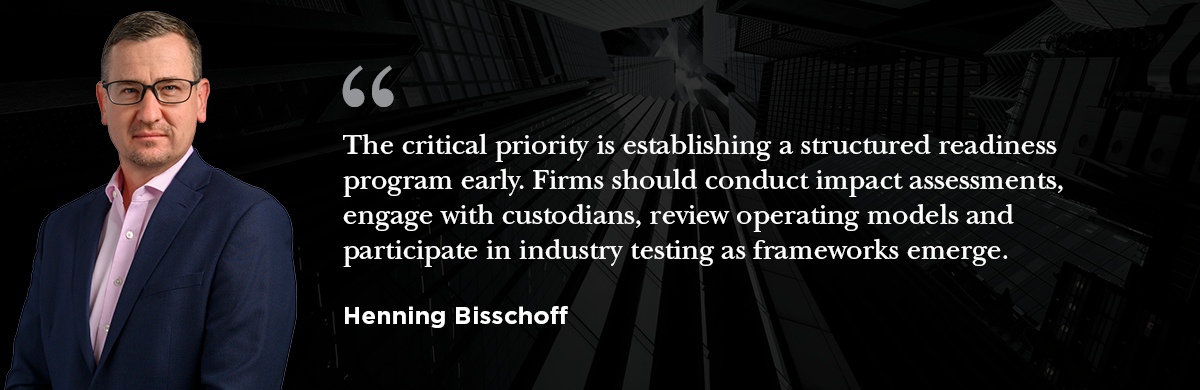
Henning Bisschoff: The other critical priority is establishing a structured readiness program early. Firms should conduct impact assessments, engage with custodians, clear brokers and market infrastructures, review operating models and participate in industry testing as frameworks emerge.
The key pain points are likely to center around cross-border funding, securities borrowing and lending, liquidity forecasting, exception management, time-zone coordination and managing multiple settlement cycles simultaneously. Institutions that begin addressing these challenges now will be significantly better positioned when regulatory timelines become more definitive and industry testing accelerates.
How Capco can help
As market participants await further guidance from HKEX in the coming months, the conversation is already shifting from whether T+1 will happen to how firms can prepare for it. Those that begin assessing funding, liquidity, operating model and technology impacts now will be best positioned to navigate future regulatory developments and capitalize on the benefits of a faster, more resilient post-trade ecosystem. To learn more about how Capco can help your organization prepare for T+1 settlement and evolving post-trade regulations, get in touch with our capital markets experts.
Get in touch
To find out more about working with Capco and how we can help you overcome any potential challenges, contact our experts or subscribe for the latest insights below.
