
Banking and Payments


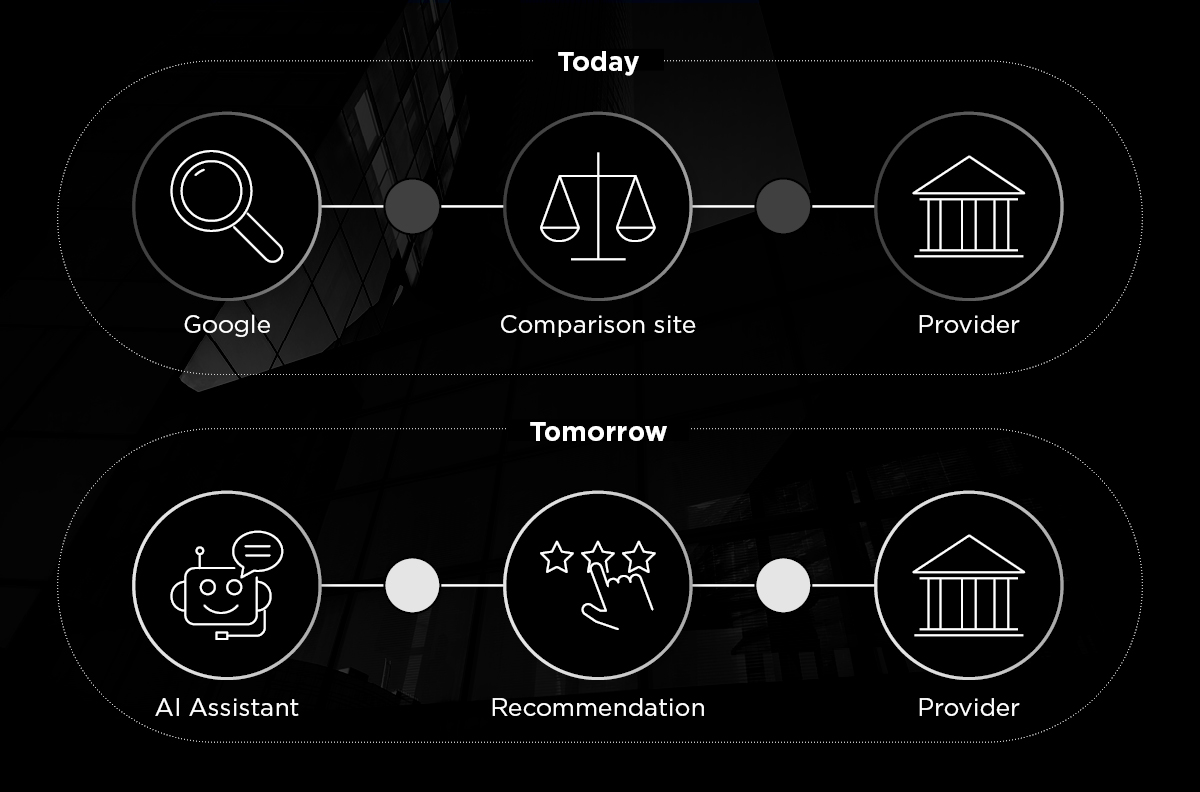
AI assistants are rapidly becoming a new front door to financial services. Increasingly, customers are beginning their financial journeys with a conversation rather than a search. However, while OpenAI and other providers have made it significantly easier to build conversational experiences, the challenges lie beyond the technology.
For the past two decades financial institutions have invested heavily in digital channels. Websites replaced branches, mobile apps transformed servicing, comparison sites became major acquisition channels. Most firms are still optimizing for this world – but many customers are moving on.
Questions once submitted via search engines are now being asked directly to ChatGPT, Claude, Gemini and other conversational AI assistants, for example:
According to Lloyds, over 28 UK million adults are already using AI to help manage their money, making personal finance the most common use case for AI in the UK.1 More than a third are using AI for investment research and recommendations, while many are using it for financial planning and debt management. Customers are no longer simply searching for information; they are looking to understand their options, explore scenarios and make more informed decisions.
The question is whether your products, services and customer journeys will be represented, and how you can avoid missing out on this new interaction layer between customers and financial institutions. If AI becomes the first conversation, will you be part of it?
Financial institutions have already invested heavily in personalization, typically built around customer profiles, transactions, demographics and digital behaviors. AI assistants introduce something much more powerful to the equation: intent.
Consider the difference between these two signals:
The first tells you that a customer registered an interest, the second tells you what they are trying to achieve. This opens the door to a new generation of personalized customer experiences tailored around goals, context and outcomes.
The ease of use offered by modern AI tools means building an app on platforms like ChatGPT is less a technology challenge than a question of scope, risk appetite and governance:
Such questions matter far more than the underlying model. Operating within a highly regulated industry, financial services firms cannot simply deploy AI and hope for the best. Factors such as consumer protection and suitability requirements, financial promotion rules, advice boundaries and model governance must all be considered from the outset.
This is why we believe governance by design is set to be a true competitive advantage. Success will not be predicated on an early launch, but rather on creating experiences that customers can trust. That means ensuring conversational journeys incorporate:
Fully autonomous financial advice delivered direct to the customer by an AI assistant is not happening any time soon, not least due to regulatory constraints. The near-term opportunity is more practical in nature: helping customers to take the correct next step by ensuring they understand their options, explore the scenarios open to them, and supporting them in navigating the complex choices they might face.
When assessing the introduction of AI assistants, financial services leaders should ask themselves:
AI assistants represent a powerful new customer channel for financial services. To find out how Capco can help you design and implement journeys that are trusted, governed and fully aligned with your customers’ desired outcomes, contact us via the form below.
References:
1 Over 28 million adults now using AI tools to help manage their money - Lloyds Banking Group plc
To find out more about working with Capco and how we can help you overcome any potential challenges, contact our experts or subscribe for the latest insights below.

