
Technology Delivery


Crude oil trading desks do not suffer from a lack of data. They suffer from the cost of fragmentation. Benchmark prices, inventory balances, tanker flows, macro indicators, geopolitical news and desk-level analysis often sit in separate tools, reports and workflows. The result is slower decision-making, inconsistent market views across traders, analysts and risk teams and a higher burden explaining why a position was taken, delayed or avoided.
This fragmentation creates a clear opportunity for agentic AI. In commodity trading, and in crude oil markets in particular, the value of AI is not simply to generate another forecast or automate a trading signal. Its greater value lies in coordinating multiple analytical tasks, connecting financial and physical-market evidence and turning dispersed information into an explainable decision workflow.
Our experience building a crude oil trading dashboard proof of concept (PoC) shows how an agentic framework can support this shift. By combining market data, physical balances, logistics indicators, news intelligence and regional crude-market context, the system can help trading teams move from isolated data points to a more consistent and auditable market view.
The key lesson is that agentic AI should not be positioned as a black-box replacement for trader judgment. It should be positioned as decision-support infrastructure: a way to separate market bias from trade timing, expose the drivers behind a recommendation, highlight uncertainty and give traders a clearer basis for acting, waiting or avoiding exposure.
For crude oil markets, where price formation depends on financial flows, physical constraints, regional dislocations, policy decisions and geopolitical risk, this distinction is critical. The same orchestration logic can be relevant across other commodity markets, but crude oil is the specific use case addressed in this paper. The most valuable AI systems will be those that improve speed, consistency, transparency and governance, while keeping human expertise at the center of trading decisions.
Key point: Agentic AI can create value across commodity trading environments by turning fragmented market signals into explainable, governed decision intelligence. Our crude oil dashboard PoC demonstrates how this can work in practice, particularly in markets shaped by physical flows, local dynamics and fragmented data.
Crude oil is a natural use case for agentic AI because price formation is driven by multiple financial, physical, logistical and geopolitical forces that rarely move on the same timeline. A move in the front-month futures contract may reflect inventory expectations, tanker congestion, refinery runs, OPEC+ policy messaging, shifts in the US dollar or broader changes in risk sentiment. Effective interpretation requires these signals to be assessed together rather than in isolation.
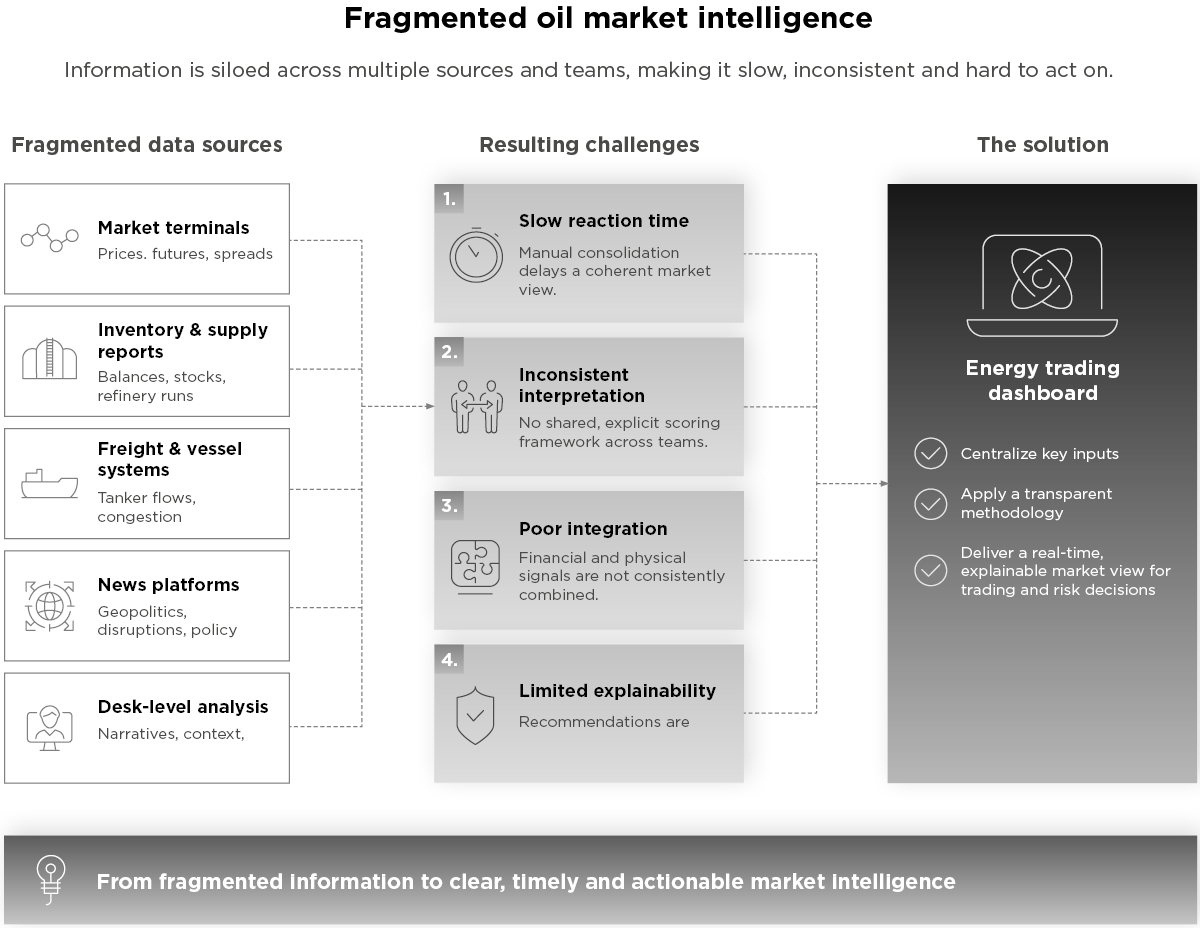
That is where many current workflows remain inefficient. Relevant information is typically spread across separate tools and teams, including market terminals for benchmark prices and futures curves, inventory and supply reports for balance signals, freight and vessel systems for logistics data, news platforms for geopolitical and disruption context and desk-level analysis for narrative synthesis.
This fragmentation creates four recurring challenges. First, reaction time is too slow because traders and analysts must manually consolidate information before a coherent market view emerges. Second, interpretation varies across teams because there is no shared and explicit scoring framework. Third, financial and physical signals are not consistently integrated, even though both materially affect crude pricing. Fourth, recommendations are often difficult to explain or audit because the reasoning process is informal and dispersed.
This is where agentic AI can create value. Rather than adding another isolated analytics tool, an agentic workflow can coordinate data gathering, signal interpretation, contextual enrichment and reporting into a single explainable process. For energy trading teams, the opportunity is not simply faster access to information; it is a more disciplined way to connect evidence, interpret market conditions and explain trading decisions.
Key point: Crude oil markets are driven by multiple financial, physical, logistics and geopolitical signals, making them well suited to agentic AI that can connect and interpret evidence across sources.
Figure 1: Agentic AI can help convert fragmented crude-market information into explainable trading intelligence
The real opportunity for agentic AI in trading is to move beyond static dashboards toward decision-workflows that connect data, interpretation, context and actionability:
In an agentic trading-intelligence workflow, different analytical tasks can be separated, coordinated and governed. Market and fundamental inputs can be gathered systematically, transformed into regional indicators, interpreted through transparent signal logic, enriched with news and logistics context and converted into a narrative that traders and risk teams can review. The value lies not in the number of agents, but in the fact that each step of the reasoning chain can be inspected, challenged, improved and tailored to business DNA.
This distinction matters because agentic AI should be treated as a decision-support capability, not as a black-box prediction engine. A useful system should not simply assign a bullish or bearish label. Instead, it should make the analytical chain visible: which inputs are driving the market view, how strong conviction is, whether timing supports action and which risks could invalidate the setup.
A credible energy-market AI workflow also needs to respect regional market structure. WTI, Brent and OPEC+ should not be treated as minor variations of the same signal. Each regional view is linked to a distinct benchmark and shaped by a different mix of physical and financial drivers. US inventory and Cushing dynamics, for example, are more relevant to WTI, while Atlantic Basin balances and spread relationships matter more for Brent, and producer behavior, export flows and disruption overlays are more material in the OPEC+ view.
This regional lens helps trading teams identify where stress, tightness or dislocation is emerging across the crude market.
The practical value of this approach becomes clearest when viewed through a trading-desk scenario rather than through the underlying technology. For traders, analysts and risk teams, the value of the Energy Trading Dashboard lies not in the technology stack itself, but in how quickly it converts fragmented market inputs into a clear, explainable and action-oriented view.
Key point: The real value of agentic AI is not better dashboard alone, but a governed workflow that turns fragmented market inputs into explainable decision support.
The value of agentic AI in energy trading is best understood through its effect on decision discipline.
A trader or analyst does not only need to know whether a market view is bullish or bearish. They need to understand why that view exists, which evidence supports it, what information may contradict it and whether the setup is actionable now.
This is where agentic AI can add value beyond conventional dashboards. It can connect the market view, the underlying drivers, the contextual evidence and the trade-readiness assessment into one explainable workflow.
In an example of using agentic AI to avoid a premature Brent trade, a Brent analyst starts the morning with a constructive market view. Supply indicators have tightened, demand inputs are stable and the regional Brent assessment has moved into slightly bullish territory. On its own, this would normally prompt a closer look at long exposure.
The agentic workflow, however, separates directional market bias from trade timing. Although the fundamental view is constructive, timing has not yet confirmed upside momentum, so the trade-readiness assessment remains neutral. Rather than forcing a position, the analyst reviews the underlying evidence. Inventory data shows a recent build that appears inconsistent with the otherwise constructive market setup.
Logistics intelligence provides the missing context: increased tanker arrivals and temporary congestion around key Atlantic Basin delivery points suggest that the inventory build may be logistics-driven rather than a sign of weakening demand. The news overlay does not show a major bearish catalyst, but the price trend has not yet confirmed the fundamental view.
The trader therefore holds off on entering the position. The desk retains a constructive Brent bias, monitors the timing confirmation and has a clear rationale for why the trade has not yet been activated. The value of agentic AI in this example is not that it produces a signal; it helps the desk distinguish between a market view, a tradeable setup and the evidence required to act.
Key point: Agentic AI helps traders separate market bias from trade timing, so a constructive view does not become an unforced trade before confirmation arrives.
The quality of any agentic AI workflow in energy trading depends on the strength, transparency and market relevance of its data foundation. In crude oil markets, this means combining direct market data with transparent proxy inputs where direct observation is limited, delayed or commercially constrained.
Data modularity is essential because energy trading organizations rarely operate with identical data stacks, vendor relationships or internal architecture. A credible framework should therefore work with different preferred data sources, provided they supply the required information with sufficient quality, frequency and governance rights. In practice, the framework should not be tied to a single vendor, API or dataset. Benchmark prices, inventory signals, logistics indicators, news flows and macro variables from different providers should be connectable, depending on data availability, licensing constraints and enterprise architecture. This modularity makes the accelerator easier to deploy across different environments while preserving a consistent analytical framework.
The important point is not the specific vendor list, but the categories of intelligence that an energy-market AI workflow must be able to combine - market prices, inventories, physical flows, logistics signals, macro indicators, geopolitical news, sanctions data and positioning context.
The governing principle should be clear: use direct regional data wherever available and use transparent proxies only where the underlying market is less observable at the required frequency.
This creates different data-quality profiles across crude-market regions, and those differences should be visible to users. The WTI or US view is typically supported by stronger direct data coverage, including benchmark prices, inventories, Cushing stocks and products data. The Brent or Atlantic Basin view requires direct Brent pricing and curve data to be combined with regional physical indicators, spread relationships and logistics context. The OPEC+ or global view often requires more proxy-based interpretation because policy decisions, export behavior, disruption risk and regional flow data may not be observable with the same frequency or consistency.
This distinction should be highlighted rather than minimized. Traders, risk teams and governance stakeholders need to understand where a view is supported by direct data and where it is inferential by design. In energy markets, transparency about data quality is not a limitation of AI adoption; it is a condition for trust.
Key point: A credible energy-market AI system must be modular, data-transparent and able to combine direct inputs with clearly labeled proxies where needed.
An effective agentic AI framework for energy trading must do more than classify a market as bullish or bearish. It must separate directional market bias, timing confirmation and trade-readiness.
At a conceptual level, crude-market intelligence should combine four broad categories of evidence: supply, demand, inventory and macro conditions. These inputs can be combined into a transparent regional market assessment that shows not only the direction of the view, but also which drivers are contributing most to that view.
The resulting market assessment should be expressed in business language that traders can challenge and interpret, such as bullish, slightly bullish, neutral, slightly bearish or bearish. The exact thresholds should be transparent and governable.
A second stage should assess whether the market view is tradeable now. This timing layer is important because a market can be fundamentally constructive or bearish before price action confirms the setup. This creates a disciplined separation between market interpretation and trade activation. The framework may identify a constructive or bearish market view, while still recommending patience if timing, risk or confirmation signals are not aligned.
This separation between market view and trade-readiness is one of the most important ideas for applying agentic AI in energy trading. A region can be fundamentally constructive while the recommended action remains neutral until timing confirms the setup. For trading and risk teams, this is more realistic, more controllable and easier to govern than forcing action whenever fundamentals lean in one direction.
The same principle should be applied regionally because crude-market drivers are not uniform across WTI, Brent and OPEC+. A WTI or US view should emphasize US production, net exports, rig activity, products supplied, inventories, Cushing conditions and macro context. A Brent or Atlantic Basin view should focus on regional production, Brent-WTI spread relationships, refinery intake, Atlantic Basin imports, logistics constraints and inventory conditions. An OPEC+ or global view should emphasize core OPEC production, Russian flows, China demand proxies, OECD inventory signals, policy behavior and disruption risk.
The result should be a framework that is standardized enough to be governed consistently, region-aware enough to reflect physical crude-market realities and transparent enough to be monitored and recalibrated when market conditions change.
This does not mean the framework is static or immune to changing market conditions. Like any market-intelligence process, it must be monitored for signal drift, data-quality issues and regime changes that may reduce the relevance of historical relationships. Examples include extreme geopolitical shocks, sudden sanctions or embargoes, major supply outages, structural changes in OPEC+ behavior or periods where logistics constraints distort inventory signals. In these situations, agentic AI should not be treated as a fully autonomous decision engine. Instead, it should flag lower-confidence conditions, make the affected drivers visible and support a governed review of whether thresholds, data inputs or regional feature logic need to be adjusted.
This creates a controlled feedback loop between model output, trader judgment, risk review and post-event learning. Backtesting, live signal monitoring, user feedback and post-event review can be used to identify where the model logic continues to perform well and where recalibration is required. The objective is not to hide model limitations, but to make them visible and manageable so that the decision process can improve over time while remaining transparent and auditable.
Key point: Directional market view and trade readiness are not the same thing, and the most useful framework keeps them separate.
For agentic AI to be credible in energy trading, governance and explainability must be designed into the workflow from the beginning. Fast interpretation is valuable only if users can understand the reasoning, challenge the evidence and retain control over the decision.
A robust agentic AI framework should be modular, model-agnostic and deployable within a client-controlled environment. This matters because trading organizations operate under strict requirements for security, data protection, operational resilience and auditability.
In practice, specialized agents can be used to separate responsibilities across data ingestion, feature preparation, signal interpretation, contextual enrichment, backtesting and reporting. The LLM layer should be used where it adds the most value: reasoning support, summarization, narrative generation and contextual explanation. The core market logic should remain explicit, deterministic and inspectable. This balance is critical. Large language models can support contextual synthesis and communication, but they should not obscure the underlying market methodology or turn trading logic into an unexplained black box.
For traders, analysts and risk teams, the important point is not the number of agents. It is the separation of responsibilities: each step in the analytical chain should be inspectable, governable, adaptable and improvable without turning the overall process into a black box. The user experience should make the reasoning chain visible, not merely display the final output.
From an enterprise standpoint, agentic AI in trading must satisfy three requirements. First, it must be modular, so that data sources, analytical components and reporting outputs can be extended independently. Second, it must be governable, with transparent signal logic, documented source usage and visible assumptions. Third, it must be deployable within a controlled environment that supports operational ownership, security and long-term extensibility.
Key point: In energy trading, AI only creates durable value when it remains explainable, governable and supportive of human judgment.
Agentic AI addresses a practical market problem in energy trading: how to convert fragmented crude-market information into a coherent, explainable and region-specific market view.
The key differentiator is not simply the aggregation of many data sources. The business value lies in converting fragmented inputs into transparent market views, linking those views to timing-aware trade-readiness and presenting the reasoning in a way that supports both trading action and risk discussion. For trading teams, this can reduce the time spent reconciling fragmented information, improve consistency between traders, analysts and risk teams, and create a more explainable basis for deciding whether to act, wait or avoid exposure.
Another important lesson is that customizability matters. In an environment shaped by evolving regulations, complex security requirements and client-specific IT constraints, agentic AI must be modular, adaptable and capable of operating within controlled enterprise environments.
For energy trading teams, the business benefit is a more disciplined and explainable trading workflow: less time spent reconciling fragmented information, more consistent interpretation across desks and a clearer basis for acting, waiting or avoiding exposure. For technology and innovation stakeholders, it demonstrates a credible and governable application of agentic AI in a market setting where transparency matters as much as analytical insight.
In that sense, the experience from building the Energy Trading Dashboard demonstrates a broader point: agentic AI can become trading intelligence infrastructure. Its role is not to replace traders or obscure judgment behind a black box, but to connect fragmented signals, expose reasoning, support human expertise and improve decision discipline in complex energy markets.
Capco brings a blend of agentic AI expertise, over 25 years of experience in the energy sector and a practical understanding of how to apply AI in complex, data-rich trading environments. Our work in this space has focused on converting fragmented information into decision support that is explainable, governable and useful for trading and risk teams. We understand the realities of energy markets, where analytical quality, speed and transparency all matter, and where solutions must fit within enterprise constraints rather than sit outside them.
More broadly, Capco can help clients identify the right agentic AI use cases, shape the operating and governance model and design solutions that are aligned to energy business needs. We combine domain knowledge, data strategy and implementation experience to create approaches that are modular, scalable and built for real-world adoption. The goal is not AI for its own sake, but practical value: better decisions, greater consistency and a clearer link between market insight and business action.
References