

In the past, energy trading firms may have considered technology roadmaps to be mainly a corporate compliance concern. However, in today’s rapidly changing technology environment, roadmaps offer critical strategic advantages to those hoping to remain at the forefront of the market.
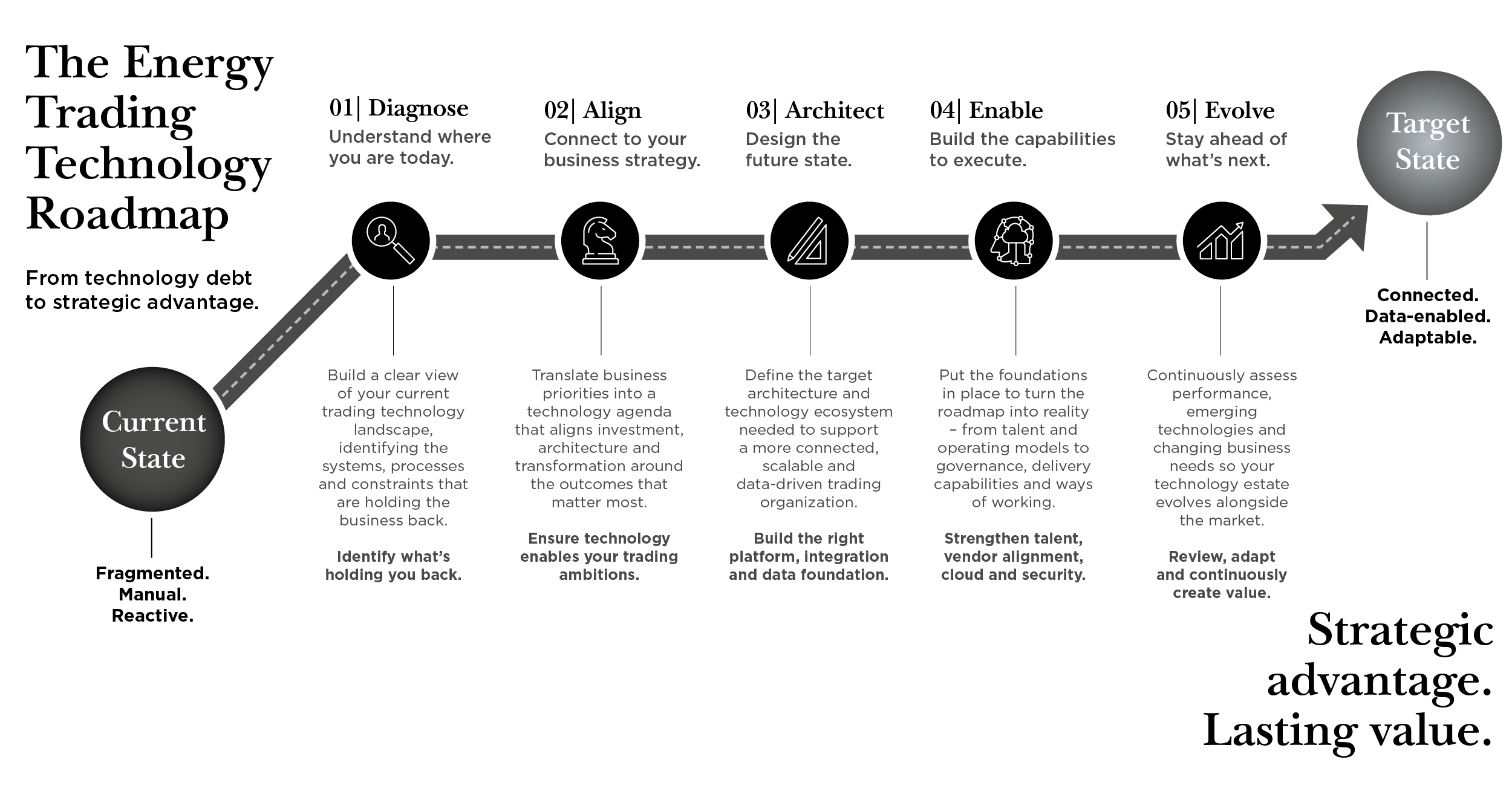
The reason why technology roadmaps have become so important lies in the increasing pace of change. In the past, state-changes in technology such as the growth of the internet or the acceptance of cloud-based solutions were adopted relatively slowly over many years.
Today’s timeline for adopting new technologies has shortened dramatically, with machine learning, GenAI and now agentic AI all gaining acceptance at a much faster pace. Competitive advantage for trading companies increasingly depends on their ability to identify, adopt and leverage new technologies efficiently and effectively within very short timeframes.
Energy trading companies operate in a highly complex environment with diverse and rapidly changing technology needs. The challenge is complicated by the rate of technical innovation in the wider energy industry, as new energy technologies such as renewables and batteries reshape industry fundamentals and drive the redesign of energy markets.
To keep up, trading organizations must continuously evaluate their technology landscape to ensure alignment with business objectives, operational requirements, market evolution, and future strategic growth initiatives. Firms that lag in the latest technology adoption will quickly be left behind by their trading peers.
Assessing technology landscapes – key areas of concern
Trading firms should assess their current technology and systems landscape by considering a series of potential concerns. The first is whether their ability to make the changes their business requires is in line with the rate of market change. For example, how quickly can a new commodity, new market, new strategy or even a new location or counterparty be introduced? Does the company have a record of integrating acquisitions on a fast timeline?
The firm also needs to assess how scalable their current solution landscape is, not only from a performance standpoint, but from a user standpoint. In many firms, some data continues to be entered manually when it should be automatically uploaded, and transactions are still not flowing seamlessly through the organization and its systems.
Then there is the question of how much technology debt has accumulated through acquisitions, duplicative systems, custom applications and spreadsheets. Firms should question how well internal systems are integrated and assess the maturity of external interfaces.
Data is often a key problem area. Firms need to evaluate if they have a sound data architecture strategy that amalgamates data across all aspects and systems within the trading organization. They will also need to ask if enterprise trading data is readily available in a consumable format for self-service end user reporting, so that it can be used for analytics and to fuel emerging AI capabilities.
IT functions – key questions
Within energy trading firms, IT functions can augment these general assessments with the following questions:
1. Are our current vendors adopting new technologies that are aligned with our technology roadmap? If not, are we looking at what other vendors are offering?
2. Are our in-house, custom-built solutions architected in alignment with our technology roadmap? If not, do we have plans to re-architect or replace these in-house solutions?
3. Is our IT team attaining the skills necessary to operate and support the latest technology? If not, do we have a training program in place or plan to hire the required skill sets?
4. Where is our organization with respect to cloud migration and related issues such as cyber security, data security and disaster recovery preparedness?
5. To what extent are we considering future AI and ML initiatives in the planning of our technology roadmap?
A technology roadmap today needs to be much more than an inventory of systems with planned upgrade or replacement timelines. A proper technology roadmap should focus on the technology platform and application architecture. Alongside that, the integration and data architectures are paramount to supporting the strategic initiatives of trading organizations.
Timescales and coverage
In the past, technology roadmaps may have been revisited every five or 10 years. With the accelerated pace of technological advancement, Capco recommends a thorough review, leading to the necessary revisions, every three years. Additionally, we recommend a more focused review annually to ensure the roadmap acknowledges emerging technologies such as new forms of AI as well as fast-emerging security concerns.
The topic of cybersecurity risk warrants its own article. But it would be remiss not to mention its ever-increasing importance as a cornerstone of a technology roadmap, especially given the movement to cloud, mobile enablement, increasing data accessibility and the push to leverage AI technologies.
A sound technology roadmap is not only intended to benefit the IT organization or tick a corporate compliance checkbox. The technology roadmap must benefit the underlying business organization.
Better tools and technology will help individuals cope with their workload and raise the quality of their job. Improved technology will also serve to reduce key-person dependencies.
In the age of AI transformation, the goal is not to eliminate manual work, but to enable the business to focus on exceptions and new opportunities rather than routine, manual and mundane data-processing tasks. The goal must not only be higher productivity and reduced errors, but improved job satisfaction, and more professionally stimulating roles for individual users of technology.
Conclusion
The pace of technology advancement continues to accelerate, making long-term technology predictions less reliable. It is critical to improve the planning around technology roadmaps and revisit them more frequently to ensure technology platforms remain sound.
Trading organizations with sound technology platforms will be able to respond more quickly to changing market conditions, improve business agility and better manage operational risk and complexity. Energy trading companies should not be thinking of their technology roadmap as a cost-management concern, but as a strategic opportunity.
How Capco can help
Capco works with its clients to assess their current state technology environments and prepare their future-state target architecture and technology strategy. This includes creating and actioning technology roadmap strategies. In addition to establishing the client’s target operating technology, Capco helps turn new technology investments into measurable business value. Our work ensures that our clients are not implementing new technology for technology’s sake but instead gaining new capabilities that deliver strategic advantage.