

Cyber security


AI is reshaping cybersecurity across the business and expanding the conversation around cyber from the realm of the CISO to the office of the CEO. The same frontier intelligence that can help an attacker identify and exploit vulnerabilities can now help defenders investigate, validate and fix them. However, for financial institutions, the limiting factor is not access to capable AI but the ability to act on that intelligence at comparable speed, while also maintaining control, resilience and regulatory accountability.
In this article, Capco and OpenAI explore what we are currently seeing across financial services, from AI-enabled vulnerability management and agentic security workflows to the organizational and governance changes required to make them work. The direction of travel is clear: the best placed institutions will be those that can compress the end-to-end cycle from vulnerability discovery to remediation decision and do so safely. They must continue to view security holistically, including patching, zero trust network access, identity protection and attack surface reduction.
AI is reshaping cybersecurity for attackers and defenders alike. Frontier AI models are increasingly able to find and exploit longstanding security gaps, from software bugs to forgotten permissions. As these capabilities advance, defenders have a narrowing window to prepare.
The answer is to put frontier intelligence in the hands of trusted defenders to perform longer, more complex sequences of cybersecurity work, before attackers can deploy offensive AI capabilities at scale.
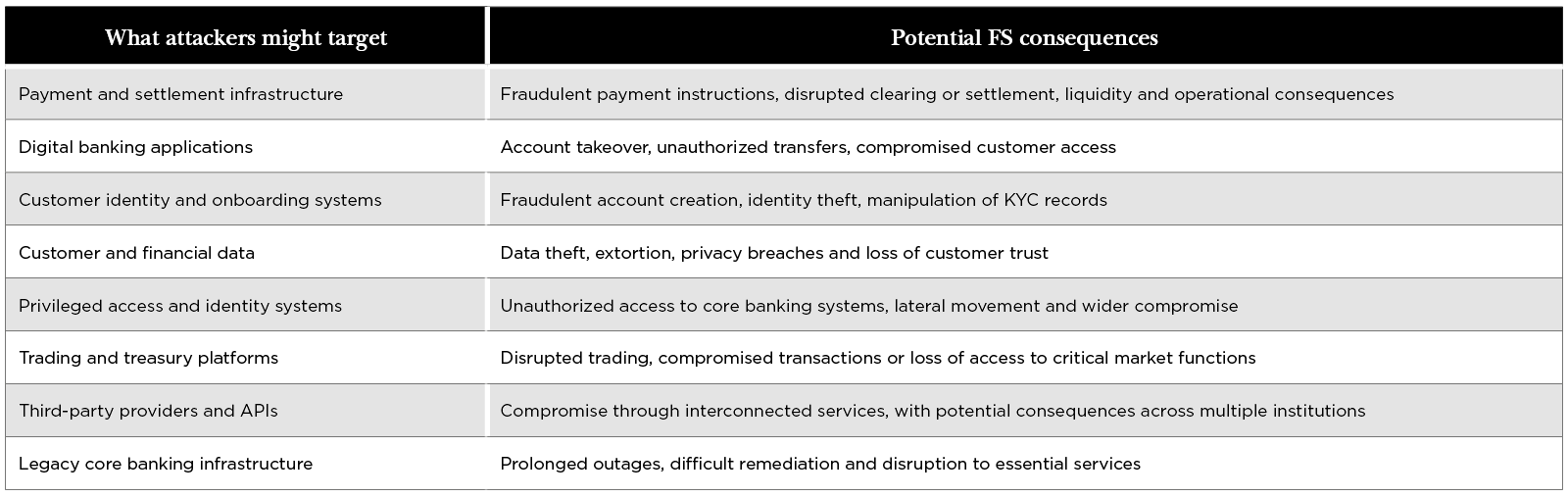
For financial institutions, the consequences of these vulnerabilities can extend well beyond a compromised application or system. Attackers may seek to access customer accounts and sensitive data, manipulate payment instructions, exploit weaknesses in digital onboarding to enable fraud, or disrupt critical banking services, including payments and settlement.
The exposure is not simply technical: it can translate into direct financial loss, operational disruption, regulatory consequences and damage to customer trust. Moreover, with banks operating across complex legacy estates, interconnected platforms and third-party providers, understanding which vulnerabilities present a genuine business risk is becoming increasingly important. We outline potential vulnerabilities in Figure 1.
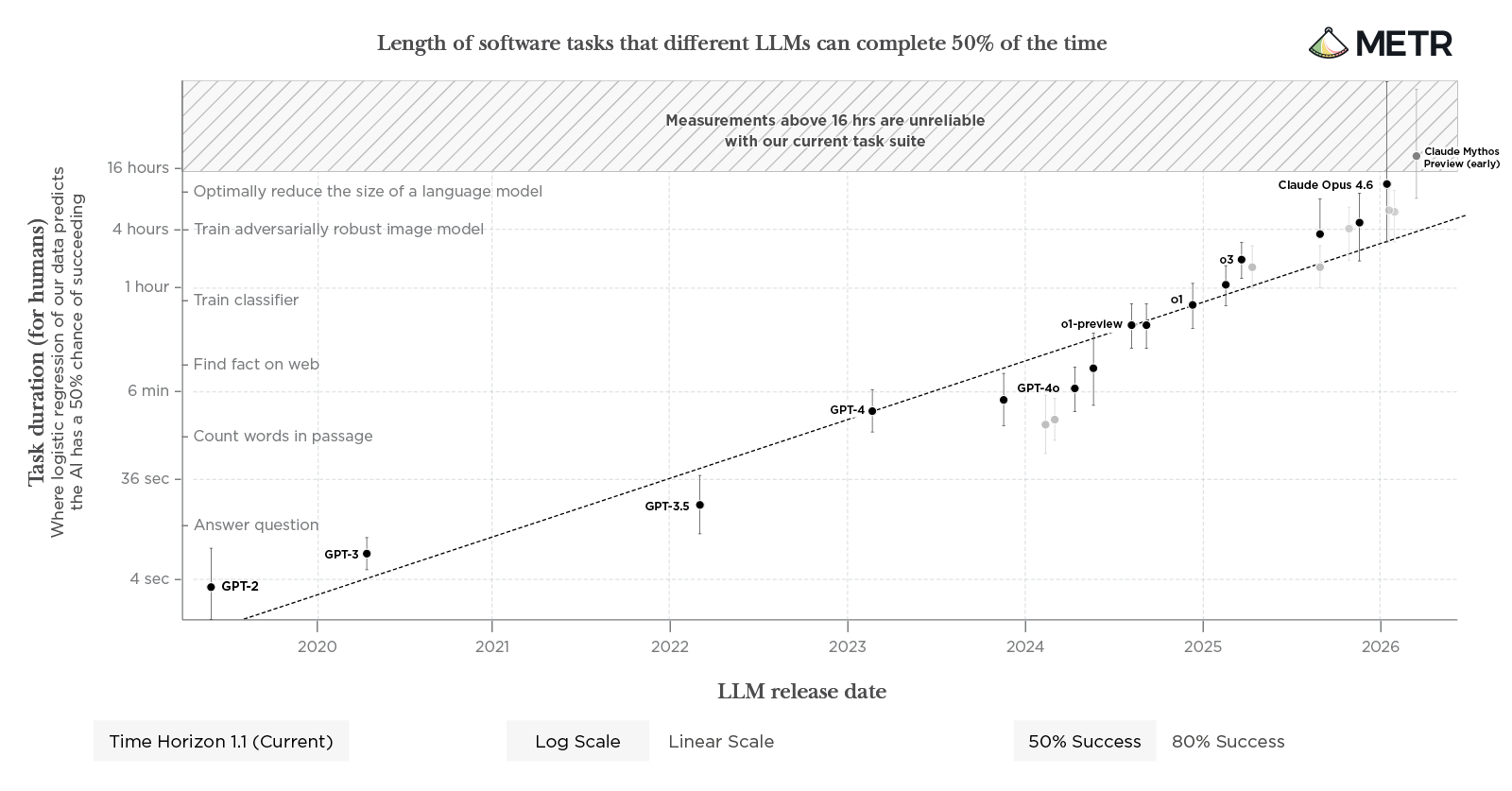
Frontier AI systems are increasingly able to sustain longer sequences of technical work, moving from tasks measured in minutes to tasks equivalent to several hours of expert human effort. In software engineering, machine learning and cybersecurity evaluations, this is enabling models to undertake increasingly complex, multi-stage investigations and execution.
Frontier AI agents have progressed from completing tasks equivalent to minutes of expert human work to tasks requiring many hours, reflecting a rapid increase in their ability to execute longer, multi-step technical workflows.
Figure 2
It is also now much faster to weaponize those exploits or reverse engineer patches and CVE advisories to exploit vulnerabilities. The result is a shrinking window between vulnerability publication, validation and exploitation.
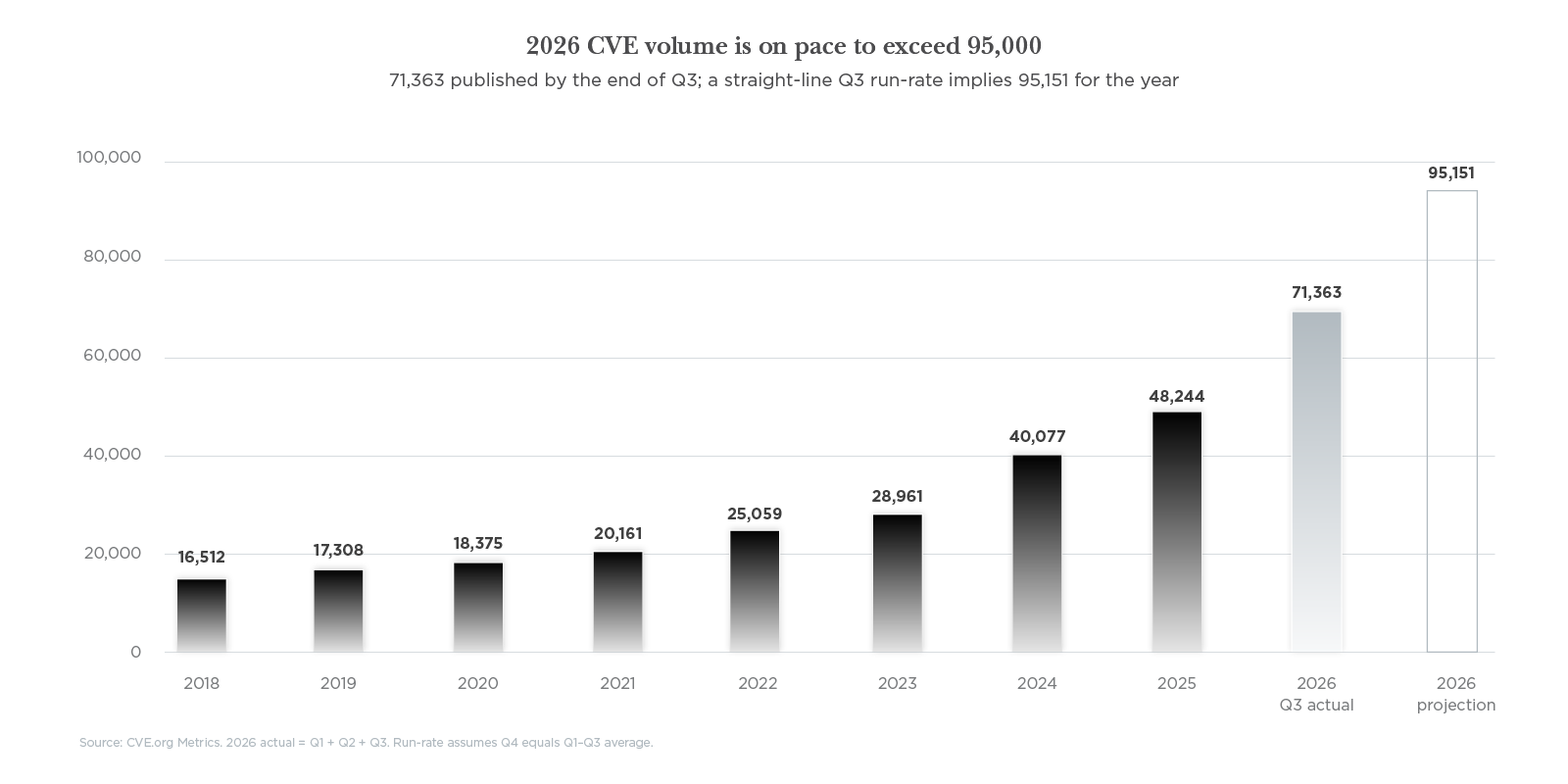
The threat is real. The number of published common vulnerabilities and exposures (CVEs) is increasing exponentially. While 48,000 CVEs were published during the whole of 2025, by just the end of Sept of this year we had already reached more than 71k – and given a linear trajectory the expectation is this may well exceed 90,000 published vulnerabilities by year end. [Source: CVE.org]
Figure 3 (Source: CVE.org Metrics. 2026 actual = Q1 + Q2 + Q3. Run-rate assumes Q4 equals Q1-Q3 average.)
What matters more for defenders is the combination of volume, exploitability and speed: more vulnerabilities, a lower barrier to understanding them, and less time in which to decide what to do.
This is where we think the conversation needs to move on. The challenge for a financial institution is reorganizing itself quickly enough to act on AI-generated intelligence before the attacker does. Given the number of publicly disclosed vulnerabilities, the lower bar to entry when it comes to weaponizing vulnerabilities and the availability of abliterated open weight models, ‘wait and see’ is not an option.
As OpenAI’s models have become better at software engineering, they also become more capable at cybersecurity. Many of the same skills can help find and fix vulnerabilities or exploit them. It also trains models specifically to support defensive security work. OpenAI’s Daybreak gives verified defenders access to advanced AI models for authorized security work, with safeguards to help prevent misuse.
With access to specifically tuned frontier level intelligence, defenders can reduce risk faster by bringing down vulnerability debt while keeping trusted access and action under human control.
What we are seeing with our clients is that the technology itself is often not the hardest part. The harder question is how to put it into an organization in a way that actually changes the speed of the workflow at scale.
A common challenge across financial services and energy organizations is the time it takes to assess, deploy and implement new cyber controls and defences due to both legacy processes and regulatory overheads. However, both Capco and OpenAI are working with very large enterprise customers who recognize this to be a special case. They are moving quickly to leverage capabilities – setting up specialized projects, carving out sections of their engineering function – with a view to burning down technology debt more quickly as opposed to prioritizing features.
That distinction is becoming more important. The attacker does not have to work through our governance committees, procurement processes or release calendars. A large enterprise does. The result is a potential asymmetry: the defender may have better intelligence, but a slower operating model. For us, that is fast becoming one of the defining questions in cyber. Where is the bottleneck now – is it identifying the vulnerability, or is it everything that has to happen afterwards?
Cybersecurity must be embedded in any transformation process from start to finish. The rise of AI agents is a central consideration. The rising agentic workload means you need to have systems in place for non-repudiation, access control, logging and monitoring to ensure visibility across your agent inventory and what those agents are doing. Within large sophisticated and mature organizations other priorities include zero data retention policies, data sovereignty and data processing.
We increasingly think about this as two related but distinct challenges: AI for security, and the security of AI. AI for security is about using intelligence to improve the defender’s ability to detect, investigate, validate and remediate. Security of AI is about controlling the growing population of agents themselves who or what can act, what they can access, what they have done, and whether those actions can be evidenced and governed.
We are seeing some organizations pursue a full AI transformation – multiple pillars, the development of AI centres of excellence, going deep into each department to find the workflows that are constrained by a lack of people or organizational knowledge.
The goal as defenders is to force multiply the ability of your highly skilled people to focus on more high-fidelity work. That comes down to picking your critical workflows, identifying where the bottlenecks are happening, and then unpicking them to see where a layer of intelligence might be added. Taking this approach is as, if not more, effective in cyber security as it is in optimizing standard business processes.
This matters particularly in cybersecurity because the constraint on talent is real. While we are seeing rising demand for people who understand both security and how to build the ‘harness’ around AI, the available pool of experienced specialists remains limited. Rather than automating people out of the workflow, the opportunity is to eliminate lower-value work, and to decrease the time taken to allow those experts to focus on the decisions that genuinely require human judgement.
Going truly end-to-end agentic when it comes to detecting and responding to vulnerabilities, automatically deploying the fixes into code without a human in the loop, is not yet the norm.
While we have yet to see anyone going pure live patching in production, we are getting to a point where that is not too far off, particularly with the significant advancements in model capability. We have end-to-end workloads, but for the moment it is more a maturity journey.
A human layer in defence will likely remain for now, at the cost of time, compared with attacker speed. The more useful way to think about this is not "human versus autonomous". It is about where human judgement belongs.
OpenAI has built an end-to-end workflow using Codex as the harness. The harness connects models so it can see code, and context can then be consumed in that harness as well, be it connecting to the source code repositories to JIRA, your ticketing systems and so forth. The harness orchestrates these connections, this context, and brings the modeling to consume that context with code to make informed decisions and take action.
Codex can help teams investigate potential vulnerabilities and develop fixes within the same workflow. It can help assess whether an issue is exploitable, identify affected code and propose a patch for developers to review and test. This gives teams more evidence to prioritize vulnerabilities and act on them. Developers remain responsible for validating findings, testing fixes and deciding whether they are ready for production.
For a financial institution, that difference can be material. Imagine a critical vulnerability in a personal banking application that has been verified as exploitable and could enable customer account takeover. The decision is no longer theoretical. The organization has to decide whether to take the service offline to remediate or accept a known risk. The value of AI is partly in getting the organization to that high-fidelity decision much faster.
OpenAI’s Daybreak Blue is designed to support defenders conducting legitimate cyber work, helping security teams find and fix vulnerabilities as part of their software development process. The model can be integrated directly into continuous integration and continuous deployment (CI/CD) pipelines to help teams identify and address outstanding vulnerabilities.
Some firms are better prepared to do this than others. The difference is often what foundations they already had in place.
In financial services, organizations with established internal vulnerability research teams are better placed to use AI in their security work. Years of investment in security engineering, internal research, AI experimentation and workflow integration help them assess new threats and respond quickly.
Cyber teams also need testing environments that reflect their live systems and can be quickly set up, taken down and recreated for further testing. This requires engineering time both to strengthen systems and fix existing weaknesses, and to build environments where teams can investigate vulnerabilities and test fixes safely.
This is a very real challenge to financial services, where much of the underlying estate is older, more complex and more constrained than a cloud-native reference architecture. It is extremely expensive and labour intensive to spin up representative mainframes in particular. The question becomes how to create enough representative capability around the most critical systems to test and respond at speed, without pretending that every part of the estate can be transformed overnight.
The answer is unlikely to be "do everything". The more practical approach is to identify the systems where response time matters most and build the strongest capability around those critical paths first.
Running this type of program at scale is going to be expensive. The challenge is that cybersecurity has always had a difficult ROI story: we are trying to put a value on something not happening. The more mature banks are aware and have typically put a value against certain types of breaches via a typical risk matrix capturing impact versus likelihood. That becomes harder, not easier, when the investment case includes always-on testing, engineering capacity and new AI infrastructure.
The good news is the cost to use cyber capable frontier intelligence is going down and the niche skill sets of individuals expert in areas like vulnerability research is becoming available to general security practitioners, no longer limited to niche expert vulnerability researchers. In time it is going to cost less to solve equivalent issues, and we expect the cost of intelligence to keep reducing. More and more companies will be able to democratize AI in cyber without the level of sophistication currently required to leverage the benefits of applying intelligence at the security layer.
It cannot be ignored that the governance processes required for putting AI in place takes longer to navigate than they should do. There needs to be more agile ways of doing governance within large enterprises to allow AI to be implemented at speed. That is definitely a challenge we are seeing almost on a daily basis: we are fighting the structure of the enterprise to embed AI almost every step of the way. This is not an argument for removing controls. In financial services, controls, evidence and accountability remain essential. The question is whether governance can become more risk-based and dynamic, so that it protects the organization without inadvertently slowing the remediation of an active cyber risk. In short, governance itself needs to operate at the speed of the threat.
AI has moved cyber from being a CISO conversation to a CEO conversation, not just due to the scale of investment but also the level of prioritization, visibility and action that is required in order to understand and mitigate business risk. In recent months we have seen increased regulatory focus around cyber and AI. How firms are prepared to deal with the challenges is a question that the CEO has to answer.
The CISO plays a critical role in providing insights and is the primary person who must translate cyber risk into business impacts for the CEO to understand and relay to regulators, boards and shareholders. CISOs must consider that there is a new dynamic shaping the cyber landscape. This new dynamic is attacker speed and scale.
While existing mitigations still hold true in many cases, security teams must be enabled to move quickly in order to match the pace and capability attackers can now leverage. To ensure ongoing resilience, organizations should take the steps set out in Figure 4.
Figure 4
Leveraging cyber capable models to force-multiply the existing security workforce capability can accelerate the first, second and third lines of defense to ensure that risk mitigation is effective and controlled. The organizations that benefit most will be those that are able to turn frontier intelligence into an enterprise capability – quickly, safely and repeatedly. The challenge goes beyond simply adopting AI in cyber: it is about transforming technology controls and operating models to be able to defend at AI speed.
To find out more about working with Capco and how we can help you overcome any potential challenges, contact our experts or subscribe for the latest insights below.
